·
· 
Life Insurance With Huntington’s Disease in Canada
By Parvesh Benning, Licensed Life Insurance Broker
The diagnosis is rarely the real problem; the bigger mistake is applying to the wrong insurer, in the wrong order, before anything goes on record.
Most people assume a Huntington’s diagnosis, or even a family history of it, makes life insurance impossible in Canada. It doesn’t. There are guaranteed and no-medical paths that approve regardless of diagnosis, plus federal genetic non-discrimination rules that generally prevent insurers from requiring genetic testing or asking for your genetic test results. What changes the outcome is knowing which insurer to approach, and in what order, before any application goes on file.
Updated: June 16, 2026

Life Insurance With Huntington’s Disease in Canada
By Parvesh Benning, Licensed Life Insurance Broker, Updated: June 16, 2026
The diagnosis is rarely the real problem; the bigger mistake is applying to the wrong insurer, in the wrong order, before anything goes on record.
Most people assume a Huntington’s diagnosis, or even a family history of it, makes life insurance impossible in Canada. It doesn’t. There are guaranteed and no-medical paths that approve regardless of diagnosis, plus federal genetic non-discrimination rules that generally prevent insurers from requiring genetic testing or asking for your genetic test results. What changes the outcome is knowing which insurer to approach, and in what order, before any application goes on file.
This guide is built for the three situations people actually contact us about: a confirmed Huntington’s diagnosis, a positive genetic test with no symptoms, and a parent or sibling with Huntington’s but no testing of your own. Each one routes to a different insurer and a different product.
None of these paths requires a genetic test, and most do not require a medical exam. What they require is applying in the right sequence, which is where a broker who places these cases regularly keeps a decline from following you to the next insurer.
Short answer
Yes. A Huntington’s diagnosis does not make you uninsurable in Canada. Guaranteed-issue and no-medical policies approve regardless of diagnosis, and federal genetic non-discrimination rules generally prevent insurers from requiring a genetic test or asking for your results.
Diagnosed: guaranteed-issue whole life approves with no health questions, commonly $50,000 to $100,000, with a two-year wait on non-accidental death.
Family history only, no symptoms: more options open up, sometimes traditional coverage, and you should not be required to disclose a genetic test result.
Order matters: the wrong application can put a decline on your record. The fix is routing to the right insurer first.
What this guide covers
- Can you get life insurance with Huntington’s disease?
- How insurers assess Huntington’s applications
- Which profiles qualify, and for what
- What to prepare before you apply
- How a diagnosis affects your premiums
- Policy types that approve with Huntington’s
- Which Canadian insurers approve, and how
- Genetic testing and your rights in Canada
- How to improve your approval odds
- Frequently asked questions
Can You Get Life Insurance With Huntington’s Disease in Canada?
Yes. A Huntington’s diagnosis does not make you uninsurable in Canada, though it does change which door you go through. Traditional fully underwritten coverage usually closes once symptoms are confirmed. What stays open is no-medical and guaranteed-issue coverage, which approves without a medical exam and, in the guaranteed case, without health questions at all.
Here is the part most people get backwards. The diagnosis itself is rarely what sinks an application. The damage comes from applying to a fully underwritten insurer that was always going to decline, then carrying that decline into the next application. Route it right the first time and there is almost always a path.
Where you land depends on which of these three situations is yours.
Diagnosed
Guaranteed-issue whole life is the reliable path. No health questions, smaller face amounts, and a waiting period on non-accidental death. A policy you own, often paired with a second owned plan to reach a real number.
Family history, no testing
The widest set of options, sometimes traditional coverage. The outcome depends on your own health and the application details, and no genetic test is required to apply.
Positive test, no symptoms
You should not be required to disclose a genetic test result. Simplified or guaranteed plans fill the gap depending on the questionnaire, and any workplace group coverage may remain available subject to the plan’s rules.
None of this is automatic, and none of it is a promise of a particular rate. It depends on your full picture and the insurer’s current rules. But the through-line holds: there is almost always coverage available, and the order you apply in matters more than the diagnosis.
How Insurers Assess a Huntington’s Disease Application
Insurers assess a Huntington’s application on where you are today, not on a genetic marker. What they weigh is whether you are diagnosed, how the condition is progressing, how you function day to day, and what else sits on your file. Stability counts for more than the label.
One distinction trips people up constantly, and it is worth getting straight before you apply anywhere.
On a fully underwritten application, here is what an underwriter is actually reading.
Reports
Neurology notes, current diagnosis or testing status
Treatment
Medications and whether the plan has held steady
Function
Mobility, falls, speech or swallowing, mood, cognition
History
Family history and, if diagnosed, age at onset
Lifestyle
The usual factors, tobacco and alcohol included
For someone diagnosed and symptomatic, that fully underwritten review is the path most likely to end in a decline, which is exactly why it is the wrong place to start. For someone asymptomatic with family history, a clean file with steady care can read like any other application. Either way, the no-medical routes sidestep most of this. If the difference between simplified issue and guaranteed issue is new to you, read that first.
What underwriters weigh most
Not the diagnosis on its own. They are pricing your current function and your stability. A documented, stable file gives an underwriter a reason to approve. A thin or inconsistent one gives them a reason to postpone.
Which Huntington’s Profiles Qualify, and for What
Your profile decides your path more than your age or province does. Insurers split Huntington’s applicants into a handful of situations, and each one points to a different product. Find yours below, then read the options and carrier sections with that lane in mind.
Diagnosed and symptomatic
Fully underwritten coverage is usually closed once symptoms are confirmed. Guaranteed issue becomes the dependable option: no health questions, a waiting period on non-accidental death, modest face amounts. A policy you own, often layered with a second owned plan.
Diagnosed but mild and stable
With documented stability and ongoing specialist care, simplified issue may be possible in select cases. It asks a short health questionnaire, no exam, and tends to allow higher amounts than guaranteed issue. If the questions flag a likely decline, guaranteed issue is the fallback.
Positive genetic test, no symptoms
Fully underwritten applications are often postponed or declined, but you should not be required to disclose the test result itself. Simplified or guaranteed plans fill the gap depending on the questionnaire, and any workplace group coverage may remain available subject to the plan’s rules.
Family history, never tested
A parent or sibling diagnosed, but no symptoms and no testing of your own. You may still have access to traditional coverage, though the outcome depends on the application wording, your age, your family history details, and your own health. Predictive genetic information is not required. This is the same ground covered for other hereditary conditions.
Two things shift the picture at the edges. Age caps vary, so some guaranteed issue plans stop new applications around 75 while others run to 80 at reduced amounts. And family history alone does not block the no-medical paths, which is why those routes stay open even when traditional underwriting gets cautious.
The honest summary: if you are diagnosed, start with guaranteed or simplified. If you are asymptomatic, lock in traditional coverage early before any future diagnosis narrows the door. Applying early is the single biggest lever you control.
What to Prepare Before You Apply
Preparation is where applications speed up or stall. Insurers reward a clear, consistent file, and on no-medical paths a tidy submission can be the difference between an instant decision and weeks of back-and-forth. Pull these together before anything goes in.
Medical documentation
Latest neurology report, medication list, any hospital summaries. These confirm your current status and treatment plan.
Primary care summary
A short note from your family doctor showing consistent follow-up. Underwriters read steady care as a stability signal.
Function notes
How you manage daily activities: driving, mobility, dressing. This carries real weight on underwritten files.
Work and income
Recent pay or employment details, or benefit documentation if you are on disability or reduced hours.
Existing coverage
Copies of any prior or workplace policies, so coverage can be layered rather than duplicated.
Coverage goal
A target amount and reason: mortgage, income, final expenses. This points to the right product faster.
Two cautions. Be ready to state whether immediate family have been diagnosed and at what age, since family history is a fair underwriting question. But do not volunteer genetic test results, even if you have them, because no insurer is allowed to ask for them. More on that below.
A complete file can reduce delays, because the insurer has fewer follow-up questions to come back with.
How a Huntington’s Diagnosis Affects Your Premiums
Price tracks the product more than the diagnosis. Once fully underwritten coverage is off the table, what you pay is set by which no-medical route you land on, your age, and what else is on your file. Guaranteed issue costs the most per dollar of coverage. Group coverage costs the least. Simplified sits in between.
It helps to picture the cost ladder rather than chase an exact quote, since real numbers move with age, province, smoking status, and the insurer’s current rates.
Lowest cost
Group life. Uses a plan formula, no individual medical review. Often the best value when you can get it through work or an association.
Mid range
Simplified issue. Priced above standard healthy rates, but with higher limits than guaranteed issue and no exam. Possible in select stable cases.
Highest per dollar
Guaranteed issue. No health questions, so you pay for the certainty. Smaller face amounts and a waiting period on non-accidental death.
A few factors push the number around within that ladder. Age is the big one, younger applicants see lower costs and more product choice. Smoking status matters. So do other health factors such as diabetes or heart disease, which can raise pricing on top of the Huntington’s picture.
Because guaranteed issue caps are modest, the real cost question is usually not the rate on one policy, it is how to stack a couple of smaller policies to reach a number that actually protects your family. That is the work in the options below.
Policy Types That Approve With Huntington’s Disease
The coverage you actually want is a policy you own outright, one no employer or lender controls. For Huntington’s applicants in Canada that means three product types, and most plans combine two of them. Start with whatever is open to you today, then layer up to a real number.
Guaranteed issue
Approval with no health questions. The dependable path once a diagnosis closes underwritten and simplified routes. Smaller amounts and a waiting period on non-accidental death, but it is yours and it cannot be taken away.
Simplified issue
A short health questionnaire, no exam. Viable for some diagnosed-but-stable applicants and many with family history only. Higher limits than guaranteed issue, and still a policy you own and control.
Final expense
Smaller permanent coverage for funeral costs and small debts, issued through guaranteed or simplified screening. Predictable lifetime premiums and a clean payout to your beneficiary. See how final expense coverage works.
The move most people miss is stacking your own policies. A guaranteed-issue plan plus a final expense plan, or a simplified policy topped up with guaranteed issue, can reach a number that genuinely protects a family even when no single plan could.
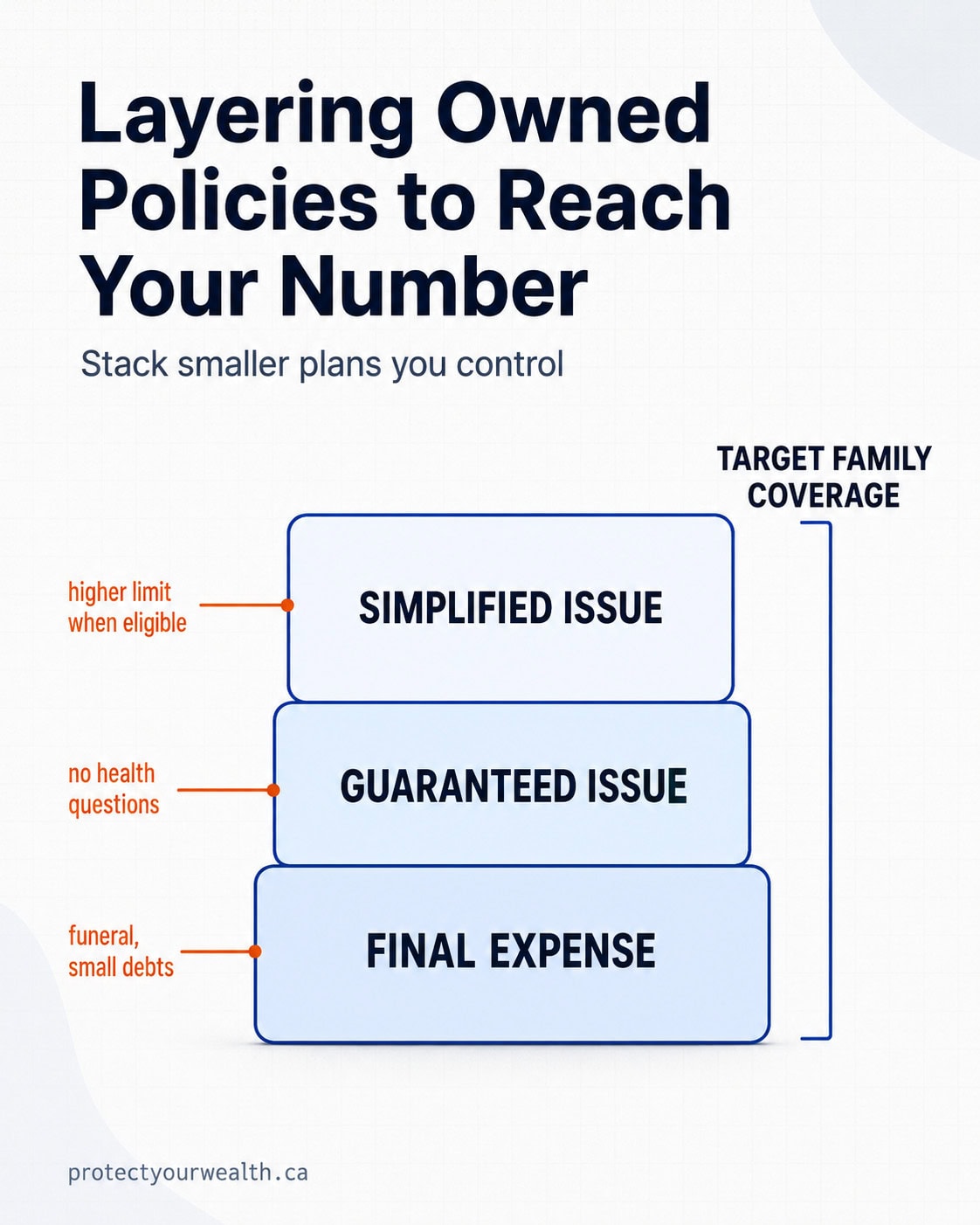
This is the kind of file where an independent broker who places these every week provides the most value: matching each layer to the insurer most likely to say yes, in the order least likely to leave a mark on your record.
A word on workplace group coverage
If you already have group life through an employer, it is a fine supplement while it lasts. Just do not build your plan around it. Group coverage is tied to your job, so it disappears the moment you change employers or your hours drop, which is often the worst possible time to lose it. Treat it as a bonus on top of coverage you own, never as the foundation.
Begin with the policy open to you now and add layers as budget and eligibility allow. A staged plan you control beats waiting for one perfect policy that may never come.
Which Canadian Insurers Approve Huntington’s, and How
The insurers that reliably approve a Huntington’s application are the ones with guaranteed-issue and simplified products, not the large fully underwritten names. This is where a lot of online guides get it backwards. They list the big traditional brands as “flexible” on Huntington’s, when in practice a confirmed diagnosis at a fully underwritten insurer is the application most likely to come back declined.
Here is the routing I actually use, by product line. Pay attention to which company and which product, because a few of these carriers run both a fully underwritten line and a no-medical line, and only the no-medical one is the path for a diagnosed file.
Where the door is narrower
Fully underwritten insurers such as Foresters do not offer a no-questions guaranteed product for this. A confirmed diagnosis is generally rated heavily or declined there, while an asymptomatic applicant with family history might be considered on a rated basis. Humania also offers a no-medical guaranteed option, since its simplified questions exclude Huntington’s family history.
So how do I choose? Not by whichever brand sounds friendliest. I match the carrier whose product and questions fit your exact situation, then sequence the applications so a likely decline never goes on record ahead of a likely approval. For a diagnosed client that usually means a guaranteed-issue policy first, then a second owned policy layered on to reach the amount your family actually needs.
Some coverage in place beats a perfect policy you never qualify for. These caps and benefit periods are illustrative only and depend on the full application, your age, and each insurer’s current rules, so confirm eligibility with a licensed broker before assuming a rate class.
Genetic Testing and Your Rights in Canada
In Canada there is a genetic non-discrimination act, and an insurance company cannot ask for or use your existing genetic test results. It is a law, not a courtesy. The Genetic Non-Discrimination Act has been in force since 2017, and in 2020 the Supreme Court of Canada upheld it, so this protection is settled.
If you have been tested for Huntington’s, that result is yours. An insurer cannot require you to take a genetic test, cannot ask whether you have taken one, and cannot ask you to hand over the result. They still assess your application using ordinary underwriting information: your personal health history, symptoms, diagnosis, family history, medications, and lifestyle. A positive, negative, or inconclusive genetic test simply does not enter the picture.
Protected, off limits to insurers
Your genetic test results. Whether you have ever taken a genetic test. Any request that you take one as a condition of coverage.
Still fair game
Family medical history, such as whether a parent or sibling was diagnosed. Your own diagnosis and symptoms if you have them. Standard health and lifestyle questions.
That line matters, because people mix the two up. Family history is a normal underwriting question and you have to answer it honestly. A genetic test result is not, and you should not volunteer it. If you are asymptomatic and untested, there is usually nothing to disclose beyond ordinary health questions, which is exactly why applying early is such an advantage.
If you are ever unsure what an application is really asking, get the question clarified before you answer it. You can read more on genetic testing and life insurance, or work through it with a broker so nothing private ends up on a form that never should have asked. The full text of the law is on the Genetic Non-Discrimination Act page if you want the source.
How to Improve Your Approval Odds
You have more control over the outcome than the diagnosis suggests. Most of what moves an application is timing, documentation, and routing, all things you can influence before anything goes on record.
Apply before symptoms
Family history but no symptoms? Apply now. Once symptoms appear, underwritten options usually close. Early action keeps the widest set of doors open.
Route before you apply
An independent broker can match your file to insurers that actually accept it, instead of collecting declines from companies that never would.
Be accurate, not extra
Answer family and health questions honestly and consistently. Do not volunteer genetic test results. Inconsistencies cause delays.
Show stable care
A current note confirming steady specialist or family-doctor care reads as a stability signal on any file that gets underwritten.
Layer your own policies
Combine smaller owned plans to reach a meaningful amount, rather than chasing one large policy a diagnosis will block.
Reapply if it has been a while
Declined more than a year ago? Products and rules change. A different insurer or new plan may fit now if your situation held steady.
And keep the basic lifestyle factors in your favour where you can: avoid tobacco, watch alcohol, stay active. None of it cures the underwriting picture, but it can offset other risk and it never hurts.
The thread running through all of it is simple. Some coverage in place beats no coverage while you wait for perfect. Start with what is open to you today, then build.
Frequently Asked Questions
Q1
Can someone diagnosed with Huntington’s disease get life insurance in Canada?
Yes. Fully underwritten coverage is usually unavailable once symptoms are confirmed, but guaranteed-issue and simplified-issue policies remain open regardless of diagnosis. Many people pair a small owned policy with a second one to reach a meaningful amount.
Q2
Does a positive genetic test have to be disclosed to the insurer?
No. Under the Genetic Non-Discrimination Act, insurers in Canada cannot ask for or use genetic test results when deciding on coverage or price, and they cannot require you to take a test.
Q3
Will a family history of Huntington’s affect my premium?
It can. Family history is a fair underwriting question, unlike genetic test results. On its own it does not always raise the price if you are asymptomatic and otherwise healthy, and it does not block the no-medical paths.
Q4
Which insurers are most open to Huntington’s cases?
For a confirmed diagnosis, the guaranteed-issue products are the dependable routes: Manulife, Canada Protection Plan, Beneva, Assumption Life, and Empire’s Guaranteed Life Protect, among others. The right fit depends on your age, amount needed, and each insurer’s current rules, which is what a broker matches for you.
Q5
What is the difference between simplified issue and guaranteed issue?
Simplified issue asks a short health questionnaire but no medical exam. Guaranteed issue asks no health questions at all and accepts applicants regardless of health, typically with a two-year waiting period on non-accidental death.
Q6
Are there waiting periods before full benefits start?
Usually, yes, on guaranteed-issue plans. Most apply a two-year waiting period for natural-cause death, with accidental death covered from day one. Simplified plans may have partial or no waiting periods depending on your answers.
Q7
Can I apply if I am on disability income or unable to work?
Yes. Guaranteed-issue policies do not ask about employment or income. Simplified plans may still be available depending on your ability to manage daily activities and the cause of any disability.
Q8
Does Huntington’s affect critical illness or disability coverage?
It can. Critical illness and long-term disability plans often exclude neurological conditions like Huntington’s. For most applicants the practical focus is life insurance and guaranteed products that do not hinge on health questionnaires.
Q9
Can I increase coverage later if I am already approved?
Often, yes. Many simplified and permanent policies let you add coverage or buy additional insurance without a new medical exam, as long as the policy stays active and premiums are current.
Talk to a broker directly
Get a Huntington’s-aware coverage plan, matched to the right insurer the first time
A diagnosis or family history makes the routing the whole game. We compare guaranteed-issue and simplified-issue options across more than 20 Canadian insurers, including Manulife, Canada Protection Plan, Beneva, Assumption Life, and Empire, and sequence the applications so a likely decline never goes on record first.
Bring a brief health summary, any physician notes, and a target coverage amount. We will map the options and the order to apply in.
Licensed and serving clients across Ontario, British Columbia, Alberta, Manitoba, Saskatchewan, Nova Scotia, and New Brunswick.