Smoker Classification for Life Insurance in Canada

Confused about whether vaping, cannabis, or occasional cigars make you a smoker for life insurance? This guide shows how Canadian insurers actually classify habits so you can aim for non-smoker rates, understand clear carrier rules, and plan a path to lower premiums.

📖 17 Minute read
📅 Originally Published: July 27, 2021
🔄 Updated: November 5, 2025

Isometric shield with heart surrounded by icons for smoking, vaping, and cannabis, symbolizing life insurance balance.

Smoker Classification for Life Insurance in Canada

Confused about whether vaping, cannabis, or occasional cigars make you a smoker for life insurance? This guide shows how Canadian insurers actually classify habits so you can aim for non-smoker rates, understand clear carrier rules, and plan a path to lower premiums.

📖 17 Minute read
📅 Originally Published: July 27, 2021
🔄 Updated: November 5, 2025

Isometric shield with heart surrounded by icons for smoking, vaping, and cannabis, symbolizing life insurance balance.

Your smoking status drives price and eligibility more than almost anything else. We break down what typically counts as smoking, how cannabis frequency can still qualify as a non-smoker with some carriers, and why most insurers still treat vaping as smoking. You will also see practical ways to move back to a non-smoker status and compare policy routes if full underwriting is not the best fit right now.

Inside, you will find plain-language rules, examples, and next steps: when cotinine testing matters, how long you need to be nicotine-free, and what to do if you exceed a carrier’s cannabis limits. The goal is simple: help you choose the right policy today and map a timeline to better rates tomorrow.

“Can I get life insurance if I smoke cigarettes, vape or smoke/consume cannabis?”

Yes, even if you are a cigarette smoker, if your vape, or smoke cannabis/marjiuana then you can definitely get life insurance. You likely have a good chance in getting an underwritten life insurance policy, or if you are having trouble with that, you are very likely to get a great simplified life insurance policy.

Overview: Smoking, Vaping, and Cannabis & Life Insurance in Canada

split scene showing lifestyle contrast between smoking outdoors and reviewing insurance indoors.”

In Canada, your smoking or substance use habits have a direct impact on the cost and type of life insurance you can qualify for. Whether you smoke cigarettes, vape, or use cannabis, insurers view these activities as lifestyle factors that influence overall health and longevity. Because life insurance premiums are based on risk, even small habits can affect how much you pay for coverage.

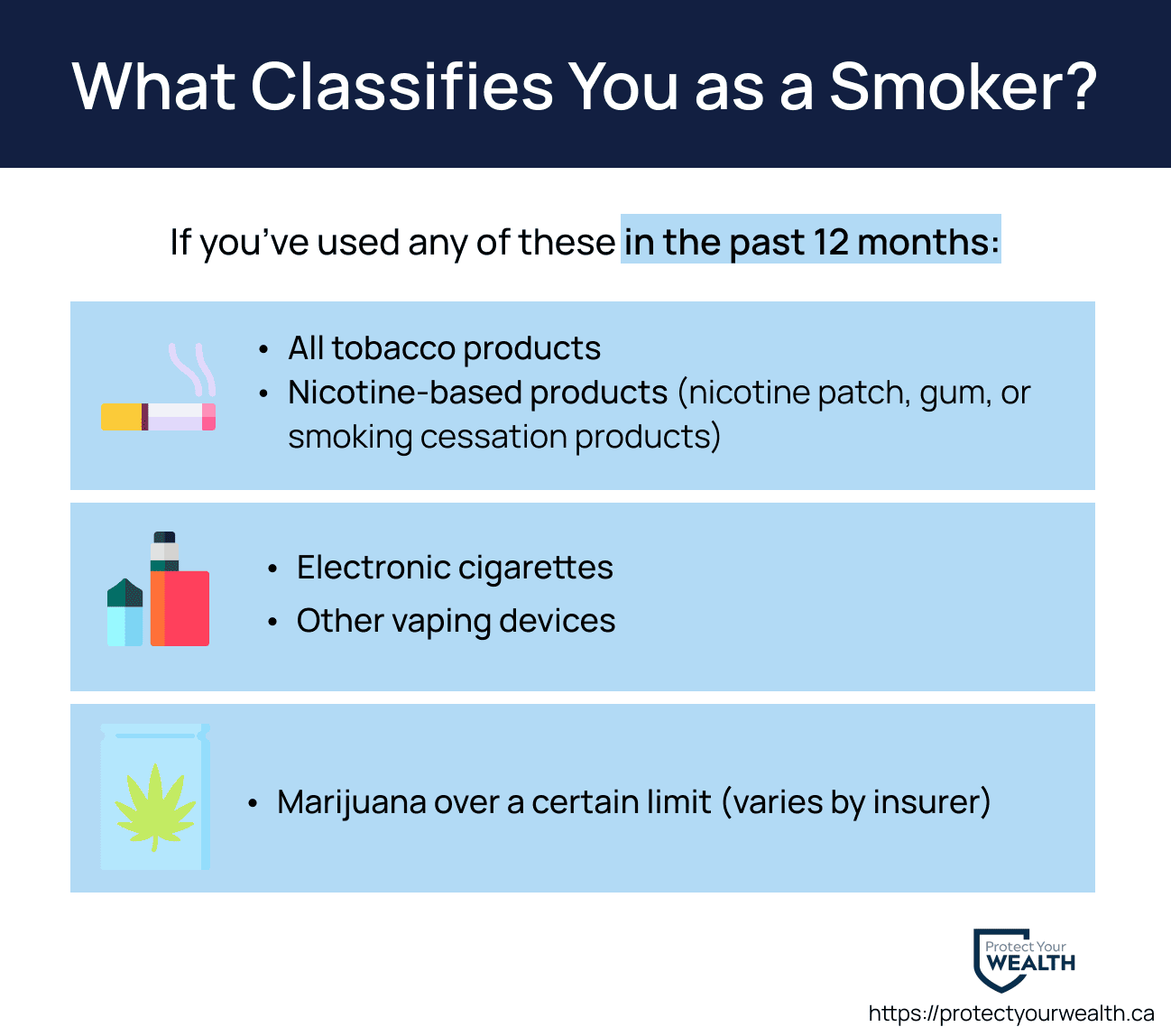
Smoking remains one of the most significant rating factors across all insurers. Individuals who use any nicotine-based products, such as cigarettes, cigars, or e-cigarettes, are generally categorized as smokers. This typically results in higher premiums, sometimes 30% to 200% more than non-smoker rates, depending on age, health, and frequency of use. In contrast, non-smokers who have remained nicotine-free for at least 12 months are rewarded with lower, preferred rates. Many Canadian insurers use similar smoker classifications to determine eligibility and pricing.

Vaping and Alternative Nicotine Products

Although many Canadians turn to vaping as a perceived healthier alternative to smoking, insurers have not fully embraced this view. Most companies treat vapers and e-cigarette users as smokers, largely due to the ongoing uncertainty around long-term health effects. Even nicotine-free vaping liquids may lead to a smoker classification since the inhalation process itself can introduce unknown risks to the body.

Cannabis and Life Insurance Eligibility

Since the legalization of cannabis in 2018, Canadian insurers have adapted their policies to reflect different consumption habits. Occasional cannabis use, whether through smoking, edibles, or oils, does not always result in smoker classification. In most cases, applicants who use cannabis a few times per week can still qualify for non-smoker rates, provided their use remains moderate and does not combine with nicotine or tobacco products. However, daily or heavy consumption typically leads to higher premiums or special rating categories.

Why Your Habits Matter

Life insurance providers base pricing on long-term health statistics and mortality data. Nicotine and smoke exposure are strongly linked to chronic illnesses such as heart disease, respiratory conditions, and reduced cardiovascular performance. Similarly, excessive cannabis or vape use can signal higher health risks over time. By disclosing your habits honestly, you allow insurers to match you with the most accurate and sustainable coverage options available in Canada.

Lifestyle & Health Factors That Influence Life Insurance Approval

When applying for life insurance in Canada, insurers look closely at lifestyle habits and health indicators that could affect your long-term well-being. These factors help determine your overall risk profile, which directly impacts your eligibility and premium costs. While every insurer’s process is slightly different, most rely on a combination of medical history, personal habits, and behavioural patterns to assess how likely you are to make a future claim.

Lifestyle Factors

Your daily habits and choices have a significant impact on how insurers view your application. Certain behaviours can raise concern due to their correlation with higher health risks or potential for chronic conditions. Common lifestyle triggers include:

  • Smoking and Nicotine Use: Any form of tobacco or nicotine, including cigarettes, cigars, vaping, or nicotine pouches, usually results in a smoker classification and higher premiums. To qualify as a non-smoker, most insurers require at least 12 months free from nicotine.
  • Cannabis Consumption: Light to moderate cannabis use may still qualify for non-smoker rates, but frequent use (over two to three times per week) or combined use with tobacco often triggers smoker classification.
  • Alcohol Consumption: Regular, moderate drinking is typically acceptable, but heavy or daily consumption can increase risk ratings or even lead to policy declines if liver or dependency concerns exist.
  • Recreational Risks: High-risk hobbies, such as motorsports, rock climbing, or skydiving, can lead to premium increases or exclusions for high-risk life insurance coverage.
  • Occupational Hazards: Dangerous professions, including mining, aviation, or construction, are evaluated for risk exposure and may affect both coverage amounts and pricing.

Health Factors

Beyond lifestyle, your current health and medical history are key components of the underwriting process. Insurers evaluate these factors to determine overall longevity, the likelihood of complications, and whether coverage can be issued at standard or preferred rates. Key medical triggers include:

  • Pre-Existing Conditions: Conditions such as diabetes, hypertension, asthma, or heart disease can influence eligibility. Well-managed cases often qualify for standard rates, while uncontrolled or recent diagnoses may lead to higher premiums.
  • Body Mass Index (BMI): Being significantly underweight or overweight may increase the perceived risk of future illness, impacting pricing or coverage limits. See how height and weight affect life insurance pricing in Canada.
  • Blood Pressure & Cholesterol: Elevated readings may indicate cardiovascular risk, leading to modified rates or additional medical documentation requests. Learn more about how high blood pressure and cholesterol can affect approvals.
  • Family Medical History: A history of early-onset heart disease, stroke, or hereditary cancers can affect how insurers assess long-term health outcomes.
  • Mental Health: Conditions such as anxiety or depression are reviewed on a case-by-case basis. Applicants demonstrating consistent treatment and stability are more likely to receive standard approval.

By recognizing these lifestyle and health influences early, applicants can make proactive adjustments, such as quitting smoking, improving their diet, or maintaining regular medical checkups, to strengthen their applications and reduce premiums over time. For Canadians seeking coverage, small improvements in health and daily habits can translate to significant long-term savings.

How Canadian Insurers Assess Smoking, Vaping, and Cannabis Use

Canadian life insurance companies evaluate smoking, vaping, and cannabis use by examining frequency, recency, and substance type. Applicants are asked about all forms of use within the past 12 months, and many policies require a urine or blood test to detect nicotine or THC. Even one instance of nicotine use during that period typically results in a smoker classification.

While traditional tobacco use automatically triggers higher premiums, cannabis is treated more flexibly. Most insurers allow up to two or three cannabis sessions per week while still qualifying for non-smoker rates, provided no tobacco or nicotine is used. Vaping, however, is generally treated the same as smoking due to limited long-term research on its effects.

Each insurer follows its own internal guidelines, informed by actuarial data and health research, to balance fairness with risk management. This means two applicants with similar habits could receive very different rates depending on the company.

Key Underwriting Factors for Smokers, Vapers, and Cannabis Users

Isometric fitness scene showing healthy activity symbolizing lifestyle factors for life insurance.

Canadian insurers use several key factors to determine how smoking, vaping, or cannabis use impacts a life insurance application. These factors help establish the level of risk an applicant poses and guide whether they qualify for non-smoker rates, smoker classifications, or specialized underwriting categories. While each company’s criteria differ slightly, most align on the same core considerations that directly affect pricing and approval.

Primary Underwriting Factors

  • Frequency and Recency of Use: Any nicotine or cannabis use within the last 12 months generally places applicants in the smoker category. Occasional use, such as two or fewer cannabis sessions per week, may still qualify for non-smoker rates with select insurers.
  • Product Type: Traditional tobacco products, nicotine vapes, and e-cigarettes are rated most heavily due to clear health data. Edible or oil-based cannabis products are viewed as lower-risk compared to smoking or vaping cannabis.
  • Combination Use: Mixing cannabis with tobacco or using multiple nicotine products increases risk and almost always results in smoker classification.
  • Duration of Use: Long-term users face higher premiums, even if they have recently quit. Most insurers require at least 12 consecutive months without nicotine before reclassifying someone as a non-smoker.
  • Medical Testing: Many underwritten policies include urine or blood tests for nicotine (cotinine) and THC. Any positive result can override self-disclosure and confirm smoker status.

Those planning to quit or reduce consumption should coordinate with a licensed advisor to reapply once the 12-month period has passed. This can significantly lower premiums and expand available coverage options.


Table 1: Core Underwriting Factors - Smokers, Vapers, and Cannabis Users
How typical factors translate into favourable vs. higher-risk outcomes across major Canadian life insurers.


Underwriting FactorFavourable CaseHigher-Risk Case
Frequency & RecencyInfrequent cannabis use (≤2–3/week) and no nicotine use in past 12 months.Daily smoking/vaping or any nicotine use within past 12 months.
Product TypeNo nicotine; cannabis via edibles/oils; occasional large cigar with negative cotinine.Cigarettes/cigarillos; nicotine vapes/pouches; smoked or vaped cannabis.
Combination UseSingle substance only; no concurrent nicotine and cannabis.Nicotine plus cannabis or multiple nicotine products together.
Duration & HistoryShort, recent, or ceased use; documented reduction over time.Long-term or heavy past use; relapse patterns noted in history.
Medical EvidenceNegative cotinine/THC as declared; stable vitals (BP, BMI, lipids).Positive cotinine/THC contrary to disclosure; abnormal vitals or labs.
Disclosure ConsistencyClear, complete application; usage details match tests and physician notes.Omitted or unclear details; discrepancies vs. labs or medical records.
Time Since Last UseNicotine-free for ≥12 months; cannabis within carrier limits.Recent nicotine exposure or cannabis beyond carrier thresholds.
Overall Health ContextNo significant comorbidities; good activity, sleep, and follow-ups.Compounding risks (e.g., hypertension, diabetes) or poor follow-up.
  • Frequency/Recency: Infrequent use & 12+ months nicotine-free is best; daily or recent use increases risk.
  • Type: Non-nicotine products and non-smoked cannabis are favoured; cigarettes and nicotine vapes are highest risk.
  • Combination: Mixing nicotine and cannabis raises classification.
  • History: Short or reduced use is better; long/heavy use is higher risk.
  • Evidence: Negative tests and stable vitals help; positives or abnormal labs hurt.
  • Disclosure: Consistency helps; discrepancies trigger downgrades.
  • Last Use: 12+ months nicotine-free improves class.
  • Health: Fewer comorbidities = better outcome.

Vaping vs. Tobacco: Why Most Life Insurers Classify Vapers as Smokers

Despite the perception that vaping is a safer alternative to smoking, most Canadian life insurance companies continue to classify vaping users as smokers. From an underwriting standpoint, both habits introduce nicotine or other inhaled substances into the body, which carry measurable health risks, even if those risks differ in degree or form from traditional tobacco use.

One of the main reasons insurers maintain this classification is the lack of long-term clinical data on vaping’s effects. While cigarette smoking has decades of actuarial data linking it to mortality and disease, vaping is relatively new, leaving insurers without enough evidence to justify separate pricing models. Until more definitive research emerges, underwriters take a conservative approach and align vaping with tobacco to ensure consistent risk management.

Why Vaping Is Treated Like Smoking

  • Nicotine Exposure: Most e-liquids contain nicotine, which leads to dependency and cardiovascular strain, key risk indicators used in life insurance for smokers.
  • Respiratory Risk: Vaping can cause inflammation and lung injury, and early studies show a correlation with reduced respiratory function similar to smokers.
  • Unknown Long-Term Impact: Because vaping is relatively recent, there’s not enough longitudinal evidence for insurers to model its risks separately from tobacco.
  • Consistency Across Applicants: Insurers prefer standardized classifications; treating all nicotine-based inhalation as “smoking” ensures fair comparisons and transparent pricing.

Non-Nicotine and Nicotine-Free Exceptions

Applicants who exclusively use nicotine-free vapes may sometimes qualify for non-smoker status, but this depends on clear disclosure and verified testing. A negative cotinine test is usually required to confirm no nicotine exposure in the past 12 months. However, since many “nicotine-free” products still show trace levels, these cases are rare and require additional underwriting review.

For those looking to reclassify from smoker to non-smoker rates, maintaining a nicotine-free status for at least 12 consecutive months is typically required. Advisors often recommend scheduling a retest or reapplication once this period is achieved to secure lower premiums.

Do Nicotine Pouches or Replacement Products Count as Smoking?

Nicotine pouches, gums, lozenges, and patches are often marketed as safer alternatives to smoking or vaping, but from an underwriting perspective, they still count as nicotine use. Most Canadian life insurers classify applicants using any nicotine-based replacement product as smokers, even if there’s no smoke or vapour involved.

The reasoning is simple: the presence of nicotine, regardless of how it’s delivered, still affects cardiovascular health and addiction risk. Since nicotine elevates blood pressure, heart rate, and stress on the circulatory system, it carries similar long-term implications to smoking, even without tar or combustion exposure.

Some insurers may be more lenient if the product is used temporarily during a quit attempt and cotinine tests confirm declining or negative nicotine levels. However, to qualify for non-smoker rates, applicants must remain completely nicotine-free, without any pouches, gums, or patches, for at least 12 consecutive months.

For individuals transitioning away from smoking, advisors can recommend policies that accommodate temporary use of cessation products until the non-smoker threshold is met.

Life Insurance Policy Options for Smokers and Cannabis Users in Canada

office scene with advisor guiding clients toward symbolic policy option paths.

Smokers, vapers, and cannabis users in Canada have several viable life insurance policy options, even though their rates and approval pathways differ from non-smokers. The three main categories, fully underwritten, simplified issue, and guaranteed issue, offer varying degrees of flexibility, medical scrutiny, and cost. Understanding how each works helps applicants choose a policy that aligns with both their current habits and long-term plans.

  • Fully underwritten life insurance is the most comprehensive option, offering higher coverage limits (often $500,000 to several million) and the potential for premium reductions after a successful quit period. However, it requires full medical testing, including urine or blood tests that detect nicotine or THC. Applicants with stable health and limited substance use often benefit most from this route, as it provides the broadest protection at the lowest long-term cost once reclassified as non-smokers.
  • Simplified issue policies cater to those who want quicker approval and fewer medical barriers. These plans skip full exams and rely on short health questionnaires. They’re ideal for individuals who vape, use cannabis regularly, or are in the process of quitting tobacco but still want affordable coverage. Premiums are moderate, and approvals can occur in just a few days.
  • Guaranteed issue life insurance is designed for high-risk or previously declined applicants. It provides near-instant approval without medical questions, but coverage amounts are smaller, and premiums are higher per dollar of coverage. These policies are often used to protect final expenses or small debts and can act as a bridge until the applicant qualifies for traditional coverage.

Across all three policy types, transparency is key. Failure to disclose smoking or cannabis habits can result in claim delays or denied benefits. Working with a licensed advisor ensures you match your coverage with your health profile, helping you avoid unnecessary costs and maximize your long-term insurability.


Table 2: Life Insurance Options for Smokers and Cannabis Users in Canada
Comparison of main policy types available to smokers, vapers, and cannabis users, outlining medical requirements, approval time, and ideal fit.


FeatureFully UnderwrittenSimplified IssueGuaranteed Issue
Medical RequirementsFull exam with blood/urine tests; mandatory disclosure of nicotine or cannabis use.No medical exam; brief health questionnaire covering smoking and lifestyle habits.No medical exam or questions; automatic approval regardless of use or health history.
EligibilityBest suited for healthy smokers or light cannabis users with stable habits.Ideal for moderate users or those with mild health issues who want faster approval.Designed for heavy smokers, frequent users, or individuals declined elsewhere.
Coverage Range$100K–$5M depending on age and health profile.$25K–$750K, depending on insurer and usage disclosure.$10K–$50K, primarily for final expenses or debt coverage.
Approval Time3–6 weeks depending on medical review time.1–5 business days; some same-day approvals available.Instant approval within minutes of application.
Premium LevelLowest cost per coverage dollar, but higher for smokers or recent users.Moderate cost; balanced between speed and affordability.Highest per dollar of coverage due to guaranteed acceptance.
Best ForApplicants seeking full protection and long-term savings potential.Smokers or cannabis users needing quicker, simpler approval.Individuals with past denials or health conditions affecting eligibility.
Policy Term OptionsAvailable as 10, 20, 30-year term or permanent (whole/universal).Typically term coverage (10–20 years) or small permanent plans.Permanent coverage only; no renewal or conversion needed.
Reclassification OptionPossible after 12 months nicotine-free; retesting may apply.Limited; some insurers offer lower rates after disclosure review.None; premiums fixed for life of policy.
  • Fully Underwritten: Full exam, highest coverage, best long-term value.
  • Simplified Issue: No exam, faster approval, moderate coverage.
  • Guaranteed Issue: Instant approval, small coverage, higher premium.

Typical Approval Outcomes & Premium Scenarios for Smokers

When it comes to life insurance in Canada, smokers and nicotine users are typically classified in higher-risk tiers due to the increased likelihood of health complications over time. However, the outcome of a life insurance application can still vary widely depending on frequency of use, the type of product (tobacco, vape, or nicotine replacement), and time since last use. Applicants who have been nicotine-free for 12 months are often eligible for non-smoker reclassification, which can reduce premiums by up to 50% or more.

While standard smoker rates are common for regular users, there are several intermediate approval types that allow flexibility. For instance, an occasional smoker or a light cannabis user might be rated slightly higher but still receive affordable coverage. Those in transition, such as people using nicotine patches or quitting, may qualify for temporarily rated policies until they can reapply under better conditions. Simplified or guaranteed issue plans remain fallback options for those facing declines due to medical or usage history.

Each insurer sets unique thresholds for classifying applicants. Some are more lenient toward cannabis use, while others treat vaping as equivalent to smoking. Below is a summary of typical approval outcomes and premium scenarios that smokers and cannabis users can expect when applying for life insurance in Canada.


Table 3: Typical Approval Outcomes & Premium Scenarios for Smokers in Canada
Overview of how major Canadian life insurers classify smokers, vapers, and light cannabis users, including approval categories, rate impact, and common scenarios.


OutcomeDescriptionPremium EffectTypical ScenarioCommon Insurers
Standard Approval (Smoker Class)Regular cigarette, cigar, or vape user with stable health and full disclosure.Base smoker rates (typically 50–100% higher than non-smoker).Daily smoker with clean medical test results and no other risk factors.Canada Life, Empire Life, Manulife
Rated ApprovalModerate usage or vaping habit with no other medical issues.25–75% higher than standard smoker rate.Light smoker or frequent cannabis user who recently quit nicotine.RBC Insurance, Beneva, IA Financial
Deferred / Conditional ApprovalApplication held until 12 months nicotine-free or medical recheck period.Variable; may qualify for lower rates upon reapplication.Applicant transitioning from smoker to non-smoker using cessation products.Manulife, Empire Life, Canada Life
Simplified IssueNo medical exam; limited health questions; rates reflect current usage.30–100% higher than standard, depending on frequency of use.Daily vaper or heavy cannabis user needing fast approval.Foresters, Assumption Life, IA Financial
Guaranteed IssueAutomatic acceptance; no questions about smoking or cannabis habits.Highest premiums (100%+); smaller coverage limits.Declined or high-risk applicants seeking minimal coverage.CPP, Assumption Life
Reclassified Non-SmokerNicotine-free for 12+ months with negative cotinine test results.Up to 50–60% lower premiums compared to smoker rates.Former smoker or vaper who maintained verified abstinence for 1 year.Canada Life, Beneva, Empire Life
  • Standard Smoker: Daily use, stable health — Canada Life, Manulife.
  • Rated: Light user or in transition — RBC, Beneva, IA Financial.
  • Deferred: Waiting 12 months nicotine-free — Empire, Manulife.
  • Simplified: Quick approval for daily use — Foresters, Assumption.
  • Guaranteed: Auto-approval, small coverage — CPP, Assumption.
  • Reclassified Non-Smoker: 12 months nicotine-free — Beneva, Canada Life.

How Major Canadian Insurers Classify Smokers and Cannabis Users

downtown scene of a young adult vaping at twilight with warm and cool lighting.

Each major Canadian life insurance company takes a slightly different approach to underwriting smokers, vapers, and cannabis users. While most insurers treat any form of nicotine use as a “smoker” risk class, some are more flexible with cannabis users or those who have transitioned to nicotine-free vaping. Understanding these insurer-specific tendencies can help applicants and advisors target companies with more favourable classifications, potentially saving thousands of dollars in long-term premiums.

Generally, insurers fall into three categories: traditional underwriters (like Manulife and RBC), who maintain strict smoker classifications; balanced assessors (like Canada Life and Empire Life), who review usage patterns before rating; and flexible or modern underwriters (like Beneva and Foresters), who use lifestyle-based evaluations. Cannabis users tend to receive more lenient treatment than tobacco users, provided their usage frequency is low and no nicotine exposure is present.

The following table outlines how each insurer tends to classify applicants who smoke, vape, or use cannabis, highlighting where each company stands on nicotine exposure, cannabis frequency, and disclosure transparency.


Table 4: Underwriting Tendencies of Major Canadian Life Insurers for Smokers and Cannabis Users
Comparison of how leading Canadian insurers assess smoking, vaping, and cannabis use, including nicotine testing, classification thresholds, and flexibility toward lifestyle disclosures.


InsurerClassification ApproachNicotine Exposure PolicyCannabis Use PolicyIdeal Applicant Profile
ManulifeTraditional and data-driven; conservative stance on nicotine and vaping.All nicotine users classified as smokers, regardless of quantity or form.Allows up to 3 uses/week for non-smoker rates if no nicotine use present.Applicants who vape occasionally or use cannabis infrequently.
Empire LifeBalanced and documentation-based approach; flexible with clear records.Smokers and vapers rated similarly; nicotine-free verified users may qualify non-smoker.Non-smoker rates possible for light cannabis use (≤2–3/week).Applicants with transparent disclosures and consistent testing results.
Canada LifeStructured with clear thresholds; prefers full medical and lifestyle detail.Any nicotine use in past 12 months = smoker rate.Standard for non-smokers if cannabis use is occasional and THC test aligns.Individuals who recently quit smoking and maintain stable health.
RBC InsuranceHighly procedural; applies firm smoker rules with limited exceptions.All forms of nicotine (including vaping and patches) treated as smoking.Moderate cannabis use accepted but flagged for additional review.Applicants seeking predictable, structured underwriting outcomes.
IA FinancialConservative; detailed testing and physician statements often required.Nicotine users rated smokers until 12 months confirmed abstinence.Cannabis users rated individually; no automatic smoker class unless tobacco mixed.Applicants with documented health stability and cessation plans.
BenevaModern and lifestyle-based; flexible for moderate cannabis users.Nicotine vapes rated smokers; nicotine-free vapes reviewed case-by-case.Up to 3 uses/week may still qualify for non-smoker rates.Applicants using cannabis socially or transitioning off nicotine.
Foresters FinancialAccessible and advisor-friendly; pragmatic for moderate-risk lifestyles.Smoker rating applied for nicotine; flexible for disclosed vaping without nicotine.Accepts light-to-moderate cannabis use with full disclosure.Applicants seeking smaller, quick-issue coverage with fair pricing.
Assumption LifeHigh-access insurer with strong simplified and guaranteed lines.No differentiation between tobacco and nicotine alternatives.Permits cannabis use under simplified plans; higher-risk rated guaranteed.Applicants previously declined elsewhere or needing fast approval.
  • Manulife: Conservative with nicotine; light cannabis allowed.
  • Empire Life: Balanced; accepts verified nicotine-free users.
  • Canada Life: Clear 12-month rule for non-smoker reclass.
  • RBC: Strict smoker rules; cannabis reviewed individually.
  • IA Financial: Conservative, test-based approach.
  • Beneva: Modern, flexible with cannabis and vaping.
  • Foresters: Friendly to smaller, simplified plans.
  • Assumption Life: High-access simplified and guaranteed plans.

Best Timing to Apply and Alternative Coverage Options

The ideal time to apply for life insurance as a smoker, vaper, or cannabis user often depends on your usage patterns, recent lifestyle changes, and readiness to transition toward a non-smoker classification. Timing your application correctly can have a major impact on approval outcomes and long-term premiums. Those planning to quit smoking or reduce nicotine use should aim to apply after at least 6–12 months of nicotine-free testing to qualify for non-smoker rates. In contrast, frequent users or individuals with upcoming health changes may benefit from short-term coverage first, followed by a switch to a fully underwritten plan later.

For individuals currently using nicotine or cannabis, simplified or guaranteed policies offer immediate protection while avoiding deferrals or medical delays. Applicants who have recently quit or switched to nicotine-free vaping should consider starting with term life coverage to lock in insurability before moving to a permanent or reclassified non-smoker plan once eligibility improves. Timing and transparency remain critical; applying too soon after quitting may still result in smoker rates, while waiting too long can risk higher premiums due to age increases.


Table 5: Best Timing to Apply & Policy Options for Smokers and Cannabis Users
Guidelines for when to apply for life insurance based on current smoking, vaping, or cannabis use, and which policy types align best with each stage.


SituationUnderwriting ViewBest TimingSuggested Policy
Currently smoking or vaping nicotineRated smoker class; full disclosure required; possible deferral if recent quit.Apply anytime if immediate coverage needed; reapply 12 months nicotine-free for better rates.Term Life or Simplified Issue (short-term bridge).
Recently quit smoking (under 12 months)Still rated as smoker; may qualify for reclassification after consistent abstinence.Apply after 12 months nicotine-free with test verification for non-smoker rate.Fully Underwritten Term or Universal Life.
Light cannabis user (≤2–3 times per week)Often treated as non-smoker if no nicotine use; must disclose THC frequency.Apply anytime with clear usage detail; best approved during stable health.Term Life or Permanent Life (non-smoker class).
Frequent cannabis use (daily or near-daily)Possible rate increase; varies by carrier; no automatic smoker class unless mixed with nicotine.Apply during stable usage pattern; consider switching to simplified plan if delayed.Simplified Issue or Permanent Life.
Using nicotine replacement (patch, gum, pouch)Still classified as smoker until 12 months free of all nicotine products.Apply once nicotine-free period verified by test; short-term plan for interim protection.Simplified Issue or Term Life.
High-risk or declined applicantDeferred or denied for traditional underwriting due to lifestyle or health.Apply immediately for guaranteed coverage while improving eligibility.Guaranteed Issue or Short-Term Simplified.
  • Smoking/Vaping: Apply now, reapply 12 months nicotine-free.
  • Recently Quit: Wait 12 months for non-smoker rates.
  • Light Cannabis: Apply anytime; likely non-smoker class.
  • Frequent Cannabis: Simplified coverage during heavy use.
  • Nicotine Replacement: Apply after 12 months nicotine-free.
  • Declined/High Risk: Choose guaranteed or simplified plan.

How to Improve Your Chances of Non-Smoker Approval

patio scene showing moderate cannabis use in a relaxed Canadian home setting.

Improving your odds of qualifying for non-smoker life insurance rates starts with timing, consistency, and transparency. Canadian insurers rely on both self-disclosure and medical testing, so applicants must show a clear, verifiable pattern of nicotine-free living before reclassification. Typically, you’ll need to be completely nicotine-free for 12 consecutive months and pass a cotinine test that confirms no trace of nicotine or its byproducts in your system.

Steps to Strengthen Your Application

  • Document your quit date: Keep a record of when you stopped smoking or vaping, as insurers often request written confirmation or advisor notes.
  • Maintain a healthy lifestyle: Improving cardiovascular health, exercising regularly, and keeping blood pressure and cholesterol stable can help offset prior smoker classifications.
  • Avoid nicotine substitutes: Patches, gums, or pouches still count as nicotine exposure until you’ve been off them for at least a year.
  • Get pre-tested: Ask your advisor about ordering a private cotinine test before applying; passing it confirms readiness for non-smoker rates.
  • Disclose honestly: Full transparency avoids policy rescission and builds trust with underwriters.

Work with a licensed advisor who understands Canadian insurer reclassification policies. They can guide when to apply or reapply, ensuring your timing aligns perfectly with your nicotine-free period and maximizes approval success.

When Quitting Smoking Can Lower Your Life Insurance Rates

Quitting smoking is one of the most effective ways to reduce your life insurance premiums in Canada. Most insurers require that you remain completely nicotine-free for at least 12 consecutive months, without smoking, vaping, or using any nicotine replacement products, before they’ll consider you for non-smoker rates. Once that milestone is reached and verified through a negative cotinine test, you can request a policy reclassification or reapply for a new plan at significantly lower premiums.

Typical Timeline for Rate Reduction

  • 0–12 months after quitting: You’ll still be classified as a smoker; however, you can start a short-term plan to maintain coverage.
  • 12–24 months: Eligible for non-smoker status if cotinine tests are clear and no relapse is reported.
  • 2–3 years: Potential for preferred or “healthy lifestyle” ratings if overall wellness has improved.

Key Considerations

  • Each insurer’s reclassification process varies; some may require a new medical exam, while others accept updated testing only.
  • Advisors can often time a new application to coincide with your verified quit date to lock in lower premiums quickly.

Get Personalized Advice & Quotes

Get Personalized Life Insurance Advice for Smokers, Vapers & Cannabis Users

Finding the right life insurance coverage when you smoke, vape, or use cannabis can be confusing, but you don’t have to navigate it alone. The licensed advisors at Protect Your Wealth help Canadians understand which insurers offer fair, affordable rates and how to qualify for non-smoker reclassification after quitting or reducing use.

Speak with advisors who understand how Canadian insurers classify smokers, vapers, and cannabis users. Learn which companies, like Manulife, Canada Life, Beneva, and Empire Life, offer the most flexible underwriting for your lifestyle. Get personalized advice to find the best coverage for your needs and budget.

Case Studies: Real-World Life Insurance Outcomes

🚬Case 1: Daniel, 42, Alberta

Profile: Light smoker (5 cigarettes per week). Healthy, active lifestyle. No major medical conditions.

  • Problem: Daniel had been declined previously for non-smoker rates due to occasional tobacco use, even after reducing his intake.
  • Approach: Worked with a Protect Your Wealth advisor to identify insurers (like Beneva and Empire Life) that assess smoking frequency rather than label all nicotine users the same. Completed cotinine testing after a 3-month break.
  • Resolution: Approved at standard smoker rates initially, with eligibility to reapply as a non-smoker after 12 months nicotine-free.

Takeaway: Consistency and clean testing are key; even light smokers can earn non-smoker reclassification after a documented quit period.

💨Case 2: Aisha, 29, British Columbia

Profile: Vapes occasionally (nicotine-free). Uses cannabis 1–2 times per week. No underlying health issues.

  • Problem: Unsure if vaping or cannabis use would automatically label her as a smoker and lead to higher rates.
  • Approach: Advisor submitted a full disclosure outlining vaping habits and confirmed nicotine-free use with a negative cotinine test. Applied with flexible carriers (Foresters Financial, Beneva) known for lifestyle-based assessments.
  • Resolution: Approved at non-smoker rates for a 20-year term policy, with full disclosure noted in the underwriting file.

Takeaway: Nicotine-free vaping and moderate cannabis use are often not penalized if clearly disclosed and tested; honesty and testing results make all the difference.

FAQ – Frequently Asked Questions About Smoking, Vaping & Cannabis and Life Insurance

Can I still get life insurance if I smoke or vape?

Yes, but you’ll likely be classified as a smoker and pay higher premiums than non-smokers. All Canadian insurers consider any form of nicotine use (including cigarettes, cigars, vapes, and nicotine pouches) as smoking. However, you can still qualify for standard rates through simplified or fully underwritten plans. After 12 months nicotine-free, you can apply for non-smoker reclassification to reduce premiums.

Does vaping count as smoking for life insurance in Canada?

In most cases, yes. If your vape contains nicotine, insurers treat it the same as smoking. Even nicotine-free vaping may require disclosure and testing. Only applicants with proven nicotine-free status for at least 12 months can potentially qualify for non-smoker rates. Always disclose vaping habits honestly to avoid future claim issues.

Can I get life insurance if I use cannabis?

Yes, cannabis use alone does not automatically classify you as a smoker. Most insurers allow light or moderate cannabis users (typically up to 2–3 times per week) to qualify for non-smoker rates. Frequent or daily users may receive a rating increase, especially if use is combined with tobacco or nicotine. Always disclose your frequency and form of use for the most accurate underwriting outcome.

How long after quitting smoking can I get non-smoker rates?

Typically, you must be completely nicotine-free for at least 12 consecutive months, including no vaping, gum, or patches, before applying for non-smoker reclassification. Some insurers may require cotinine testing to confirm your results. Once approved, your premiums can drop by 30–50% or more, depending on your policy and health profile.

What’s the best life insurance option if I recently quit smoking?

If you’ve quit within the past year, consider a term policy or simplified issue plan to maintain coverage while waiting for reclassification. Once your nicotine-free period reaches 12 months, you can reapply or request reclassification for lower non-smoker premiums. An advisor from Protect Your Wealth can help you determine the right insurer and timing for your application.

Do insurers test for marijuana use during life insurance exams?

Some do. Cannabis screening is becoming more common, especially for fully underwritten policies. However, a positive THC test doesn’t automatically affect your approval — insurers will review your frequency of use and whether it’s recreational or prescribed. The key is consistent, honest disclosure; undisclosed usage may cause claim disputes later.

Can my rates improve if I switch from smoking to vaping?

Not immediately. Even if you switch from smoking to vaping, most Canadian insurers still classify you as a smoker if your vape contains nicotine. Once you stop all nicotine use and maintain a clean cotinine test for 12 months, you may qualify for a lower non-smoker rate. Your advisor can help plan a timeline for reclassification and savings opportunities.

Finding The Right Life Insurance For Your Habits

Working with a life insurance advisor can help you determine which life insurance company’s recreational use limits align with your habits. At Protect Your Wealth, we work with and compare quotes and policies from the best life insurance companies in Canada to help find the perfect solution for your needs..

Contact Protect Your Wealth or call us at 1-877-654-6119 to talk to our life insurance advisor today. We’re proudly based out of Hamilton, and work with clients anywhere in Ontario, British Columbia, Alberta, and Manitoba including areas such as Kitchener-Waterloo, Calgary, Victoria, and Winkler.

Talk to an advisor today.

Best Life Insurance Quotes Canada