·

How to Find a Life Insurance Policy After Someone Dies in Canada
By Parvesh Benning, Licensed Life Insurance Broker
Most searches start with bank statements. That only works if the policy was still active when your loved one died.
Updated: April 10, 2026

How to Find a Life Insurance Policy After Someone Dies in Canada
By Parvesh Benning, Licensed Life Insurance Broker
Most searches start with bank statements. That only works if the policy was still active when your loved one died.
Updated: April 10, 2026
If the policy was paid up years ago, there are no premiums to find. No bank debit, no annual statement, nothing that shows up in the usual places. That’s the scenario nobody talks about, and it’s more common than most families realize.
This guide covers how to search systematically, starting with the right places, using Canada’s official search tools correctly, and filing a claim that moves without unnecessary delays. A broker’s perspective on where families get stuck, and how to get past it.
How do you find a life insurance policy after someone dies in Canada?
Start with bank statements and personal documents, then contact the largest Canadian life insurers directly and submit an OLHI Policy Locator request at the same time. Those two tracks run in parallel, not sequentially. The OLHI search is free, covers 99% of Canadian insurers, and takes 4 to 6 weeks, so submitting on day one matters.
The most common reason searches stall: the policy was fully paid up years ago. No ongoing premiums means no bank transactions to find. If statements turn up nothing, that result does not mean no policy exists. The sections below cover what to do at each stage, including what to do when the obvious places come up empty.
On this page:
Why Finding a Policy Matters
Financial Stability and Support
Life insurance payouts are often the financial buffer that keeps a family stable in the months after a loss. Funeral costs, outstanding debts, mortgage payments, everyday expenses: none of these pause for grief. The policy your loved one paid into exists specifically to cover them, so the people left behind can focus on recovery instead of scrambling.
For families where the deceased was the primary earner, the stakes are higher. The difference between finding the policy and not finding it can mean years of financial strain for the beneficiaries who were supposed to be protected.
Education and Future Plans
Many life insurance policies are purchased with a specific goal in mind. Funding a child’s education, supplementing a spouse’s retirement, keeping a family business running after a key person is gone. If the policy goes unclaimed, none of that happens. The money sits idle while the people it was meant to help go without.
Fulfilling the Deceased’s Wishes
When someone buys a life insurance policy and keeps paying premiums for 10, 15, 20 years, that is a deliberate choice to protect the people they care about. Finding that policy is how you honour that choice. Walking away from an unclaimed benefit because the search felt too hard means someone’s intention never materialized. That is worth the effort to avoid.
For anyone who has worked through estate planning with an advisor, the policy is always part of the conversation. But not everyone plans ahead. Which is exactly why knowing how to search after the fact matters as much as planning before.
Preventing Benefits from Going Unclaimed
When an insurer cannot locate the beneficiaries after a policyholder dies, the funds eventually transfer to the province’s unclaimed property registry. Ontario, BC, Alberta, and Quebec all maintain these registries. The money does not disappear, but it can sit there for years, accessible only to those who know to look.
A benefit meant to pay for someone’s education or keep a mortgage current ends up in a government database instead. Finding it is not complicated once you know where to start. That is what the rest of this guide covers.
First Steps to Search: Documents and Accounts

Most people start exactly where they should: looking for paperwork. What catches families off guard is that a thorough search can turn up nothing, even when a policy definitely exists. That happens when the policy was fully paid up. No ongoing premiums means no bank debits to find. The paper trail ends years earlier, often before anyone thinks to look.
Start with the obvious places first, then go deeper if nothing surfaces:
- Personal documents: Home offices, filing cabinets, safes, and safe deposit boxes. Look for the original policy contract, renewal notices, or any correspondence from insurance companies. Some people store policies digitally, so check USB drives and cloud accounts too.
- Incoming mail: Set a mail redirect if possible and monitor for several months. Annual statements, dividend notices, or coverage updates from insurers sometimes arrive long after a policyholder has passed, especially if billing cycles are annual.
- Bank and credit statements: Pull at least 12 months and look for recurring debits to an insurer. This works well for active policies with ongoing premium payments. For fully paid-up policies, statements will show nothing. That is where most searches stall and most families give up. If you suspect a policy exists but find no payment history, do not stop there.
- Professional contacts: Lawyers, accountants, and financial advisors often have policy details in estate or tax files. Ask about any recurring premium references in prior filings or estate planning notes.
- Employer records: Current and previous employers may have group life coverage on file. HR departments are generally cooperative once they know the person has passed and can direct you to the group insurer and the claim paperwork.
If the first round of searching turns up nothing, that does not mean no policy exists. Paid-up policies, lapsed policies still within a grace period, and older group coverage can all go undetected in a standard document search. The sections below cover what to do when the obvious places come up empty.
Bank Statement Clues

Bank and credit card statements are the right starting point, but they have a limit worth understanding upfront: they only show premium payments for active policies. If your loved one had a fully paid-up policy, there are no ongoing premiums and no payment trail to find. A clean 12 months of statements does not mean no policy exists. Keep that in mind before you conclude the search here.
Pull at least 12 months of statements, 24 if the deceased retired or changed jobs in recent years. Here is what to look for:
Insurer name as payee
Banks abbreviate: "MAN LIFE PAD," "SUN LIFE PAD," "CANADA LIFE PAD." A truncated name is not a reason to dismiss it.
Do this: Screenshot the exact string and search it before calling anyone.
Consistent cadence
Same amount, same payee, every month or quarter. That is the clearest signal of an active policy with ongoing premiums.
Do this: Pull 12 months minimum. Annual payers need 24 months to surface reliably.
Amount changes slightly
A premium that shifts by a few dollars year over year is normal. Riders get added, modal fees adjust, coverage changes.
Do this: Don't discard a payee because the amount varies. Confirm with the insurer directly.
Annual lump sum
One larger debit per year, same month. Annual mode is common on older permanent policies and easy to miss on a short statement pull.
Do this: Note the month and use it as your inquiry window when contacting the insurer.
Generic processor code
"INS PREM PROCESSING" or a numeric merchant code with no insurer name attached. Third-party billing used by several carriers.
Do this: Call your bank and ask for the full legal merchant name behind that code. Most can tell you within minutes.
Group life deduction
"GROUP LIFE PREM" via payroll, or a benefits line on a pay stub. Will not appear as a bank transaction if it came off a paycheque.
Do this: Check T4s and pay stubs, not just bank records. Then call HR directly.
NSF or reversed premium
A returned premium in the months before death is a flag, not a confirmed cancellation. Most insurers carry a 30-day grace period before a policy lapses.
Do this: Call the insurer and ask about grace period and reinstatement status before assuming coverage ended. Do not close the file on this one without a direct answer from them.
Who to Contact When You Cannot Find the Policy
Here is something most guides do not tell you: do not treat these contacts as a sequential list. Do not finish one step before starting the next. Contact the top 10 Canadian life insurers directly and submit your OLHI request at the same time. Those 10 carriers represent over 90% of the Canadian market. Running both tracks in parallel cuts weeks off the search.
With that in mind, here is who to contact and what to ask:
- The major carriers directly: If you have no idea which insurer held the policy, start by contacting the largest Canadian life insurers directly. Each one has a claims or unclaimed property process. You do not need the policy number to initiate a search. You need the deceased’s full name, date of birth, and last known address. This is faster than waiting on OLHI alone and covers most of the market immediately.
- OLHI (simultaneously, not after): Submit your OLHI Policy Locator request at the same time as your direct carrier outreach, not after. OLHI contacts its member companies on your behalf. The search is free. Results take 4 to 6 weeks. Starting it on day one means you are not waiting an extra month after the direct calls come up empty.
- Financial advisors and brokers: If your loved one worked with a financial advisor or broker, contact them directly and explain the situation. They are bound by confidentiality but can confirm whether they placed coverage and direct you to the insurer if you are the executor or a named beneficiary. This is often the fastest way to identify the carrier on individually placed policies.
- Lawyers and estate professionals: If your loved one completed any estate planning, the lawyer may have policy references stored alongside the will. Ask specifically for any insurer names, certificate numbers, or beneficiary designations in the estate file. Do not ask generically. Ask for the documents.
- Accountants: Worth a call if the deceased was self-employed or if premiums were paid through a business account. Accountants often see insurance premium references in annual filings. Ask about any recurring insurer payments or policy references in the last few years of returns. Useful lead for tax planning related coverage that might not show in personal bank accounts.
- Employers and HR departments: Group life coverage through an employer is one of the most commonly missed policies. Call HR and let them know the person has passed. In my experience, HR departments are generally cooperative once they know the situation. They will tell you which insurer held the group policy and walk you through the claim paperwork. If the person retired or changed jobs, contact previous employers too. Some group coverage continues post-retirement. Some does not. You need to ask.
- Professional associations and unions: Teachers, engineers, lawyers, construction workers, government employees, nurses — many professional associations offer group life coverage to members. Check whether your loved one belonged to any association or union and contact their benefits office directly. These policies rarely show up in bank statements if dues were paid through payroll.
- Credit card companies: Some credit cards include small life insurance or travel accident coverage as a cardholder benefit. Check the deceased’s credit card agreements or call the card issuer directly. These are usually smaller amounts but worth confirming, particularly if death occurred during travel.
When you contact any of these, have the death certificate ready along with your own government-issued ID and proof of your relationship to the deceased — whether as executor, beneficiary, or next of kin. Most organizations will not release details without verification, but they will confirm whether a policy exists once you are identified.
Online Tools to Search for a Life Insurance Policy in Canada
Two tools do most of the heavy lifting here: the OLHI Policy Locator and your province’s unclaimed property registry. Both are free. Both are official. And as covered in the previous section, you should submit your OLHI request at the same time you are calling carriers directly, not after.
Before you use OLHI, there is one constraint most families do not know about until it is too late.
OLHI Policy Locator: What It Does and When It Works
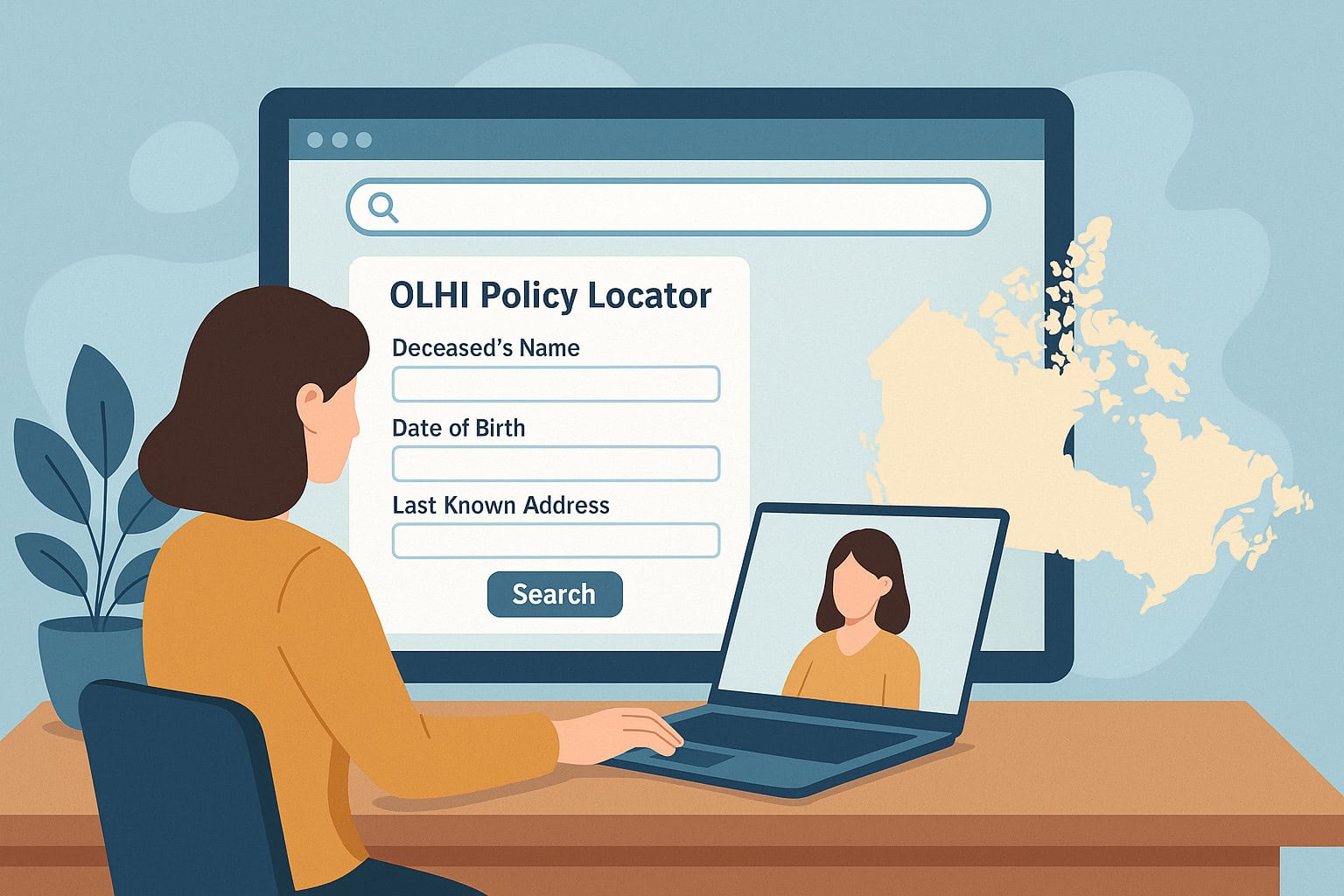
The OLHI Policy Locator contacts its member insurance companies on your behalf and asks whether a policy exists for the deceased. The search is free, covers approximately 99% of Canadian life and health insurers, and does not require you to know which company held the policy.
Here is the part that catches families off guard. OLHI will only conduct a search if the death occurred more than three months ago and less than two years ago. Submit too early and they will decline the request. Wait too long and the window closes entirely.
If you are within that window, submit immediately. Do not wait until the direct carrier calls have finished. OLHI results take 4 to 6 weeks. Starting the request on day one means you are not adding that wait time at the end of your search.
One more limitation worth knowing: OLHI does not reliably find group life policies issued through employers or professional associations. If you suspect group coverage existed, contact the employer or association directly regardless of what OLHI returns.
To submit a request, visit the OLHI website and provide the deceased’s full name, date of birth, last known address, and your relationship to them. If a matching policy is found and you are legally entitled to the information, the insurer will contact you directly.

Provincial Unclaimed Property Offices
When an insurer knows a policyholder has died but cannot locate the beneficiaries, the funds are eventually transferred to the province’s unclaimed property registry. This can happen years after death. The money does not disappear, but it sits there unclaimed until someone searches for it.
Each province manages this differently. Ontario, BC, Alberta, and Quebec all have their own registries. For other provinces, the Bank of Canada’s Unclaimed Balances portal covers national unclaimed financial assets including insurance proceeds.
Search with the deceased’s full name and last known province. If a match appears, the portal will walk you through the claim process, which typically requires a death certificate, your ID, and proof of your relationship to the deceased. Results from the Bank of Canada portal are instant. Provincial registry timelines vary.
Contacts 99% of Canadian life and health insurers on your behalf. Free. Does not require you to know which company held the policy.
Bank of Canada Unclaimed Balances
NationalSearches unclaimed financial assets transferred to the Bank of Canada, including insurance proceeds where the insurer could not locate beneficiaries.
BC Unclaimed Property Society
British ColumbiaHolds unclaimed insurance, estate, and financial assets for BC residents. Separate from the Bank of Canada portal.
Alberta Unclaimed Property
AlbertaAlberta Treasury Board and Finance maintains records of unclaimed funds including insurance payouts. Searchable online.
Revenu Québec - Unclaimed Property Registry
QuébecMaintains records of unclaimed financial products for Québec residents, including life insurance policies where beneficiaries could not be located. Search is online and free. Claims require proof of heirship.
How to File a Life Insurance Claim After a Death in Canada
Most claims go through without major issues. The ones that get delayed almost always come down to the same few things. Here is what actually matters from a broker’s perspective, and what the generic step-by-step guides do not tell you.
1. Contact the Claims Department Directly
Do not call general customer service. Call the claims department. If you have the policy number, give it to them. If not, the deceased’s full name, date of birth, and last known address are enough to open a file. The insurer will confirm whether a policy exists in their system and tell you what to send.
If the policy was originally placed through a broker or financial advisor, call them first. A broker who placed the policy can open the claim on your behalf and walk you through exactly what that specific insurer requires. That is part of what they are there for. Most families do not think to call.
2. Use the Online Claim Form, Not a Paper Copy
Most major Canadian insurers have online claim portals. Use them. Online forms flag incomplete fields before you submit, which means nothing gets sent with missing information. They capture EFT details cleanly so the payout goes directly to a bank account instead of waiting on a cheque. And they generate a reference number the moment you hit submit, so you have documented proof of when the claim was filed.
Paper forms get lost in the mail. They arrive without a timestamp. A missing signature or blank field means the whole package comes back, and you have lost another week. If an online portal is available, that is the right choice every time. If paper is your only option, send it registered mail and keep a copy of every page before it leaves your hands.
3. What Documents You Actually Need
Two documents are non-negotiable: an official death certificate and the completed claim form. A funeral director’s statement of death can substitute for a death certificate in most cases and is usually faster to obtain. After that, you will need government-issued ID and confirmation that you are the named beneficiary or the executor of the estate.
The original policy document is helpful but rarely required. If you found the policy through the OLHI search or a carrier inquiry, the insurer already has it in their records. Do not delay filing while searching for the original if the insurer has already confirmed the policy exists.
4. The Two-Year Contestability Period and What It Actually Means
If the policy was issued less than two years before the death, expect a more detailed review. This is the contestability window where the insurer has the right to verify the original application against the medical information on file. It is not an accusation. It is a standard step built into every Canadian life insurance contract.
What actually causes delays during a contestability review is incomplete paperwork or slow responses when the insurer asks for additional records. Respond to every request within the week. If you are not sure what they are asking for, call and ask them to clarify before guessing and sending the wrong thing. A file that sits idle stretches the timeline unnecessarily.
If the policy was in force for more than two years before the date of death, the contestability window has passed. The review is largely administrative at that point. Submit a clean, complete package and payment typically follows within 30 business days. Longer-standing policies (ones in force for 10, 15, or 20 years) move through with the least friction. The underwriting was done long ago. The insurer is not re-evaluating the risk. They are verifying the paperwork and issuing payment.
5. If There Are Disputes or Delays
Keep a dated log of every contact: who you spoke to, their name, the reference number, and what was said. If calls are not returned within a reasonable window, request escalation to a supervisor in writing. Keep copies of everything you submit.
If a claim is disputed over cause of death, application accuracy, or beneficiary entitlement, that is when you need professional help. A lawyer who handles estate or insurance matters can review the file and represent your position. If you believe the insurer is handling your claim unfairly, OLHI provides free, impartial review of unresolved disputes. You also have the option of contacting your provincial regulator if you believe a denial was improper.
6. If the Policy Pays to the Estate
When a policy names the estate as beneficiary rather than a specific individual, the payout is subject to probate before it flows through to heirs. The insurer releases funds to whoever the policy designates. If that is the estate, the money waits for the executor to complete probate.
Confirm with the insurer upfront whether named beneficiaries are on the policy. If they are, payment goes directly to them without probate, regardless of what the will says. That is one of the practical advantages of naming individuals on the policy from the start. If probate is unavoidable, work with the executor to obtain those documents as quickly as possible and notify the insurer when they are ready.
Common Claim Challenges and Fixes
Most claims process without major friction. When they don’t, the problems tend to fall into the same handful of categories. Here is what causes delays, and what to actually do about each one.
- You cannot identify the insurer: No policy number, no company name, nothing definitive in the files.
Fix: Work backward through bank statements, email, and cloud storage for premium payments or policy PDFs. Contact current and former employers for group life details. Ask the estate lawyer or accountant whether any insurer appears in prior filings. Run the OLHI search and call the top 10 carriers directly at the same time, not sequentially. - Policy was not in force at time of death: Premiums lapsed, or a term policy expired before the date of death.
Fix: Ask the insurer to confirm coverage status and the exact dates. On permanent policies, ask specifically about non-forfeiture options (such as reduced paid-up or extended term coverage). These are features built into most permanent life contracts that preserve some coverage even after premiums stop. If coverage did end, get written confirmation for the estate file. - Insurer is not responding: Callbacks go unreturned, emails disappear, weeks pass with nothing moving.
Fix: Log every contact with the date, representative name, and reference number. Follow up in writing and explicitly request escalation to a supervisor. If the delay continues beyond a reasonable window, contact the insurer’s internal ombuds office. OLHI can assist if the company is a member and the delay appears unjustified. - Disputed claim: The insurer is questioning cause of death, application accuracy, or who is entitled to the benefit.
Fix: Provide whatever documentation the insurer requests, including medical records or coroner reports, without delay. If the death occurred within the two-year contestability window, a more detailed review is expected and normal. For beneficiary disputes, get legal advice before responding and request the insurer’s position in writing. The page covering when and why death benefits are denied covers the most common grounds in more detail. - Probate delay: The policy names the estate as beneficiary rather than a specific individual. The payout waits for probate to complete before funds are released.
Fix: Work with the executor to obtain probate documents as quickly as possible and notify the insurer the moment they are ready. Confirm with the insurer upfront whether any named beneficiaries are on the policy. If there are, payment goes directly to them without waiting for probate, regardless of what the will says. This is one of the practical reasons naming a beneficiary correctly from the start matters so much.
Dealing with an insurer while managing grief and estate paperwork at the same time is genuinely hard. Most families do not know what is standard procedure versus what they should be pushing back on. A broker who has been through this process many times knows the difference.
Claim delays are harder to fight when you don’t know what you’re entitled to.
Most families accept delays without knowing whether a non-forfeiture clause still applies, whether the contestability review is standard or being drawn out, or whether the insurer’s documentation request is reasonable. Knowing which questions to ask, and when to escalate, changes the outcome.
Talk to a broker directly at no cost. Serving clients across Ontario, British Columbia, Alberta, Manitoba, Saskatchewan, Nova Scotia, and New Brunswick.
If You Still Cannot Find a Policy
If you have run the OLHI search, contacted the major carriers directly, checked bank statements, gone through HR at every employer, and still have nothing, there are a few more things worth doing before you close the file.
- Confirm the OLHI window has not expired: OLHI only accepts requests between three months and two years from the date of death. If your request fell outside that window, OLHI cannot help regardless of whether a policy exists. At that point, calling the top 10 Canadian carriers directly is the most practical remaining option. They cover over 90% of the market, and each one has a process for searching their records by name and date of birth, even without a policy number.
- Contact provincial insurance regulators: Each province has an insurance regulatory body. They cannot search for policies directly, but they can confirm whether a company is still licensed and point you toward official resources. If you have a partial company name from an old statement and cannot trace it, the regulator can help identify whether it still operates or has been acquired by another insurer.
- Check for smaller and group policies: Many Canadians hold coverage through credit unions, fraternal societies, veterans organizations, or alumni associations. These rarely surface in standard searches. If your loved one belonged to any organization, contact their benefits office directly and ask whether group life coverage was included in the membership.
- Keep monitoring mail for several months: Annual statements, dividend notices, and premium receipts sometimes arrive months after a policyholder’s death, particularly on annual billing cycles. Set a mail redirect if you have not already and check that inbox for at least six months before concluding nothing exists.
- Ask a lawyer who handles estates: If you strongly believe a policy exists but cannot trace it, an estate lawyer can make formal requests to insurers and financial institutions through legal channels that are not available to individuals acting on their own. Worth the consultation if the amounts involved justify it.
Coming up empty is a real possibility. Some policies lapse, some were never put in force, and some simply cannot be traced after enough time has passed. If that is where this search ends, the most useful thing you can do is make sure the people depending on you do not face the same situation. A conversation about your own life insurance coverage takes far less time than this search did.
FAQ: Finding a Life Insurance Policy After Someone Dies in Canada
1. How do I know if my loved one had a life insurance policy?
Start with bank statements and personal files. Look for recurring debits to an insurer, policy documents in filing cabinets, or correspondence from a life insurance company. Contact their financial advisor, employer, and lawyer. For a national search, use the OLHI policy search service, which contacts member insurers on your behalf at no cost. If the policy was fully paid up, bank statements will show nothing. That is when direct carrier outreach and OLHI become the most important tools.
2. What information do I need to locate or claim a policy?
For a search: the deceased’s full name, date of birth, and last known address. For a claim: a death certificate or funeral director’s statement, a completed claim form from the insurer, government-issued ID, and confirmation of your relationship to the deceased (as beneficiary or estate executor). The original policy document is helpful but not usually required if the insurer can locate the policy in their own records.
3. How long do life insurance companies keep policy records in Canada?
Most Canadian insurers retain records for at least 10 years after a policy becomes inactive. If benefits go unclaimed and the insurer cannot locate the beneficiaries, the funds are eventually transferred to the provincial unclaimed property registry or the Bank of Canada’s unclaimed balances search. Those funds do not disappear. They sit there until someone searches for and claims them.
4. Can I claim life insurance benefits if I’m not listed as a beneficiary?
Generally, no. Only named beneficiaries or the estate executor can receive proceeds. If the named beneficiaries are deceased or unknown, the benefit is paid to the estate and goes through probate before it flows to heirs. If you believe you should have been named but were not, that is a legal matter rather than an insurance one. An estate lawyer is the right first call in that situation.
5. How long does it take to receive a life insurance payout after death?
Most Canadian insurers issue payment within 30 business days of receiving a complete, verified package. Using the online claim portal (rather than paper) speeds this up because incomplete fields are flagged before submission and EFT details are captured cleanly. Delays typically happen when documentation is missing, when the insurer requests additional records, or when the death occurred within the two-year contestability window and a more detailed review is required.
6. What happens if I can’t find the insurance company that issued the policy?
If you have a partial name or a transaction code from a bank statement, call your bank and ask for the full legal merchant name behind that code. From there, contact the insurer directly. If you have nothing to work from, submit an OLHI policy search request and simultaneously contact the top 10 Canadian life insurers by name. Those two steps together cover the vast majority of the market. OLHI can also help trace policies from companies that have been acquired or merged into larger insurers.
7. What if my loved one had multiple life insurance policies?
Each policy is a separate claim with a separate insurer. Submit individual claim forms for each one. Documentation requirements are the same across most claims: death certificate, completed form, ID, and proof of your relationship to the deceased. Group coverage through an employer and a personal policy placed through a broker are handled entirely separately, even if the same person held both.
8. Is there a deadline for claiming life insurance benefits?
There is no fixed expiry date for life insurance claims in Canada. The funds are held by the insurer or transferred to a provincial unclaimed property registry if they cannot locate the beneficiaries. That said, the sooner you file the easier the process tends to be. Records are more complete, contacts are easier to reach, and the paperwork trail is fresher. Waiting years does not disqualify a claim, but it can complicate it.