

Life Insurance with a Lung Condition
Talk to one of our experienced advisors, today!
14 Minute read
Originally published: February 9, 2022
Updated: September 19, 2022

Life Insurance with a Lung Condition in Canada
Talk to one of our experienced advisors today!
14 Minute read
Originally published: February 9, 2022
Updated: September 19, 2022
Lung conditions will have a detrimental effect on your life, as well as your life insurance plans. Life insurance agencies will take your lung condition into consideration when deciding your quote, but being approved is not off the table. If you provide the proper documentation and showcase records of effective treatment you will have options to decide what is best for you and your loved ones.
It is disheartening to get a diagnosis of a lung condition. Pneumonia, cystic fibrosis, pleural effusion, emphysema, chronic bronchitis, and chronic obstructive pulmonary disease are just a few of the lung diseases that could affect you. Our clients know that life insurance ensures that their family will not suffer a major financial setback following their death. Many of them are concerned that they would not qualify for life insurance. A common question we get is “Can I get life insurance if I have a lung disease?”

Yes, you can get life insurance even if you’ve been diagnosed with a lung disease. Do not worry, there are many options to protect you and your loved ones financially.
In this article:
What is considered a lung condition for life insurance?
Lung conditions are classified to be any issue with the lungs that prevents the organ from working effectively. They can be conditions you are born with, as well as diseases you contracted later in your life. MedlinePlus classifies these lung conditions into 3 main categories:
Airway Diseases
Airway diseases affect the airways which carry gases such as oxygen and carbon dioxide in and out of the lungs. These diseases are known to cause blockages in the airways and result in difficulty breathing.
Diseases in this category include asthma, COPD (Chronic obstructive pulmonary disease and bronchiectasis.
Lung Tissue Diseases
Lung tissue diseases affect the structure of the lung tissue themselves in the form of scarring and inflammation. This makes it difficult for the lungs to expand fully to take in oxygen and release carbon dioxide. These diseases cause uncomfortable feelings of tightness in the chest area.
Diseases in this category include restrictive lung disease, pulmonary fibrosis and sarcoidosis.
Lung Circulation Diseases
Lung circulation diseases affect the blood vessels found in the lungs in the form of clotting, scarring or inflammation. This makes it difficult for the lungs to take in oxygen and expel carbon dioxide, and may also affect proper heart function. These diseases cause shortness of breath when doing strenuous activities.
Diseases in this category include pulmonary hypertension.
Insurance agencies will all have their own policies on what diseases they decide to cover and how much coverage they offer for your specific circumstances. This will usually depend on the severity of your lung condition and how you are reacting to your treatment. The most common lung conditions insurers offer coverage for are:

How your lung condition will affect your life insurance application
If you have a lung condition, you can definitely attain life insurance, and even at an affordable rate. Life insurance companies are aware of how prevalent health conditions are amongst the general public, thus there are guaranteed issue life insurance policies, and simplified issue life insurance policies which are very affordable. As far as standard fully underwritten life insurance policies go, with lung conditions you still can find a very reasonable price and rating. Lung conditions, like most medical conditions, could have a negative impact on your ability to obtain approval for the most cost-efficient life insurance policies, but it is definitely possible to get a standard rating. As a client with a lung condition it can result in extended application processes and your quotes and rates will highly depend on a few factors:
- The severity of your lung condition
- How you are reacting to the treatment prescribed
- How long you have had the condition
- Other medical conditions
These factors are considered during the application process through questions and medical examinations. We have outlined the specific processes and questions asked for the most common lung conditions below:
Asthma
Asthma is a common long-term lung disease caused by the constriction and inflammation of the airways. It can affect people of all ages, and while with treatment it can become manageable; the disease itself is incurable. Asthma itself is a serious condition, but the severity itself will be ranked by life insurance companies based on the following questions:
- How old were you when you were first diagnosed with asthma?
- When was your last asthma attack?
- How often do you suffer from asthma attacks?
- Are your asthma attacks seasonal or year round?
- What medications are you taking for asthma? Are any of them steroids?
- Have you been hospitalized for asthma? When and how many times?
- Have you used any tobacco or nicotine products in the last year?
You may also be asked by your underwriter to provide a medical exam, blood and urine tests and reports from doctors and specialists who are involved in your treatment.
Emphysema
Emphysema is a pre-existing medical condition that falls under the diagnosis of COPD (chronic obstructive pulmonary disease). The disease causes damage to the alveoli, or air sacs within the lungs and can be treated with a variety of medications, but is ultimately incurable. Insurance agencies will judge the severity of emphysema by the following questions:
- When were you first diagnosed with emphysema?
- Who diagnosed your emphysema?
- What symptoms led to your diagnosis, and how were you diagnosed?
- Have you been diagnosed with any other pre-existing medical conditions?
- Are you taking any prescription medications?
- Do you receive oxygen treatments?
- Has your emphysema improved? Worsened? Or remained stable?
- Have you been hospitalized for any reason in the last 2 years?
- Have you used any tobacco or nicotine products in the last year?
- Have you applied for any form of disability benefits?
You may also be expected to provide a medical exam, blood and urine tests and any reports from doctors and specialists who are involved in your treatment.
Chronic Bronchitis
Chronic bronchitis is also a type of COPD (chronic obstructive pulmonary disease) that is a result of inflammation, congestion and scarring of the airways. Bronchitis in itself is treatable with antibiotics and can be cured, but chronic bronchitis is constantly recurring; making it more difficult to get insured. Questions the agencies will ask to get more information are:
- When was your first case of bronchitis?
- How often do you get bronchitis?
- How well do you react to the antibiotics prescribed for bronchitis?
- Have you been hospitalized as a result of bronchitis?
- Is your bronchitis a result of smoking and tobacco usage?
- Have you used any tobacco or nicotine products in the last year?
- Are you frequently exposed to airborne irritants?
- Do you have any persisting medical conditions?
You will probably also need to provide a medical exam, blood and urine tests and any reports from doctors and specialists who are involved in your treatment. As well as medical records which indicate the frequency of your infections.
COPD (Chronic Obstructive Pulmonary Disease)
COPD is a result of being diagnosed with both emphysema and chronic bronchitis. The disease makes it difficult to pass oxygen through the air tract and then in and out of your air sacs because of damage to the airway and air sac. Life insurance agencies use questions to determine the severity of your condition; you can find possible questions they may ask in the emphysema and chronic bronchitis sections above.
Life insurance companies classify the types of COPD into 3 categories:
- Mild
- Up to 2 attacks/year
- Little to no breathlessness
- No other medical abnormalities between attacks
- Moderate
- Season attacks
- Occasional shortness of breath
- Symptoms are continuous
- Severe
- Year-round symptoms
- Prominent coughing and wheezing
- Shortness of breath on minimal activity
How your lung condition affects your life insurance rating
Life insurance ratings are categorized into 5 classifications:
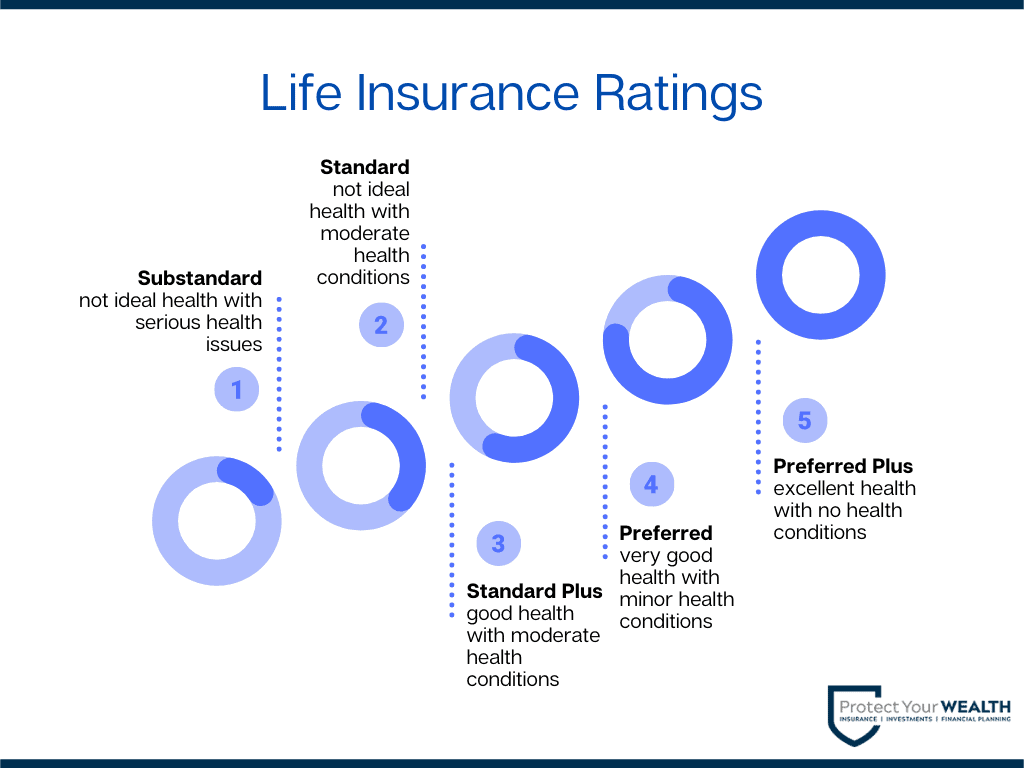
These classifications will differ from agency to agency, but provide a basis for comparison.
Asthma
Your answers to the questions posed by the life insurance companies and your medical results will assign you to a rate class. Your rate class will be a key determining factor in the calculation of your quote, and for asthma that is…
- Seasonal and well-controlled: preferred or possibly preferred plus
- Moderate with occasional attacks: standard or standard plus
- Severe with frequent attacks: substandard
- Very severe with attacks that cause hospitalization: declined (see guaranteed issue policy)
Emphysema
Your answers to the questions and your medical results will assign you to a rate class which will be a key determining factor in the calculation of your quote. Determining a rate for emphysema is difficult due to the large number of factors that need to be considered, but a few assumptions can be made based on your conditions:
- Lower severity with controlled treatment: preferred or preferred plus
- Higher severity means you will get lower ratings
- Any form of tobacco usage on top of your diagnosis within a year: declined
Chronic Bronchitis
The answers to the questions above will be evaluated by the life insurance agencies to determine your rating. Chronic bronchitis varies significantly in severity and does not have definitive ranking conditions, but the following assumptions can be made:
- Any form of tobacco usage on top of your diagnosis within a year: declined
This is especially important to people suffering from chronic bronchitis because the main causes of bronchitis are smoking and tobacco usage.
- Frequent exposure to chemical fumes on top of your diagnosis within a year: declined
Similar to tobacco, exposure to airborne irritants is a leading cause of bronchitis and will be considered negatively by agencies.
COPD (Chronic Obstructive Pulmonary Disease)
A COPD diagnosis will have a negative impact on your ability to obtain life insurance coverage, but in some cases, an okay rating can be assigned to better your chances:
- Moderate cases of COPD: standard rating or just below
- Mild COPD with coughing and shortness of breath requiring medication: sub-standard
- Severe COPD: declined (see guaranteed issue policy)

How to get the right coverage for your lung condition
The easiest way to get affordable life insurance with good coverage is to purchase it prior to being diagnosed with a lung condition. If you have life insurance prior to being diagnosed it will not be affected by your diagnosis or any complications that may arise as a result. This option is not plausible for everyone but if you believe you are at risk of developing a lung condition in the future; it would be a good idea to purchase life insurance sooner rather than later.
If you have been diagnosed and are looking for available options you will need to consider the severity of your condition. If you have a mild or moderate case you may be able to apply for standard life insurance policies, but for people with severe conditions, the standard policies will simply be too expensive. But even if standard policies are too expensive or you are denied; you still have options you can look into.
What to do if you are denied coverage
In cases where the condition is severe enough to warrant getting denied by standard life insurance policies; there are a few options you can take advantage of:
Guaranteed Issue Life Insurance
Guaranteed issue policies are considerably more expensive than the traditional term life insurance, however, they get their name from being significantly easier to obtain. Their rate of approval is almost guaranteed because they allow clients to forgo the medical questions and exams that result in high-risk evaluations. These policies are not offered at all life insurance companies and offer lower coverage, but are a great option for individuals suffering from severe lung conditions.
Simplified Issue Life Insurance
Simplified issue policies also do not require medical exams, but will have medical questions for you to answer. These questions will be standard to traditional term life insurance and will expose details of your diseases, but they have laxer conditions in place. This is a great option for individuals suffering from mild to moderate lung conditions.
Graded Death Benefit
Graded death benefit policies will also provide minimal coverage, but your family would not receive the full death benefit right away upon death like with most policies. These policies are structured to give your beneficiaries a definite percentage of the death benefit according to how long ago you purchased the policy.
Frequently Asked Questions (FAQs) about life insurance with a lung condition
These plans ask no questions at all, and require no medical exams. Guaranteed issue insurance is designed for those who have more serious health issues, or are older in age and do not qualify for traditional or simplified insurance. Guaranteed issue insurance coverage generally has a maximum of $50,000, with some insurers covering less, and comes at the highest premium out of the three because it’s also a type of permanent life insurance.
Simplified issue insurance policies don’t require a medical exam but do require you to answer certain health-related questions as part of your application. In return for no medical exam, premiums tend to be higher than traditional insurance. Simplified issue insurance is an option for those who want faster approval or don’t want to take a medical exam, and are generally used for term life insurance products.
FULLY UNDERWRITTEN | SIMPLIFIED ISSUE | GUARANTEED ISSUE | |
Cost of Premiums | |||
Medical Underwriting | Full medical history disclosed. | Limited medical questions. May differ by insurance company. | No medical questions asked. |
Visit from nurse or paramedical company | Most often yes. Sometimes substitued with physicians report. | No vist from nurse or paramedical company. | No vist from nurse or paramedical company. |
Speed of approval process | Longest process, may take few days to several weeks. | Typically within a few hours to a few days. | Typically within a couple hours to a couple of days. |
Maximum amount of coverage | No specified maximum. | Depends on company, age and health history. Can be up to 1M in coverage. | Depends on company and age. Most often between 25K and 50K maximum. |
The major lung conditions that are considered by life insurance companies are:
- Chronic bronchitis
- Asthma
- Emphysema
- Chronic obstructive pulmonary disease (COPD)
- Lung cancer
Yes, you can get life insurance with asthma, in fact, depending on the severity of your asthma it is possible to get a standard rating. If you have a mild, and less severe case of asthma, you will be able to get a standard rating from many life insurance companies thus you will have options as to which plan you want and will get a more affordable premium. If you have a more severe case of asthma, there are still plenty of life insurance companies that might offer you a fully underwritten policy, or alternatively there are guaranteed issue life insurance policies that will automatically accept you or simplified issues life insurance policies that will accept you with any in-depth medical exams. These are some factors that the life insurance companies will consider regarding you asthma:
- How old were you when you were first diagnosed with asthma?
- When was your last asthma attack?
- How often do you suffer from asthma attacks?
- Are your asthma attacks seasonal or year round?
- What medications are you taking for asthma? Are any of them steroids?
- Have you been hospitalized for asthma ? When and how many times?
- Have you used any tobacco or nicotine products in the last year?
Yes, similarly like asthma, you will be able to secure yourself with life insurance coverage if you suffer from chronic bronchitis. Many insurance companies will offer you a standard rating if you have chronic bronchitis, or a rating of 50% more than standard if you have a more severe case of chronic bronchitis which will increase your premium by 0.5 times the regular premium. There is also the option of simplified issue life insurance and guaranteed issue life insurance which will provide you life insurance in most cases regardless of the severity of your chronic bronchitis. If you have chronic bronchitis, these are some of the factors that are considered by life insurance companies:
- When was your first case of bronchitis?
- How often do you get bronchitis?
- How well do you react to the antibiotics prescribed for bronchitis?
- Have you been hospitalized as a result of bronchitis?
- Is your bronchitis a result of smoking and tobacco usage?
- Have you used any tobacco or nicotine products in the last year?
- Are you frequently exposed to airborne irritants?
- Do you have any persisting medical conditions?
Yes, similarly like asthma, you will be able to secure yourself with life insurance coverage if you suffer from chronic bronchitis. Many insurance companies will offer you a standard rating if you have chronic bronchitis, or a rating of 50% more than standard if you have a more severe case of chronic bronchitis which will increase your premium by 0.5 times the regular premium. There is also the option of simplified issue life insurance and guaranteed issue life insurance which will provide you life insurance in most cases regardless of the severity of your chronic bronchitis. If you have chronic bronchitis, these are some of the factors that are considered by life insurance companies:
- When was your first case of bronchitis?
- How often do you get bronchitis?
- How well do you react to the antibiotics prescribed for bronchitis?
- Have you been hospitalized as a result of bronchitis?
- Is your bronchitis a result of smoking and tobacco usage?
- Have you used any tobacco or nicotine products in the last year?
- Are you frequently exposed to airborne irritants?
- Do you have any persisting medical conditions?
Yes, you can get a fully underwritten life insurance policy if you are someone who is diagnosed with a lung condition. People diagnosed with a lung condition do have the ability to get insured with a simplified issue policy or a guaranteed issue policy as well if they have a more severe lung condition and think they might get declined from a fully underwritten policy.
Life insurance costs with a lung condition will really vary based on the type of life insurance you want, what your lung condition is, and the severity of it along with other specific factors based on your health. The best rates are offered by underwritten life insurance policies which will be more affordable, but will require a medical exam and questionnaires. If you don’t want to do a medical exam and/or think you might be declined from a fully underwritten policy, then you should look into simplified issue and guaranteed issue life insurance policies which will be more expensive than fully underwritten policies but will be easier to attain. To find out more about these different policies look into our blog about Guaranteed Issue vs Simplified vs Fully Underwritten Life Insurance Policies.
Finding the right life insurance for you
Even if you are diagnosed with a lung condition, you can find the right life insurance in any situation. You can enlist the help of an agent to find the best life insurance for you and your needs.
If you’re not sure of what’s the best insurance plan or company for you, working with a life insurance specialist can help you find the best solution to fit your particular situation. At Protect Your Wealth, we’ve been providing expert advice for all types of life insurance since 2007. As your trusted Life Insurance broker and financial planner, we work with you to create a plan for your family or business that covers and meets your needs.
Contact Protect Your Wealth or call us at 1-877-654-6119 to talk to an advisor today. We’re proudly based out of Hamilton, and service clients anywhere in Ontario, Alberta, and British Columbia, including areas such as Ancaster, Abbotsford, and Grande Prairie.


Leave A Comment