

Life Insurance for Scuba Diving & Skydiving
Get the protection you need, no matter what your hobby is.
10 minute read
Originally published: August 10, 2022
Updated: May 24, 2023

Life Insurance for Scuba diving & Skydiving
Get the protection you need, no matter what your hobby is.
10 minute read
Originally published: August 10, 2022
Updated: May 24, 2023
In addition to your age, gender, and overall health, your hobbies are used by life insurance companies to calculate your insurance risk. Engaging in adventurous activities or hobbies such as scuba diving, skydiving, rock climbing, racing, and other extreme sports can increase the likelihood of accidents or injuries, which will likely increase life insurance premiums. Likewise, if you only engage in recreational scuba diving or skydiving while on vacation, your life insurance premiums will not be as affected unless you have additional health concerns that could increase your risk while diving.
Despite the risks involved in scuba diving/skydiving, they are very popular sports. Each life insurance provider has its own method for assessing risk and coverage options. As such, clients are often concerned that they won’t be able to find affordable coverage, or that they would be denied altogether. A common question we receive is “can I get life insurance if I participate in scuba diving/skydiving?”
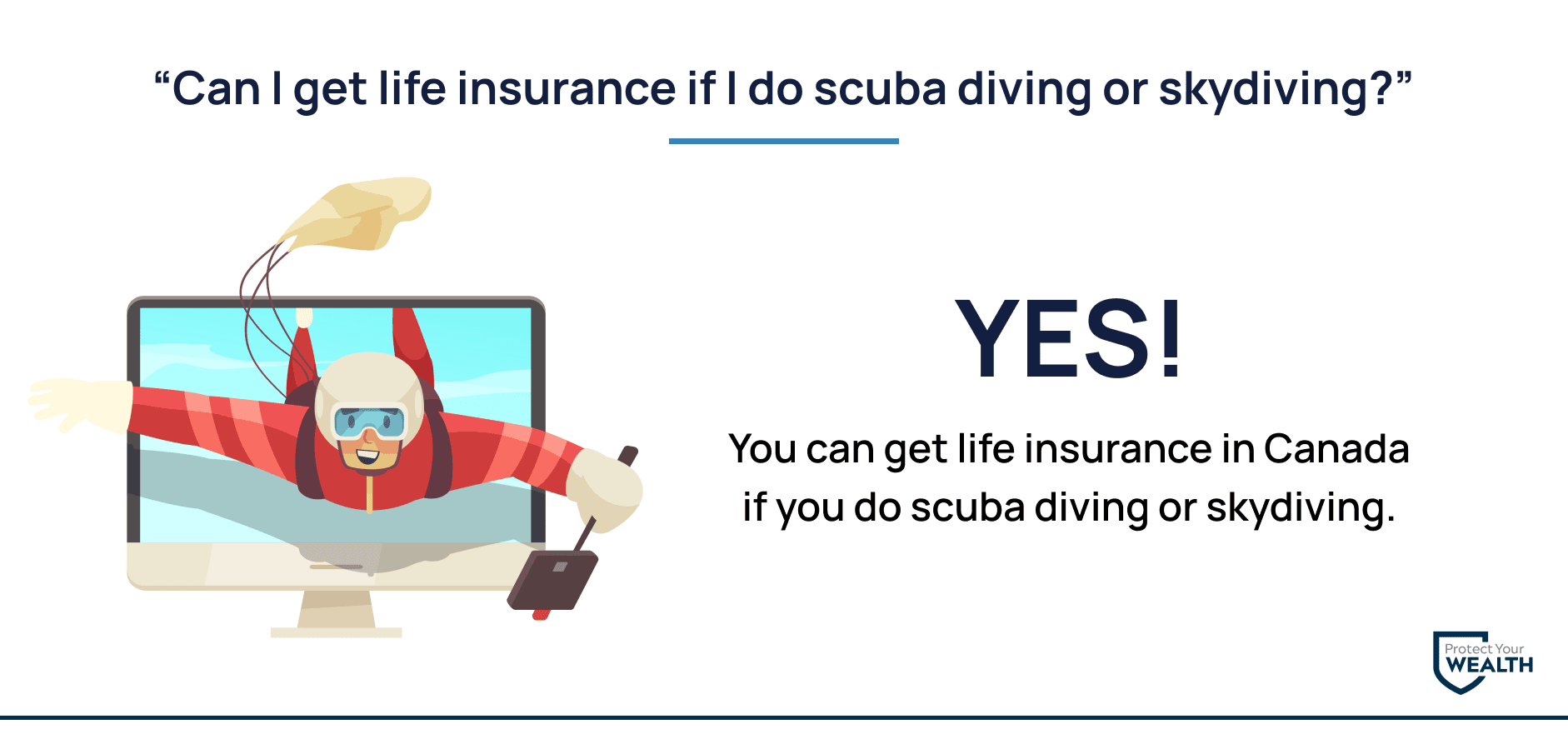
Yes! You can get life insurance even if you participate in extreme sports such as scuba diving/skydiving. At Protect Your Wealth, we are here for you to help you navigate your options and choose a policy that suits your needs.
In this article:
- Overview of Scuba Diving & Skydiving
- Does Life Insurance Cover Accidents Involving Scuba Diving & Skydiving?
- How Much Does Life Insurance cost for Scuba divers/Skydivers?
- How Insurance Companies Evaluate Scuba Divers/Skydivers
- Why is Life Insurance Necessary for a Skydiver?
- Life Insurance for Scuba Diving/Skydiving
- Frequently Asked Questions about Life Insurance for Scuba Diving & Skydiving
Overview of Scuba Diving & Skydiving
Scuba diving is a type of underwater diving in which divers use breathing equipment that is not dependent on a surface air supply. Scuba divers carry their own breathing gas, usually compressed air, which allows them more independence and movement than surface-supplied divers and more time underwater than free divers.
Skydiving is the use of a parachute to slow a diver’s descent to the ground after jumping from an airplane or other high elevation, either for leisure or competitive purposes. Modern skydivers often jump from heights between 7,500 and 15,000 feet (2,300 and 4,600 meters) above sea level, resulting in freefalls that last between 40 and 85 seconds.
Case Study: Carmela Rose’s journey to securing life insurance for skydiving
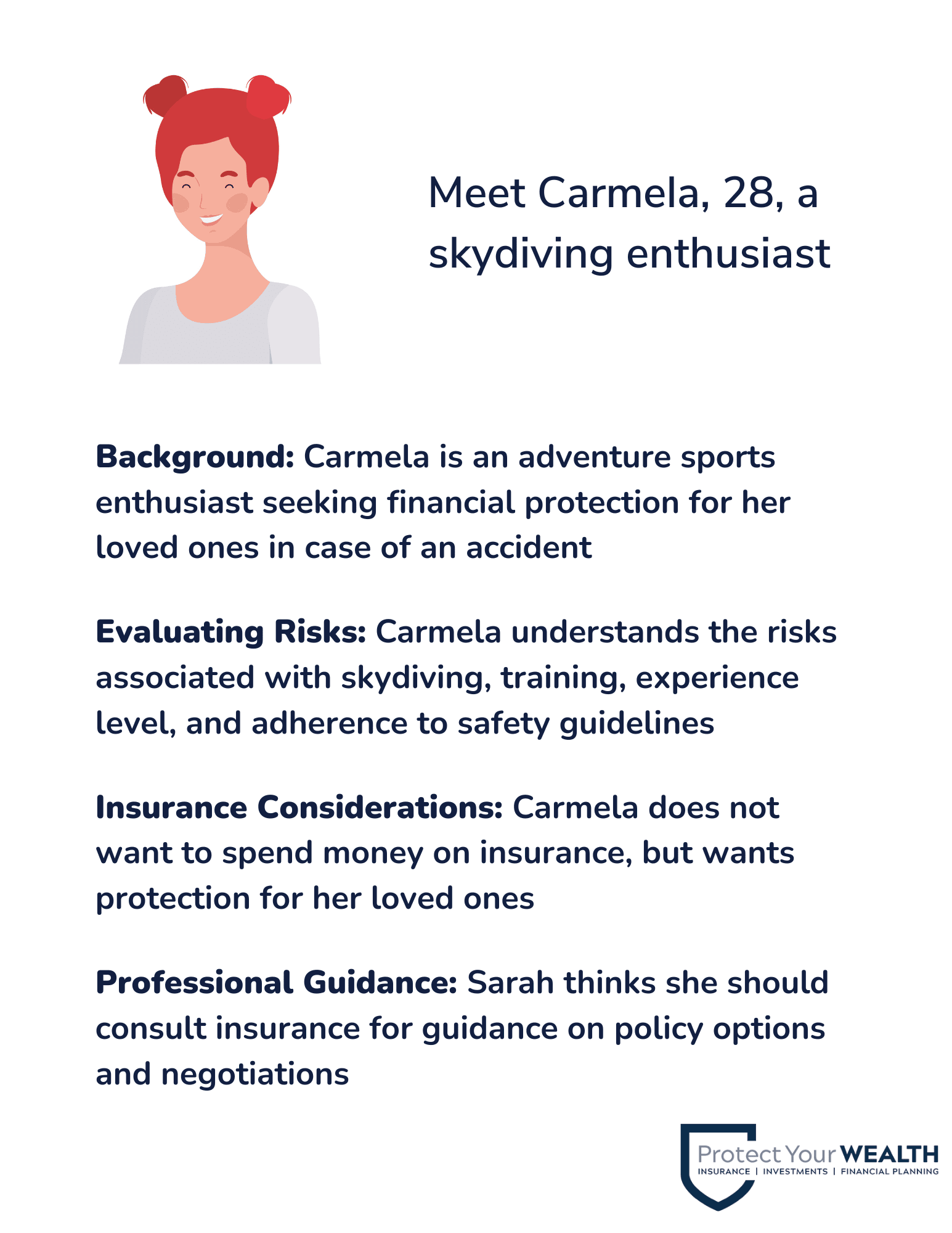
Carmela Rose, a passionate skydiving enthusiast, found herself at a crossroads when it came to acquiring life insurance coverage for her beloved extreme sport. Initially hesitant due to the higher premiums associated with skydiving, Carmela soon realized the importance of safeguarding her loved ones in case of an unforeseen event.
Though she acknowledged the slim chances of accidents, she understood that having protection provided peace of mind and a safety net that would support her family’s financial well-being if the unthinkable were to occur. With this realization, Carmela resolved to proceed with obtaining life insurance, recognizing that the benefits outweighed the initial concerns about the cost.
Does Life Insurance Cover Accidents Involving Scuba Diving & Skydiving?
Depending on your policy, life insurance can cover accidents from scuba diving and/or skydiving. But before deciding to do any diving, you should first determine if you have an existing life insurance policy or if you intend to purchase one.
If you have an existing life insurance policy, you should review your policy and check for exclusions. Review the entire insurance policy to determine if scuba diving/skydiving and extreme sports are covered. If an insurance broker previously assisted you with the policy, they can assist you with this question. If your policy does not cover scuba diving/skydiving, you should discuss your options with your insurance broker or insurance company.
If you do not have life insurance and plan to apply for life insurance while scuba diving/ skydiving, you must work with an insurance company that covers scuba diving/skydiving risks explicitly. You will be required to complete a questionnaire, and if it is a low-risk, one-time jump, it is likely to be covered. Verify this via an insurance policy document or, if none is available obtain a written statement from your insurance company or broker.
How Much Does Life Insurance Cost for Scuba divers/Skydivers?
If you plan to only engage in recreational scuba diving or skydiving while on vacation, your life insurance premiums will not be affected unless you have additional health concerns that could increase your overall risk of insuring you. Nevertheless, rescue or salvage divers may be required to pay an additional fee in addition to their life insurance rates. Your risk as a scuba diver/skydiver is determined by how frequently you dive, where you dive, and the types of dives you undertake.
As mentioned, only technical scuba divers/skydivers, with a few exclusions for other underlying health concerns, should anticipate paying extra for life insurance. Either the additional cost will be greater than typical premiums, or it will be charged as a flat extra fee, which is a fixed amount applied to the premium.
It is important to keep in mind that if you have a medical condition that could be exacerbated by participating in scuba diving/skydiving while on vacation, insurers may offer you less favorable rates. For instance, if you have a cardiac problem that could be triggered by diving, your premiums may be higher.
Avoiding Extra Fees
By adding a hazardous sports exclusion rider to your policy, you can avoid paying a flat additional fee for your scuba diving activity. Only a few insurers offer this rider, which is typically added to travel insurance or travel medical plans.
Working with an insurer that provides this rider may seem obvious, but it is not always your best option. The rider itself carries a fee, and the insurer may not offer you the most affordable coverage for your profile.
If you circumvent a flat extra with an exclusion rider, your beneficiaries will not receive the death benefit payment if you pass away while scuba diving/skydiving.
Discuss your policy options with a licensed broker to learn more.
How Insurance Companies Evaluate Scuba Divers/Skydivers
Insurance providers will ask numerous questions and consider several factors about your scuba diving/skydiving activities in order to establish a premium for you.

Certifications, frequency of scuba diving/skydiving, and depth/height of diving are some of the factors that insurers consider when underwriting and determining your premiums. Additionally, they will often ask:
- What kind of scuba diving/skydiving do you engage in?
Professional divers will be charged more than recreational divers. - How often do you scuba dive/skydive each year?
Insurers use this information to see if you engage in recreational or regular diving. Most insurers will charge greater premiums if you participate ten or more times per year, although the specific policies can vary among different companies. - Where do you scuba dive/skydive?
Some locations are seen more favorably than others. - Are you certified – which certifications do you have?
Example: Professional Association of Diving Instructors (PADI), Solo Certificate etc.
Why is Life Insurance Necessary for a Scuba Diver/Skydiver?
Despite the fact that scuba diving and skydiving are incredible experiences, they can have severe risks. Although scuba diving/skydiving equipment and techniques have advanced significantly since their inception, jumping out of an airplane or diving in deep oceans still poses risks of serious injury or death.
In reality, the greatest risk factor for skydivers is human error, not equipment failure. There is a 1 in 500,000 chance of dying in a skydiving accident, while 3 out of every 10,000 jumps result in injury. Broken and dislocated bones, back and spinal cord injuries, whiplash, and eye trauma are among the most common injuries associated with skydiving. Even if the accident isn’t fatal, the resulting injuries can be, so it’s always important to purchase or have some form of insurance to help you recover.
People who engage in deep-sea or scuba diving are susceptible to a variety of injuries, the majority of which are caused by pressure changes. Scuba diving in cold water can rapidly induce hypothermia, a condition that causes clumsiness and impaired judgment. Infrequently, cold water can cause heartbeat irregularities in coronary artery disease patients. There is a 1 in 211,864 dives resulting in a fatality.
To fully enjoy these activities while mitigating risks, it’s crucial to prioritize safety and consider acquiring appropriate insurance coverage.

Life Insurance for Scuba Diving/Skydiving
Almost every life insurance company, including Manulife, SSQ Life Insurance, Empire Life, Canada Life, and Assumption Life, offers extreme sports enthusiasts life insurance. The treatment of extreme sports can vary between companies.
Traditional, Medically Underwritten Life Insurance
Fully underwritten life insurance, also known as medically underwritten insurance or traditional insurance, is designed for healthy individuals with good health, or no significant medical or lifestyle concerns. If you plan on scuba diving/skydiving once, you are very likely to qualify for a traditional life insurance policy.
Term life insurance is a type of life insurance that pays your beneficiaries if you pass away during the policy’s term. You can specify the duration of your term policy. For Canadians and those legally residing in Canada, insurance companies offer term life insurance for 10, 15, 20, 25 or 30 years, and some offer other term lengths. After the term expires, you will be able to renew your policy, but the premiums you pay will increase. For instance, if you purchase a 10-year term life insurance policy and die within that time period, your beneficiaries will receive a tax-free payout (also called a death benefit).
Simplified Life Insurance
Simplified Life Insurance is a type of No Medical Life Insurance that does not require medical exams, but you may be required to answer some questions. A candidate must respond truthfully. Simplified issue life insurance has higher premiums than standard life insurance (also known as traditional life insurance) but lower premiums than guaranteed life insurance and provides higher levels of coverage.
Simplified Life Insurance is typically regarded as the most affordable type of No Medical Life Insurance. It has some restrictions on maximum insurance coverage limits, and the average benefit ranges from $100,000 to $500,000 per year.
If you engage in scuba diving/skydiving multiple times a year, you will generally qualify for this insurance coverage. Questionnaires vary across providers. Most questionnaires will not ask you about extreme sports, but some may.
Guaranteed Issue Life Insurance
Guaranteed Issue life insurance contains no questions and does not mandate medical exams. These plans are designed for those with more severe health conditions or who are older than the age requirements for traditional or simplified insurance. Many insurers also offer a 24-month deferral period for guaranteed life acceptance insurance. Guaranteed issue insurance coverage typically has a maximum of $50,000, although some insurers cover less, and has the highest premium of the three because it is a form of permanent life insurance.
If you scuba dive/skydive regularly and are denied coverage, you can always qualify for guaranteed life insurance.
Frequently Asked Questions (FAQs) about life insurance for Scuba Diving & Skydiving
Life insurance is not a one-size-fits-all product, and to obtain the most competitive rates, you must find an insurer that specializes in your particular needs. Working with a life insurance broker can help you obtain the best life insurance rates for your profile.
At Protect Your Wealth we compare quotes from multiple insurers to find you the best coverage and premiums based on your medical history and lifestyle preferences.
Yes, you can be denied coverage. Listing scuba diving/skydiving as a hobby on a life insurance application can result in higher premiums or a denial of coverage altogether. If you are deemed too high-risk to insure, even the largest life insurance companies can deny coverage. Your skydiving hobby may disqualify you from coverage, or your medical exam may result in a denial. Your denial could also result from a combination of these two factors. If you have a medical condition that could increase your risk of health complications and death while skydiving, you may be deemed an uninsurable risk.
If you have an existing life insurance policy when you decide to go scuba diving/skydiving, you may be covered if something goes wrong, provided you did not lie on the application. Contact your life insurance company to inform them of your plans and speak with a representative to determine whether your coverage would be extended in the event of the worst-case scenario.
Certainly not. If you lie about your hobby to an insurance company, your application could be denied or your coverage could be revoked if you already have a policy and you could be charged with insurance fraud. In addition, if you did not disclose your hobby to your life insurance company and you were killed in an accident, your beneficiaries may not be entitled to the full amount of your death benefit. Being truthful on your application can facilitate a smooth application process and payout of your death benefit.
Yes, scuba diving/skydiving has an effect on life insurance, and you must disclose this fact when applying for life insurance. A potential accident may not be covered otherwise. If it is a low-risk, one-time jump there is a good chance that you will be able to obtain a standard-rated life insurance policy. Nonetheless, you should check with the insurance company to determine whether this risk is covered, while disclosing your intentions in full.
Finding the right life insurance plan for you
For adrenaline junkies, scuba diving and skydiving are frequently the most exciting experiences possible. But due to the high-risk nature of scuba diving/skydiving, purchasing life insurance or other personal protection policies can be difficult for participants. Despite this, you can still find affordable life insurance for any situation you may have. Working with a life insurance advisor can help you build the right life insurance plan and package for your needs and lifestyle.
At Protect Your Wealth, we work with and compare policies and quotes from the best life insurance companies in Canada to ensure the best solution for you and your needs. We’ve been providing expert life insurance solutions since 2007, including critical illness insurance, disability insurance, and permanent life insurance, to build the best package to give you the protection you need.
To schedule a consultation about your income protection goals, or if you have any questions about insurance in Canada, please contact Protect Your Wealth or call us at 1-877-654-6119 to talk to an advisor today! We’re proudly based out of Hamilton, and service clients anywhere in Ontario, British Columbia and Alberta including areas such as Mississauga, Edmonton, and Nanaimo.



Leave A Comment