Life Insurance for Heart Conditions in Canada

Find the right protection for your health and your loved ones. Whether you’ve had a heart attack, stent, or atrial fibrillation, you can still qualify for affordable life insurance options in Canada. Learn how to get approved and protect your family today.

📖 Read Time: 10 Minutes
📅 Originally Published: June 24, 2024
🔄 Updated: November 4, 2025

Life insurance for heart conditions logo

Life Insurance for Heart Conditions in Canada

Find the right protection for your health and your loved ones. Whether you’ve had a heart attack, stent, or atrial fibrillation, you can still qualify for affordable life insurance options in Canada. Learn how to get approved and protect your family today.

📖 Read Time: 10 Minutes
📅 Originally Published: June 24, 2024
🔄 Updated: November 4, 2025

Life insurance for heart conditions logo

Applying for life insurance for heart conditions in Canada can feel overwhelming, but the right strategy and timing can make a world of difference. If you’ve experienced a heart attack, bypass surgery, or live with atrial fibrillation, the key is knowing which insurers specialize in cardiac risks and how to present your health profile clearly.

Many Canadians believe a heart condition means automatic denial, yet that’s rarely true. Leading insurers often provide rated, simplified, or guaranteed options depending on your recovery, test results, and medication control. This guide explains how to qualify for coverage, what underwriters look for, and how to secure affordable life insurance after a heart attack or cardiac event while protecting your family’s financial future.

you can get life insurance if you have a heart condition

Overview: Understanding Life Insurance for Heart Conditions

Life insurance for heart conditions logo

Finding life insurance for heart conditions in Canada can feel overwhelming, but it’s absolutely possible. Whether you’ve had a heart attack, bypass surgery, stent placement, or are living with atrial fibrillation, Canadian insurers provide multiple paths to coverage that reflect your current health, treatment, and recovery progress. Understanding how each option works helps you find the right balance of cost, flexibility, and protection for your loved ones.

When it comes to underwriting, insurers primarily assess three things: your stability (how long it’s been since a cardiac event), your control (how well your risk factors are managed), and your follow-up care (whether you continue to see a physician or cardiologist). The better your management and consistency, the stronger your application appears.

Broadly speaking, Canadian life insurance products for clients with cardiac histories fall into three categories:

  • Fully Underwritten Life Insurance: Best rates, requires full medical review and physician reports. Ideal if your condition is well controlled.
  • Simplified Issue Life Insurance: Moderate rates, no medical exams but several health questions. Common for mild to moderate cardiac conditions.
  • Guaranteed Issue Life Insurance: Immediate approval, no medical questions, higher cost. Often used for recent cardiac events or significant ongoing symptoms.

Each of these types can serve different needs depending on your stage of recovery and health outlook. For example, someone two years post-heart attack with stable test results may qualify for a traditional term or whole life policy, while someone recently diagnosed with congestive heart failure might look at a guaranteed issue plan as an interim solution.

Many Canadians are surprised to learn that working with a licensed independent life insurance broker can expand their options dramatically. Brokers have access to multiple insurers, each with their own tolerance for cardiac risk. That means what one insurer may decline, another may accept, sometimes even at standard rates if the recovery history is strong.

💡 Did You Know?

In Canada, several major insurers—such as Canada Protection Plan, Industrial Alliance, and Assumption Life—offer no-medical or simplified life insurance that specifically accommodates heart conditions, making approvals much faster than traditional underwriting routes.

Positive takeaway: With the right preparation, honesty about your health, and support from a knowledgeable advisor, you can secure meaningful life insurance coverage that provides peace of mind and financial protection for your family.

What Is Considered a Heart Condition for Life Insurance?

When applying for life insurance, it’s important to understand how insurers define a heart condition. In underwriting terms, a “heart condition” refers to any structural or functional problem that affects the heart’s ability to circulate blood efficiently. These can be congenital (present at birth) or acquired later in life due to lifestyle, aging, or medical factors.

Canadian insurers typically group cardiac issues into three broad categories: coronary, rhythm, and structural. Knowing where your diagnosis fits can help you anticipate how it will affect your application and premiums.

  • Coronary Conditions: These include coronary artery disease (CAD), angina, and myocardial infarction (heart attack). They indicate plaque buildup or narrowing of the arteries that supply the heart muscle.
  • Rhythm Disorders: Examples include atrial fibrillation, atrial flutter, and ventricular tachycardia. They involve irregular or rapid heartbeats that may need medication or procedures like ablation.
  • Structural or Valve Issues: These include valvular disease, heart murmurs, congenital defects, and cardiomyopathy. Some are treated surgically; others are monitored long-term.

Insurers don’t automatically decline every applicant with one of these conditions. They look for patterns that demonstrate stability, follow-up care, and improvement. If your cardiologist reports good control and regular monitoring, you may qualify for competitive rates.

Having early indicators such as high cholesterol, hypertension, or diabetes can also influence underwriting outcomes because these increase your long-term cardiac risk. However, being proactive with treatment and lifestyle adjustments can offset some of that risk.

Before applying, it’s a good idea to review your health records and ensure accuracy between your physician’s notes and your application. Even minor inconsistencies can delay approval. To learn more about how existing conditions affect pricing, see our guide on life insurance with pre-existing conditions.

Positive takeaway: A “heart condition” doesn’t automatically mean high premiums or rejection. When well-managed and documented, many cardiac histories are accepted at fair rates, especially with guidance from a specialized life insurance advisor.

Underwriting Checklist for Heart Conditions

Life insurance for heart conditions logo

Before approving life insurance for applicants with a heart condition, insurers follow a detailed underwriting checklist to assess risk and eligibility. Understanding these factors helps applicants prepare, avoid delays, and improve their chances of approval. The more complete and accurate your answers are, the stronger your application will be.

Underwriters typically look for three categories of information: medical details, lifestyle indicators, and follow-up documentation. Each plays an important role in determining your policy rating, cost, and type of approval.

  • Medical History – Includes date of diagnosis, type of heart condition, any surgeries (bypass, stents, angioplasty), and the number of years since the last cardiac event.
  • Medication and Treatment – Current prescriptions, dosage, and treatment consistency. Gaps in care or frequent medication changes may signal instability to underwriters.
  • Test Results – Recent ECG, echocardiogram, stress test, or cardiac enzyme test results. A normal test within the last year can help improve underwriting outcomes.
  • Lifestyle Factors – Includes smoking, alcohol, and exercise habits. Smoking or vaping increases premiums significantly, while maintaining a healthy diet and activity level helps lower them.
  • Family History – Early heart disease or death in immediate family members can raise perceived genetic risk.

Insurers often request an Attending Physician Statement (APS) to verify medical data. For many heart-related cases, the APS provides essential clarity about the severity, control, and prognosis of the condition. It’s usually the most influential document in your file.

Pro Tip: Keep copies of your cardiologist reports and latest test results. Submitting them upfront can shorten underwriting time by several weeks and reduce the need for follow-ups.


Table 1: Key Underwriting Factors for Cardiac Applicants
How insurers evaluate health stability and control in Canada.


Underwriting FactorHow Insurers View ItAdvisory Guidance
Medical historyKey to determining event timing, treatment type, and recovery periodDocument procedures, follow-up visits, and current cardiac stability
MedicationsIndicate condition control and compliance with treatmentMaintain dosage consistency and list all prescriptions clearly
Follow-up careShows long-term engagement with cardiologistProvide notes from the most recent annual or semi-annual review
Lifestyle and exercisePositive habits reduce perceived recurrence riskNote exercise tolerance and dietary or smoking changes
Family historyHelps estimate inherited predispositionClarify age and cause of any family heart events
Test resultsOffers objective view of current heart performanceAttach latest stress test or echo with ejection fraction percentage
  • Medical history: Track treatment type and recovery timeline. Document stability.
  • Medications: Stable doses show control and compliance.
  • Follow-up care: Provide cardiology notes for last review.
  • Lifestyle: Note exercise tolerance and healthy changes.
  • Family history: List ages and causes of any heart events.
  • Test results: Include latest echo or stress test data.

Data summarized from Canada Life, Empire Life, and Industrial Alliance underwriting guides (Protect Your Wealth 2025 Edition).

When to Apply After a Cardiac Event

Life insurance for heart conditions logo

Timing is one of the most important factors when applying for life insurance after a heart attack or cardiac procedure. Submitting an application too soon can lead to an automatic deferral, while waiting for a period of demonstrated stability can dramatically improve your approval odds and rate class.

Most Canadian insurers follow similar deferral periods based on the type and severity of your cardiac event. The goal is to ensure you have fully recovered, your treatment plan is working, and no complications have appeared during follow-up appointments.

  • Heart Attack (Myocardial Infarction) – Insurers generally require a waiting period of 6 to 12 months from the date of the event before considering full underwriting. If you apply earlier, expect a deferral until updated stress test or echocardiogram results confirm stability.
  • Stent Placement or Angioplasty – Applications are typically reviewed after 6 months of documented stability with no recurring angina or abnormal test results. Simplified issue or guaranteed options may be available sooner for immediate protection.
  • Coronary Artery Bypass Surgery (CABG) – These cases often require 12 to 24 months before a fully underwritten policy can be approved. Insurers want to see strong cardiac follow-up, no residual ischemia, and evidence of lifestyle improvement.
  • Atrial Fibrillation or Arrhythmias – If the rhythm is well controlled with medication or ablation and there are no recurrent episodes for 6 months or more, standard or mildly rated offers are often possible.
  • Valve Replacement or Repair – Most insurers require at least 12 months of post-surgery stability with good echocardiogram readings and consistent follow-up care.

Even during the waiting period, there are coverage options available. Many clients choose a simplified issue policy that provides immediate coverage without medical exams while waiting for full eligibility to return. Once you pass your deferral period, you can reapply for a fully underwritten plan with a potentially lower premium.

Each insurer sets its own internal timelines, but here’s a general guide:

  • Manulife, Empire Life, and Canada Life typically require the longest stabilization periods and most recent tests before reconsidering an applicant.
  • Assumption Life and Canada Protection Plan are known for lenient simplified issue options for recent cardiac events.
  • Industrial Alliance (iA) often provides competitive re-entry for clients 1–2 years post–procedure if lifestyle factors are well managed.

Applying with support from a licensed independent broker ensures that your case is submitted to the right carrier at the right time. A broker familiar with cardiac underwriting can identify which insurers are most receptive based on your recovery and medical history.

💡 Did You Know?

Some Canadian insurers will reconsider a previously declined or deferred application after only six months if you provide updated cardiac test results showing improvement.

Positive takeaway: The right timing can make the difference between a deferral and an approval. Working strategically with an advisor who understands cardiac underwriting can help you qualify sooner and at better rates.

What Rates Look Like by Condition

After a heart-related diagnosis, many Canadians wonder how much their life insurance rates will increase or whether they can still qualify at all. The truth is that rating levels vary widely depending on the condition, time since recovery, and control of key health markers like blood pressure, cholesterol, and ejection fraction.

Insurers typically classify applicants into one of four categories: standard, rated, simplified issue, or guaranteed issue. The better your stability and follow-up history, the more likely you are to land in a standard or mildly rated category rather than simplified or guaranteed.

  • Standard Rates – Offered to applicants with strong recovery evidence, good test results, and no recurring symptoms. Typically seen 2+ years post–heart attack or successful ablation.
  • Rated Policies – Slightly higher premiums (typically +25–100%) to account for elevated risk, often applied to controlled AFib or older post-stent cases.
  • Simplified Issue – Used when medical exams would delay coverage or health history is complex. Premiums are higher, but approval is fast.
  • Guaranteed Issue – For those declined elsewhere or within 12 months of a major cardiac event. Rates are highest, but acceptance is automatic.

Each insurer in Canada has its own internal pricing model, but general patterns hold true across the market. For example, a 50-year-old non-smoker who had a stent placed two years ago could see premiums about 50–75% higher than standard rates, while a client five years post–heart attack with excellent test results may pay close to standard premiums again.

Remember that your premiums aren’t just based on your condition; they’re also shaped by your application timing, treatment compliance, and lifestyle improvements. Consistent follow-up care and healthy routines can trigger reconsideration for lower rates within 12 to 24 months.

Below is a practical overview of typical rating trends seen across major Canadian insurers based on the condition type and recovery progress.


Table 2: Typical Life Insurance Rating Levels for Heart Conditions (Canada)
Approximate outcomes based on insurer data for non-smoking applicants aged 40–65.


Condition TypeTypical Waiting PeriodExpected Rate ClassAdvisory Notes
Heart Attack (MI)12–24 months post-eventRated 50–150% or Simplified Issue early onReapply after two years with updated echo and stress test for better pricing
Stent Placement / Angioplasty6–12 months post-procedureStandard to Mildly RatedStrong follow-up and no recurrent chest pain can lead to near-standard offers
Bypass Surgery (CABG)12–24 months post-surgeryRated 75–150%Most insurers prefer at least one year of normal tests before reconsideration
Atrial Fibrillation (AFib)6–12 months of controlStandard to Rated 50%Stable medication and no recurrence often yield competitive rates
Valve Repair / Replacement12+ months post-surgeryRated 50–125%Approval possible sooner if valve repair shows excellent echo results
Congestive Heart Failure (mild)24+ months of stabilitySimplified or Guaranteed IssueTraditional underwriting rarely available; focus on simplified products
  • Heart Attack: Wait 12–24 months → Rated 50–150%. Reapply with updated tests for better pricing.
  • Stent Placement: Wait 6–12 months → Standard to mild rating if stable.
  • Bypass Surgery: Wait 12–24 months → Rated 75–150%. Insurers need normal follow-up tests.
  • AFib: Control 6–12 months → Standard or mildly rated.
  • Valve Repair: Wait 12+ months → Rated 50–125%. Faster approvals if echo is good.
  • Mild CHF: 24+ months stable → Simplified or guaranteed issue.

Rates derived from Protect Your Wealth underwriting benchmarks and insurer manuals (Canada Life, IA, Beneva, Assumption Life, and Manulife, 2025).

Insurer Comparison and Underwriting Tendencies

Not all life insurers in Canada treat heart conditions the same way. Each company has its own underwriting philosophy, level of risk tolerance, and medical evidence requirements. Choosing the right insurer can make a major difference in both approval likelihood and premium cost.

Below is a summary of how several leading Canadian insurers approach life insurance applications involving heart attack, stent placement, bypass surgery, or atrial fibrillation. Understanding these patterns helps you target the companies most receptive to your health profile before submitting an application.

  • Traditional carriers like Manulife and Canada Life offer the most detailed underwriting but require comprehensive medicals and longer stability periods.
  • Mid-range carriers such as Empire Life and IA Financial balance medical scrutiny with more flexible age and health thresholds.
  • Simplified-issue leaders including Canada Protection Plan, Assumption Life, and Beneva specialize in faster approvals and minimal evidence for recent cardiac events.

When evaluating these insurers, focus on three key aspects:

  • Evidence requirements: Which tests and reports they typically request.
  • Risk tolerance: How conservative they are about timing after a cardiac event.
  • Product mix: Whether they offer both simplified and traditional lines for future transitions.

Remember, underwriting outcomes also depend on your broker’s submission strategy. A broker who frames your recovery story correctly and attaches key medical evidence can position your file for the best possible outcome.


Table 3: Simplified-Issue Insurers for Applicants with Heart Conditions (Canada)
Focus on leading providers offering fast, flexible approval for cardiac-risk clients.


InsurerUnderwriting ApproachEvidence RequiredTypical Strengths for Heart ConditionsFlagship Simplified Products
Canada Protection Plan (CPP)Most lenient in Canada for recent cardiac events; instant approval up to $750K coverage.Short health Q&A only – no exam or APS.Ideal for post-stent (< 1 yr) and post-heart-attack (< 12 mo) clients needing immediate coverage.No Medical Life Choice Series / Deferred Elite / Preferred Simplified
Assumption LifeBalanced simplified underwriting with tiered plans by risk level.Health questionnaire; APS only if recent surgery or unstable AFib.Strong option for clients 12+ months post-heart attack or managed atrial fibrillation.Protection Simplified / Golden Protection Elite / Platinum Protection
Industrial Alliance (iA Financial)Hybrid approach – simplified entry with option to convert to fully underwritten later.Basic health questions; APS for coverage > $500K or recent event < 12 mo.Excellent for 2+ years post-procedure clients with strong follow-up records.Access Life Simplified / Pick-A-Term Series
BenevaModern digital simplified issue with quick turnaround and lenient criteria for moderate risk.Health questionnaire + possible physician note if within 6–12 months post event.Good option for controlled hypertension and post-angioplasty applicants needing coverage fast.Express Life Simplified / Quick Issue Term Plans
HumaniaData-driven simplified underwriting with competitive pricing for stable conditions.Online questionnaire only; APS rarely requested unless decline history exists.Strong fit for AFib and valve repair patients with stable medication control.HuGO Simplified / Insurance Without Medical Exam Series
  • CPP: Most lenient; no exam; ideal < 12 mo after heart event.
  • Assumption Life: Tiered simplified plans for stable AFib and 1-yr post heart attack.
  • iA Financial: Hybrid simplified entry; great for 2+ yrs post procedure.
  • Beneva: Fast digital issue; moderate risk accepted after 6 mo.
  • Humania: Competitive simplified rates for stable AFib and valve cases.

Documents and Tests Insurers Request

When applying for life insurance with a heart condition, one of the most important parts of the process is documentation. Insurers rely on a mix of medical reports and diagnostic tests to understand the stability of your condition and how well it’s being managed.

Even if you feel healthy, your underwriter will assess how your heart has recovered, whether your lifestyle has changed, and how long it has been since your last cardiac event or treatment. The goal is not to decline you, but to assign you the right risk class and rate.

Here are the most common documents and tests requested by major Canadian insurers:

  • Attending Physician’s Statement (APS): A detailed report written by your doctor or cardiologist summarizing your medical history, recent test results, medications, and follow-up care.
  • Electrocardiogram (ECG or EKG): Helps insurers identify ongoing arrhythmias, prior heart attacks, or irregular electrical patterns in your heart.
  • Exercise Stress Test: Evaluates how your heart performs under physical exertion and detects any signs of ischemia (reduced blood flow).
  • Echocardiogram: Provides ultrasound imaging of your heart’s chambers, valves, and ejection fraction — often used to confirm recovery after surgery or a heart attack.
  • Blood Work and Lipid Profile: Measures cholesterol, triglycerides, and other key markers tied to heart disease risk.
  • Coronary Angiogram or Catheterization Reports: May be requested if you’ve undergone bypass surgery or stent placement to show restored blood flow and vessel health.
  • Medication Summary: A list of all prescribed and over-the-counter medications used to manage your condition (e.g., beta blockers, ACE inhibitors, anticoagulants).

Most traditional insurers, including Manulife, Canada Life, and IA Financial, require a recent APS and at least one diagnostic test if your cardiac event occurred within the past two years. Simplified issue providers like Canada Protection Plan, Assumption Life, and Beneva may skip these requirements entirely for smaller coverage amounts.

Submitting complete documentation up front can reduce delays and improve your chances of approval. Missing or outdated medical reports often cause insurers to request more information, which can extend the underwriting process by several weeks.

Pro tip: Before applying, ask your cardiologist for copies of your most recent tests. Providing these directly to your advisor can speed up the underwriting review and demonstrate proactive management of your condition.

Once all documentation is received, underwriting typically takes between 2 and 6 weeks for traditional insurers, depending on case complexity and physician response times. Simplified issue applications are often approved the same day.

💡 Did You Know?

Insurers in Canada often use the same APS for multiple applications. If you’re shopping around, your broker can re-use this report to save time and cost.

What You Need to Know About Heart Disease and Life Insurance

Heart disease affects millions of Canadians, yet it doesn’t automatically disqualify you from getting life insurance coverage. Insurers understand that treatment outcomes and lifestyle improvements can significantly reduce risk. What matters most is how stable your condition is and how well you manage your health after diagnosis.

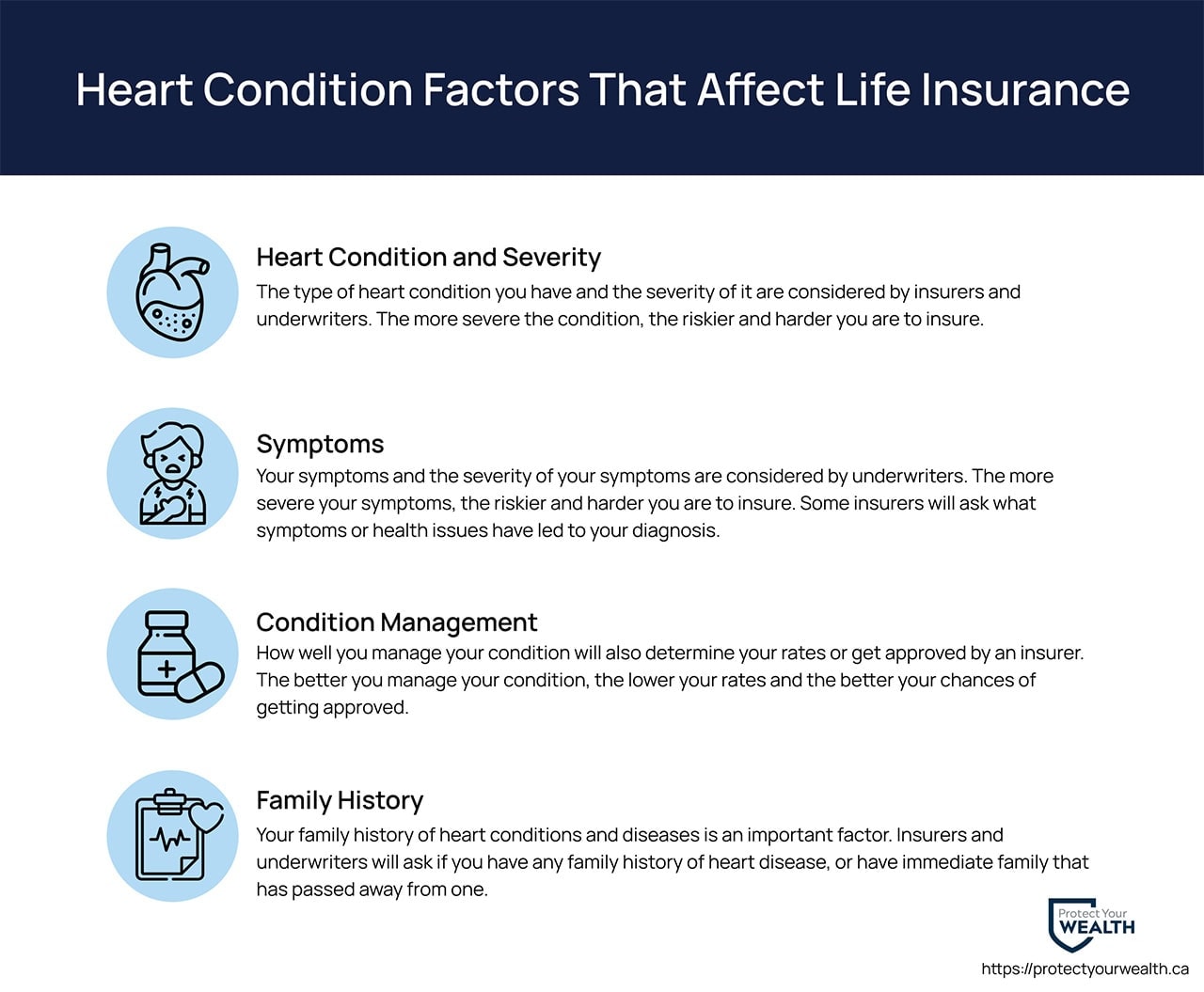
Underwriters don’t just look at your condition name; they examine the pattern and progression of your heart health. Two people with the same diagnosis can have very different risk classifications depending on test results, recovery time, and family history.

Here are the main factors insurers consider when reviewing an application involving heart disease:

  • Diagnosis Type and Severity: Coronary artery disease, arrhythmias, or valve disorders each carry unique levels of risk. Conditions that are mild or well controlled are more favorably viewed.
  • Time Since Diagnosis or Event: The longer it has been since your heart attack, bypass surgery, or stent procedure — and the more stable your test results — the better your chances of qualifying.
  • Current Symptoms and Lifestyle: Factors like chest pain, fatigue, or poor exercise tolerance may indicate ongoing issues, while consistent exercise, balanced diet, and smoking cessation all strengthen your case.
  • Medication Adherence: Consistent use of prescribed medications shows that you are following medical advice and managing your condition responsibly.
  • Family History: Insurers will ask if any immediate relatives have had early-onset heart disease, as this can increase risk classification.

Even with a history of cardiac problems, there are many paths to approval. For example, clients who are 12–24 months post-event with stable results and no recent hospitalizations often qualify for standard or slightly rated coverage with traditional insurers. Those with more recent or complex histories can still access simplified or guaranteed issue policies that require no exams or doctor’s reports.

For individuals managing heart disease with medication and lifestyle changes, presenting a detailed picture of your ongoing care is key. Providing up-to-date test results, specialist follow-ups, and clear evidence of control often helps reduce the rating or avoid a deferral entirely.

💡 Did You Know?

Many Canadian insurers will re-evaluate your rates after two years of proven stability, meaning your premiums could decrease as your heart health improves.

Positive takeaway: The heart condition itself isn’t what determines approval — your recovery story, management, and evidence of improvement do. With guidance from an experienced advisor, it’s possible to secure coverage that fits your needs and budget.

Life Insurance Options After a Heart Attack

Life insurance for heart conditions logo

Experiencing a heart attack doesn’t mean you can’t get life insurance. What matters most is how long it has been since the event, how well your heart has recovered, and whether your treatment and follow-up care are consistent. Insurers across Canada review these factors closely before offering coverage.

The type of life insurance you can qualify for depends on your recovery timeline and the amount of medical evidence you can provide. Here’s how your options generally fall within three major categories:

  • Traditional Life Insurance: Available once you have been stable for 12–24 months with normal follow-up test results. This route provides the best long-term value, but requires a full medical review including an APS, blood work, and cardiac imaging.
  • Simplified Issue Life Insurance: Designed for applicants who are within the first 6–12 months after a cardiac event or prefer not to undergo medical exams. Coverage is based on a short health questionnaire, and approval is typically instant.
  • Guaranteed Issue Life Insurance: Intended for individuals with more recent heart attacks (within 6 months) or significant complications. No medical questions or exams are required, but premiums are higher and coverage amounts are smaller (usually up to $50,000).

Because every case is unique, working with a broker who understands cardiac underwriting patterns can save you time and ensure your application goes to the insurer most likely to approve it. Some companies, such as Canada Protection Plan and Assumption Life, have flexible simplified issue options designed specifically for clients recovering from cardiac events.

Below is a breakdown of what different coverage types typically look like for post–heart attack applicants based on current insurer trends and recovery timelines.


Table 4: Common Life Insurance Options After a Heart Attack (Canada)
Comparison of underwriting requirements, coverage levels, and eligibility by product type.


Type of CoverageTime Since Heart AttackMedical Evidence RequiredTypical InsurersCoverage Amount Range
Traditional (Medically Underwritten)12–24 months post-eventFull medical, APS, stress test, and echocardiogramManulife, Empire Life, Industrial Alliance$250,000 to $5,000,000+
Simplified Issue3–12 months post-eventShort health questionnaire; no exam or APSCanada Protection Plan, Assumption Life, Beneva$25,000 to $750,000
Guaranteed Issue0–6 months post-event or unstable heart healthNo medical or health questions requiredHumania, Canada Protection Plan$5,000 to $50,000
Hybrid Entry Plans6–18 months post-event (stable improvement)Basic questionnaire + physician note (optional)Industrial Alliance, Assumption Life$50,000 to $500,000
Conversion or Re-entry Plans24+ months post-event with strong recoveryMay reuse existing APS and updated test resultsEmpire Life, IA, Canada Life$100,000 to $1,000,000+
  • Traditional: 12–24 mo post-event; full medical; up to $5M+ (Manulife, IA).
  • Simplified: 3–12 mo post-event; no exam; up to $750K (CPP, Assumption Life).
  • Guaranteed: 0–6 mo post-event; no questions; up to $50K (Humania, CPP).
  • Hybrid Entry: 6–18 mo stable; partial medical; up to $500K (IA, Assumption).
  • Re-entry: 24+ mo stable; reapply with new tests; up to $1M+ (Empire, Canada Life).

How to Get the Right Coverage for Your Situation

Life insurance for heart conditions logo

Finding the right life insurance coverage after a heart condition is about matching your current health and goals with the insurer and product that best fit your recovery profile. The process should never feel rushed — the right timing, plan type, and submission strategy can make the difference between an approval and a decline.

Start by identifying your coverage goal: protecting family income, covering debts, or securing legacy funds. From there, your advisor will review your cardiac history, medication list, and test results to determine which type of policy aligns best with your situation and time since diagnosis.

  • For recent cardiac events (within 12 months): Simplified or guaranteed issue plans provide immediate peace of mind with no exams or long wait times.
  • For stabilized conditions (1–2 years post-event): You may qualify for traditional policies with better rates and higher coverage limits.
  • For long-term recoveries (2+ years of normal results): Re-entry with major carriers like Manulife or Industrial Alliance can restore standard pricing and full underwriting options.

When comparing options, consider both short-term affordability and long-term flexibility. For example, many clients start with a simplified plan for early protection, then transition to an underwritten policy once stability is proven. This approach ensures you’re covered throughout your recovery journey without paying more than necessary.

Here are three key steps to maximize your approval success:

  1. Gather your medical documentation: Get updated reports from your cardiologist before applying. This reduces delays and builds underwriter confidence.
  2. Work with a specialized advisor: Choose an advisor familiar with heart-related underwriting. They’ll know which companies are most receptive to your condition.
  3. Review annually: As your health improves, your advisor can request re-underwriting or rate reconsideration to lower your premium.

Protect Your Wealth advisors specialize in guiding Canadians with heart histories through this process — from selecting the best-fit product to ensuring your health records are positioned for approval. You don’t have to navigate this alone; expertise can save both time and money.

💡 Did You Know?

Some insurers will reconsider your case every 12 months, meaning a well-timed reapplication could reduce your rates by up to 30% once your recovery is verified.

Positive takeaway: With a well-prepared file and advisor guidance, even a past heart attack or procedure doesn’t have to prevent you from obtaining affordable life insurance in Canada. The right approach opens doors that may seem closed at first glance.

Case Studies

🧑‍💼Case 1: Robert, 52, Alberta

Profile: Non-smoker. Heart attack three years ago. On beta blockers and cholesterol medication. Stable test results and active lifestyle.

  • Problem: Needed $500,000 of coverage to protect his family but was declined two years prior due to recency of cardiac event.
  • Approach: Provided updated echocardiogram and stress test showing normal function. Broker submitted application to Industrial Alliance after 36 months of stability.
  • Resolution: Approved for traditional Term 20 at a mild 50% rating, much lower than expected. Coverage effective within 5 weeks.

Takeaway: Demonstrating long-term recovery and consistent follow-up care can significantly improve rates even after a previous decline.

👩‍🔬Case 2: Linda, 45, Ontario

Profile: Smoker. Atrial fibrillation controlled with medication. Normal echocardiogram for 2 years.

  • Problem: Needed affordable coverage for a mortgage but worried about smoker status and heart history leading to automatic decline.
  • Approach: Advisor positioned her case to Assumption Life for a simplified issue plan with AFib acceptance criteria. Submitted cardiologist report and medication log for review.
  • Resolution: Approved instantly for $250,000 simplified issue term at standard smoker rates. No medical exams required.

Takeaway: Simplified issue plans can bridge the gap for controlled heart rhythm conditions and allow full coverage even for smokers.

FAQ – Frequently Asked Questions

Can I get life insurance if I’ve had a heart attack?

Yes. Many Canadians qualify for life insurance after a heart attack once their recovery is stable. Most insurers require at least 6–12 months of follow-up with normal cardiac test results before considering full underwriting.

How soon after heart surgery can I apply for life insurance?

It depends on the surgery type. For bypass surgery, most insurers require 12–24 months of stability. For stents or valve repair, applications are often accepted after 6–12 months if tests show good recovery and no new symptoms.

Will I need a medical exam?

Not always. Simplified and guaranteed issue policies don’t require exams or lab work. Traditional coverage does, but submitting recent cardiac test results can help speed approval and avoid duplicate testing.

Which insurers are best for heart conditions in Canada?

For simplified issue, Canada Protection Plan, Assumption Life, and Industrial Alliance are leaders. If your condition has been stable for more than two years, Manulife and Empire Life offer competitive underwritten options.

How much will life insurance cost after a heart attack?

Premiums depend on age, recovery time, and medical results. A 50-year-old applicant two years post–heart attack might expect rates about 25–75% higher than standard, though costs often decrease after several years of stable test results.

Can I switch policies after recovery?

Yes. Many clients start with a simplified policy for immediate protection and later transition to a traditional plan once their health improves. Re-underwriting after 12–24 months of stability can lower premiums significantly.

Does medication affect my eligibility?

Not necessarily. Common heart medications such as beta blockers, statins, or ACE inhibitors are viewed positively because they indicate consistent medical management. Missed prescriptions or frequent dosage changes can delay approval, though.

Can smokers with heart conditions get life insurance?

Yes, but rates will be higher. Simplified issue plans like Assumption Life’s Golden Protection and CPP’s No Medical Life Choice are good options for smokers with stable heart health and consistent medication use.

Does family history of heart disease affect premiums?

It can. A history of early cardiac events (before age 55 for men, 65 for women) in immediate family may slightly raise your rate class, though strong personal health management often offsets this risk.

Can I get coverage if I’m awaiting test results?

Yes, through no medical life insurance. Guaranteed issue policies allow approval without waiting for new test results, giving temporary protection while your medical file updates.

Finding the right life insurance for you

Whether you’re actively treating and living with your heart condition or think you are at risk of developing one, you can still find affordable life insurance for any situation you may have. Working with a life insurance advisor can help you create the perfect life insurance plan and package for your needs.

At Protect Your Wealth, we work with and compare policies and quotes from the best life insurance companies in Canada to create the best solution for you and your needs. We’ve been providing expert life insurance solutions since 2007, including no medical life insurance, term life insurance, and permanent life insurance, to build the best package to give you the protection you need.

Contact Protect Your Wealth or call us at 1-877-654-6119 to talk to an advisor today! We’re proudly based out of Hamilton, and service clients anywhere in Ontario, British Columbia, Alberta, and Manitoba including areas such as Ancaster, Richmond, Red Deer, and Winnipeg.

Talk to an advisor today.

Best Life Insurance Quotes Canada