·

TFSA vs RRSP vs FHSA: Which Account Should You Fund First
By Parvesh Benning, Licensed Life Insurance Broker
A Canadian broker's decision tree for TFSA, RRSP, and FHSA: which account to fund first based on income, employer benefits, and home-buying plans.
Three registered accounts carry most of the tax-sheltered savings load in Canada: the TFSA, the RRSP, and the FHSA. The decision that matters isn't which one is best. It's which to fund first when you can't max all three at once. This guide covers how the three accounts differ, a broker's funding-priority framework, and a calculator that runs your situation through the decision tree.
Updated: April 24, 2026

TFSA vs RRSP vs FHSA: Which Account Should You Fund First
By Parvesh Benning, Licensed Life Insurance Broker
A Canadian broker's decision tree for TFSA, RRSP, and FHSA: which account to fund first based on income, employer benefits, and home-buying plans.
Three registered accounts carry most of the tax-sheltered savings load in Canada: the TFSA, the RRSP, and the FHSA. The decision that matters isn't which one is best. It's which to fund first when you can't max all three at once. This guide covers how the three accounts differ, a broker's funding-priority framework, and a calculator that runs your situation through the decision tree.
Updated: April 24, 2026
A Canadian broker's decision tree for TFSA, RRSP, and FHSA: which account to fund first based on income, employer benefits, and home-buying plans.
Three registered accounts carry most of the tax-sheltered savings load in Canada: the TFSA, the RRSP, and the FHSA. The decision that matters isn't which one is best. It's which to fund first when you can't max all three at once. This guide covers how the three accounts differ, a broker's funding-priority framework, and a calculator that runs your situation through the decision tree.
Inside: how the three accounts differ in tax treatment, contribution limits, and withdrawal rules, plus sequencing logic for first-time buyers, employer-matched RRSPs, and every income bracket from entry-level to top-tier.
Which Account Should You Fund First?
Answer five questions. Get a ranked funding order based on a Canadian broker's real decision tree.
Bracket context: middle income, typical of many Canadians.
First-time means you haven't owned or lived in a qualifying home you owned this year or the previous four calendar years.
FHSA has a 15-year account lifespan. If you're unsure, TFSA flexibility often wins.
Includes group RRSP matching or employer stock option matching. Even a partial match counts.
FHSA eligibility ends at age 71. RRSPs must convert to a RRIF by the end of the year you turn 71.
Sections in this guide
- How TFSA, RRSP and FHSA Tax Treatment Actually Differs
- Contribution Limits, Withdrawal Rules and Eligibility Compared
- Which Account Should You Fund First (and Why Most Canadians Get It Wrong)
- How All Three Accounts Work Together for First-Time Home Buyers
- RRSP Types: Individual, Spousal, Group and Self-Directed
- What Happens to Your RRSP and TFSA in Retirement and After Death
- Frequently Asked Questions
How TFSA, RRSP and FHSA Tax Treatment Actually Differs
Each of these three accounts handles tax at a different point: when money goes in, while it grows, and when you take it out.
The way I explain it to clients is straightforward. The TFSA gives you nothing going in, but everything comes out tax-free. The RRSP lets you deduct contributions now but taxes withdrawals later. And the FHSA? You get the deduction of an RRSP while withdrawing from it is like a TFSA. It's sort of a hybrid between the two. That combination is what makes it so powerful for anyone saving for a first home.
| TFSA | RRSP | FHSA | |
|---|---|---|---|
| Contributions | After-tax (no deduction) | Tax-deductible | Tax-deductible |
| Growth | Tax-free | Tax-sheltered | Tax-free |
| Withdrawals | Tax-free | Taxable as income | Tax-free (qualifying) |
| Repayment required | No | Yes (HBP and LLP) | No |
The size of your RRSP tax refund depends entirely on your marginal rate. At $45,000 income you're getting roughly 20 cents back on every dollar you contribute. At $150,000 or above, that same dollar can return more than 50 cents. That gap is exactly why RRSP contributions don't carry the same weight at every income level.
The TFSA works the other way around. No tax break on the way in, but withdrawals are completely tax-free and don't count as income on your return. They won't reduce your OAS, GIS, or any income-tested government benefits in retirement either. For someone in a lower bracket who needs access to their money without penalties, that flexibility often matters more than a modest refund.
The FHSA sits between the two. Contributions reduce your taxable income the same way an RRSP does, and qualifying withdrawals for a first home come out completely tax-free with no repayment schedule. The catch: it's only available to first-time buyers, and the account has a 15-year lifespan. If you never purchase, the balance transfers to your RRSP without tax or penalty.
Contribution Limits, Withdrawal Rules and Eligibility Compared
The TFSA currently allows $7,000 per year with cumulative room of $109,000, the RRSP caps at 18% of prior-year earned income to a maximum of $33,810, and the FHSA allows $8,000 annually up to a $40,000 lifetime maximum.
TFSA
Annual limit: $7,000
Cumulative room: $109,000
Withdrawals: Tax-free, any time, any purpose. No repayment.
Eligibility: 18+, Canadian resident, valid SIN
RRSP
Annual limit: 18% of prior-year income (max $33,810)
Deadline: First 60 days of new year counts for prior tax year
Withdrawals: Taxable as income. HBP exception: up to $60,000 for a first home.
Eligibility: Canadian resident, contribute until Dec 31 of the year you turn 71
FHSA
Annual limit: $8,000 (lifetime max $40,000)
Lifespan: 15 years from opening or age 71, whichever comes first
Withdrawals: Tax-free for qualifying first home. No repayment required.
Eligibility: 18+, Canadian resident, not owned or lived in a qualifying home in current year or previous 4 calendar years
Before I recommend any of these, I need to know three things. What do you want the money for? What's your timeline? And what does your cashflow look like right now? If you're carrying credit card debt at 18% or above, the best return on your money is paying that down first. No savings account beats that rate.
One detail that catches newcomers: contribution room is set when you become a tax resident in Canada, not when you become a permanent resident. If you arrived mid-year, your room starts from that date. For the FHSA specifically, first-time buyer means you haven't owned or lived in a qualifying home you owned in the current year or the previous four calendar years. That's a wider window than "never bought a home" suggests.
All three accounts carry forward unused room, but differently. TFSA and RRSP room accumulates year over year with no expiry, which is why starting a retirement savings plan early matters even if contributions are small right now. FHSA room only begins accumulating once you actually open the account. Opening one early, even with a minimal first deposit, gets the carry-forward clock running.
Which Account Should You Fund First (and Why Most Canadians Get It Wrong)
If your employer matches RRSP contributions, that match is always priority one regardless of your income or home-buying plans.
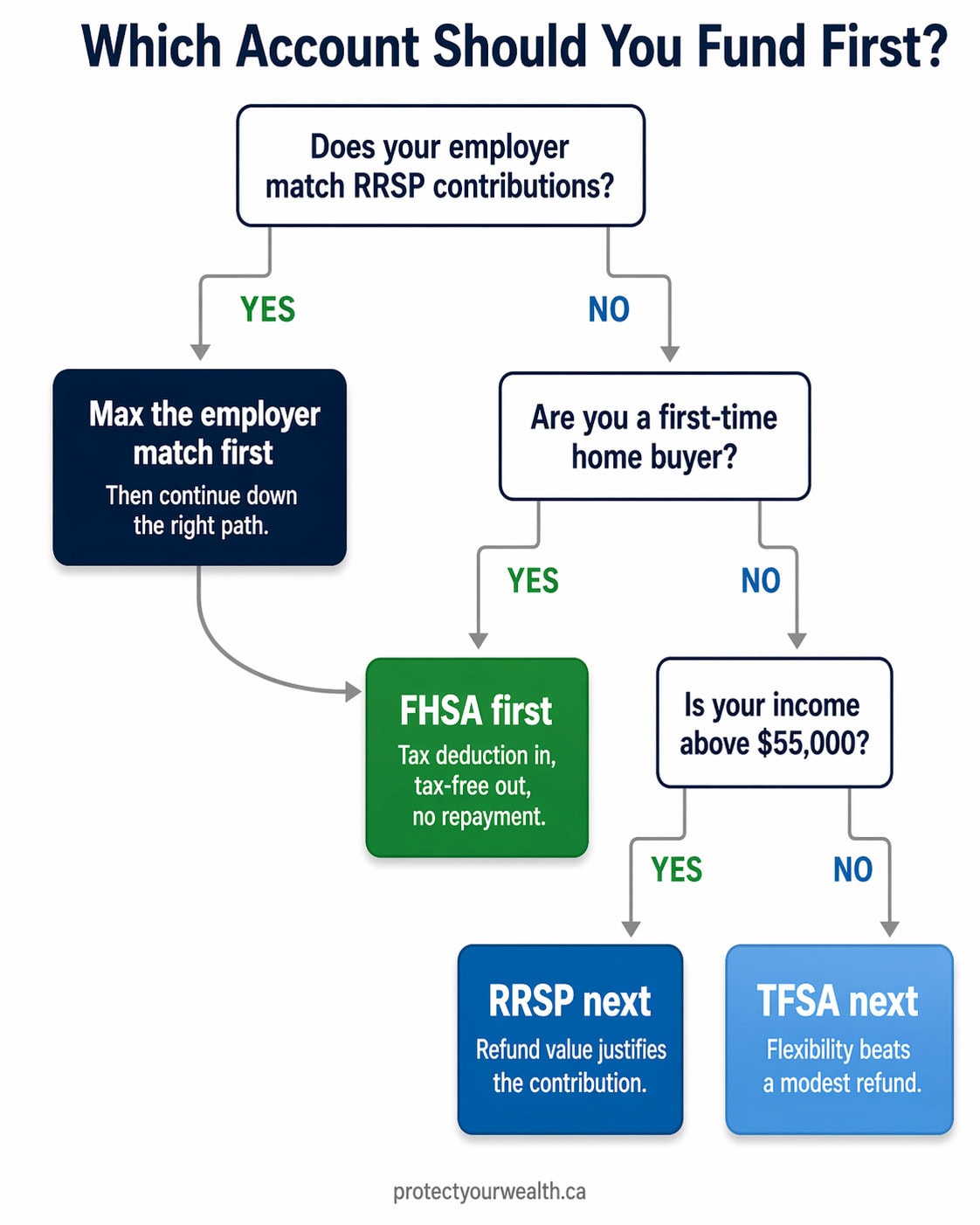
Take the free money. Whether it's a dollar-for-dollar match or even a 30% match on contributions, max that out before anything else. I feel the same way about RESPs where the government gives a 20% grant. Free money always wins.
Once the match is captured, the next question is whether you're buying your first home. If the answer is yes and you have a timeline inside 15 years, the FHSA should be the first tool utilized without a doubt. It gives you the refund of an RRSP without having to repay it.
Broker's funding order
Step 1: Employer match available? Max it out. Always first.
Step 2: First-time buyer with a purchase timeline? FHSA.
Step 3a: Income under $55,000 and not buying? TFSA carries the weight.
Step 3b: Income over $55,000 and not buying? RRSP refund value kicks in.
Under $50,000 income, if you have TFSA room, I lean heavily toward a TFSA contribution first and foremost. The RRSP refund at that bracket is modest. Maybe 20 cents on the dollar. Banks have done a great job of really ingraining in clients that they should contribute to their RRSP regardless. At lower incomes the math just doesn't support it.
Someone earning a few hundred thousand, highest bracket, no pension, that's a different story. A contribution for them could yield more than 50% return on that money. That's significant. And you can use the refund to top up your TFSA after, so you're doing one and then feeding the other.
When a client comes in already maxing their RRSP at $45,000 income while their TFSA and FHSA sit empty, the reality is we can't go back in time. We can only look forward. Having $45,000 in savings is still a great accomplishment. It's just about optimizing from here. Where does the next dollar go to give us the best return?
There's never a "you have to do this." That's why most financial advice for young adults oversimplifies the question. It's about analyzing what makes sense and evaluating both the upside and the downside. The RRSP contribution is great, the refund is real, the sheltered growth matters. But it comes with downsides if you need liquidity or you're still in a low bracket. It's always an individualized solution.
Not sure where your next dollar should go?
Run your numbers through the calculator above, or skip straight to a conversation with a licensed broker who does this every day.
How All Three Accounts Work Together for First-Time Home Buyers
A first-time buying couple can stack all three accounts to put over $180,000 in tax-advantaged dollars toward a down payment in under five years.
The sequence matters though. Max out the FHSA first. $8,000 for both of you, that's $16,000 a year. We're trying to max out that amount each, first and foremost. It gives you the refund of an RRSP without having to repay it. From there, once the FHSA is maxed, then we look at the RRSP through the Home Buyers' Plan.
Couple scenario: combined income $130,000, buying in 4 years
FHSA: $8,000/yr x 2 people x 4 years = $64,000 (tax-free, no repayment)
HBP from RRSP: Up to $60,000 x 2 = $120,000 (repaid over 15 years back into RRSP)
TFSA: Fully accessible for closing costs, moving, or any gap in the down payment
Combined down payment potential: up to $184,000+ in 4 years
The FHSA portion is the cleanest money in that stack. No repayment, no tax on withdrawal, no impact on future RRSP room. The HBP adds serious volume but it does need to be repaid into your RRSP over 15 years. Miss a repayment and that year's portion gets added to your taxable income. Two very different commitments.
Does it make sense to do a spousal RRSP in this scenario or not? Depends on the income split. If one partner earns significantly more, contributing to a spousal RRSP before using the HBP can equalize the tax hit on the repayment side. Worth running the numbers before defaulting to individual accounts.
If plans change and the purchase doesn't happen, FHSA contributions aren't lost. The full balance transfers to your RRSP without tax or penalty. And once a couple does buy and the FHSA closes, many redirect that $16,000 annual savings rhythm toward an RESP if children are in the picture. Same discipline, different account.
RRSP Types: Individual, Spousal, Group and Self-Directed
Not all RRSPs work the same way. Canada has four types, and the differences affect who contributes, who controls the investments, and how the tax benefit is shared.
Most people end up with more than one. A group RRSP through work to capture the match, plus an individual or self-directed RRSP for the additional contributions where you want broader investment options. If there's a significant income gap in the household, a spousal RRSP on top of that reduces the combined tax bill in retirement.
What Happens to Your RRSP and TFSA in Retirement and After Death
In retirement, your RRSP must convert to a RRIF by the end of the year you turn 71, with mandatory minimum withdrawals each year that are fully taxed as income. Your TFSA has no conversion deadline, no forced withdrawals, and no tax on anything you take out.
You can structure your RRIF so you're getting an amount paid monthly, and you can specify how much income tax is being withheld on each payment. That gives you predictable cashflow. But big RRSP withdrawals can have impact on your OAS. Draw too much from your RRIF in a given year and it may scale back your Old Age Security payments. The TFSA doesn't trigger any of that. Withdrawals from a TFSA are invisible to the OAS clawback calculation.
That distinction alone changes how many retirees should be drawing down their accounts. If you have both a RRIF and a TFSA, pulling from the TFSA first in years where your RRIF minimum already pushes you near the OAS threshold can save thousands.
The inheritance problem
On death, the full remaining value of your RRSP or RRIF is added to your final tax return as income. On a $1,000,000 balance, roughly 53.5% can go to taxes. Your estate pays that bill before beneficiaries see a dollar. A spousal rollover defers this, but does not eliminate it.
The life insurance offset
A permanent life insurance policy pays out a tax-free death benefit that can cover the RRSP tax bill entirely. The estate stays intact for beneficiaries. Combined with segregated fund advantages like creditor protection and probate bypass, this creates a more complete estate plan.
The TFSA has none of these problems. On death, the full balance passes to your named beneficiary or successor holder tax-free. No final return inclusion, no clawback, no estate tax bill. That's one of the reasons I advise clients to have named beneficiaries on their TFSA. The distinction between a successor holder and a named beneficiary matters for flexibility, and it's worth a conversation with your broker to get the designation right.
Frequently Asked Questions
Q1
Can I contribute to a TFSA, RRSP, and FHSA at the same time?
Yes. There is no restriction on holding or contributing to all three simultaneously. The question is sequencing: which one gets your next dollar depends on your income, whether you're buying a home, and whether your employer matches RRSP contributions.
Q2
What is the current TFSA contribution limit?
The annual limit is $7,000. Cumulative room for someone eligible since 2009 is $109,000 as of 2026. Your actual room depends on when you became a Canadian tax resident and what you've contributed to date. Log into CRA My Account to confirm your exact available room.
Q3
Does FHSA contribution room carry forward?
Yes, but only after you open the account. Unused room from one year carries forward to the next, up to a maximum of $8,000 in carry-forward per year on top of your annual $8,000 limit. The catch: carry-forward does not start accumulating until the year you actually open the FHSA. Open it early, even with a small first deposit, to get the clock running.
Q4
Are FHSA contributions tax deductible?
Yes. Fully deductible, same as RRSP contributions. You can also carry the deduction forward to a future year if you expect to be in a higher tax bracket later. One difference from the RRSP: contributions within the first 60 days of a new year do not count for the prior tax year.
Q5
Can I open an FHSA on a work permit?
You need to be a Canadian tax resident with a valid SIN. A work permit holder who files Canadian taxes qualifies. Contribution room is set when you become a tax resident in Canada, not when you become a permanent resident.
Q6
Can I transfer my RRSP to an FHSA?
No. The transfer only works in the other direction. If you don't use your FHSA to buy a home, the balance can transfer directly to your RRSP without tax or penalty and without affecting your RRSP contribution room. You cannot move existing RRSP money into an FHSA.
Q7
What is the difference between an RRSP and an RESP?
Different purpose, different rules, different government incentive. An RRSP is a retirement savings plan where contributions are tax-deductible and withdrawals are taxed as income. Combined with the Canada Pension Plan, it forms the core of most Canadians' retirement income. An RESP is an education savings plan for a child's post-secondary education where the government adds a 20% grant on the first $2,500 contributed each year.
Q8
Can I use the FHSA and Home Buyers' Plan together?
Yes. You can withdraw from both your FHSA (tax-free, no repayment) and your RRSP through the HBP (up to $60,000 per person, repayable over 15 years) for the same home purchase. Per person, that is up to $100,000 in registered account money toward a down payment. For a couple, up to $200,000.
Q9
What happens to my FHSA if I never buy a home?
The balance transfers directly to your RRSP without tax, penalty, or using up your RRSP contribution room. This must happen before the account's 15-year lifespan expires or by the end of the year you turn 71. If you miss both deadlines, remaining funds become taxable on withdrawal.
Q10
Should I pay off debt before contributing to registered accounts?
If you are carrying credit card debt at 18% or higher, paying that down first is usually the best return on your money. No tax-sheltered account reliably returns 18% per year. Once high-interest debt is cleared, redirect those payments into whatever account fits your situation. Low-interest debt like a mortgage at 4 to 5% is a different conversation, and often you can contribute and carry that debt at the same time.