·

Life Insurance for Seniors in Canada (2026)
By Parvesh Benning, Licensed Life Insurance Broker
Most seniors can get life insurance in Canada. The real question is which product fits your age, health, and budget, and how to avoid the ones that look good in an ad but cost you later.
Updated: March 9, 2026

Life Insurance for Seniors in Canada (2026)
By Parvesh Benning, Licensed Life Insurance Broker, Updated: May 28, 2026
Most seniors can get life insurance in Canada. The real question is which product fits your age, health, and budget, and how to avoid the ones that look good in an ad but cost you later.
Most seniors can get life insurance in Canada. The real question is which product fits your age, health, and budget, and how to avoid the ones that look good in an ad but cost you later.
This guide walks through every product type available after 60, what coverage actually costs by age, and the order I work through carriers to land a client on the right plan. Good health, a managed condition, or a past decline: there is almost always a path that works, and the rest of this page shows you which one fits.
Jump ahead:
- Reasons Seniors Buy Life Insurance
- How Much Coverage Do You Need
- Types of Life Insurance for Seniors
- Simplified vs. Guaranteed Issue
- How a Broker Routes You to the Right Product
- Estate Planning and Final Expense Coverage
- What Happens if Your Application Gets Denied
- Life Insurance Rates for Seniors 60 and Over
- How Health Conditions Affect Rates
- Frequently Asked Questions
Reasons Seniors Buy Life Insurance
Seniors in Canada buy life insurance for four reasons that come up again and again: covering final expenses, clearing debt that would otherwise fall on family, replacing income a spouse still leans on, and leaving a tax-free amount behind.
The conversation almost always starts the same way. What are you trying to protect, and for how long? That answer points to the product. Sometimes it is a small policy for the funeral. Sometimes it is six figures because there is still a mortgage and a spouse who cannot carry it alone.
Final expenses
Funerals run $10,000 to $15,000, sometimes more. A small policy covers it so nobody is scrambling to pay during the worst week of their life.
Debt that outlives you
A mortgage, a line of credit, a car loan. Coverage clears it instead of leaving it for a spouse or the kids to sort out.
Income a spouse relies on
If a pension or your income still supports a partner, life insurance replaces it. For couples, a joint first-to-die policy (it pays out when the first partner dies) is a common way to protect whoever is left.
A tax-free legacy
Some seniors want to leave a set amount to a grandchild, or a final gift to a cause they have backed for years. Couples leaving an estate often use a joint last-to-die policy to do it efficiently.
How Much Coverage Do You Need
How much coverage a senior needs comes down to one question I ask every time: what is the money actually for? The answer sets the amount, not your age and not a formula. A funeral needs a fraction of what an unpaid mortgage does.
Here is the range I see most often, mapped to the job the policy is doing.
| What the coverage is for | Typical amount |
|---|---|
| Funeral and final expenses | $10,000 to $25,000 |
| Leaving an inheritance | $50,000 to $250,000+ |
| Paying off debt (mortgage, line of credit) | Based on the outstanding balance |
| Supporting a spouse or dependent | $100,000 to $500,000+ |
| Covering estate tax or registered-account liability | Varies with the size of the estate |
Final expenses are where most seniors start. A lot of people just want the funeral handled so the family is not dealing with a bill on top of everything else. Others are protecting more: a mortgage that is not gone yet, a spouse who needs the income, an estate with tax exposure on registered accounts or a property. The amount follows the goal. Build it the other way around and you either overpay or come up short.
Types of Life Insurance Available to Seniors in Canada
Seniors in Canada have five main product types to choose from, and the right one depends on your age, your health, and what the coverage is meant to do. Here is how each works and where it fits.
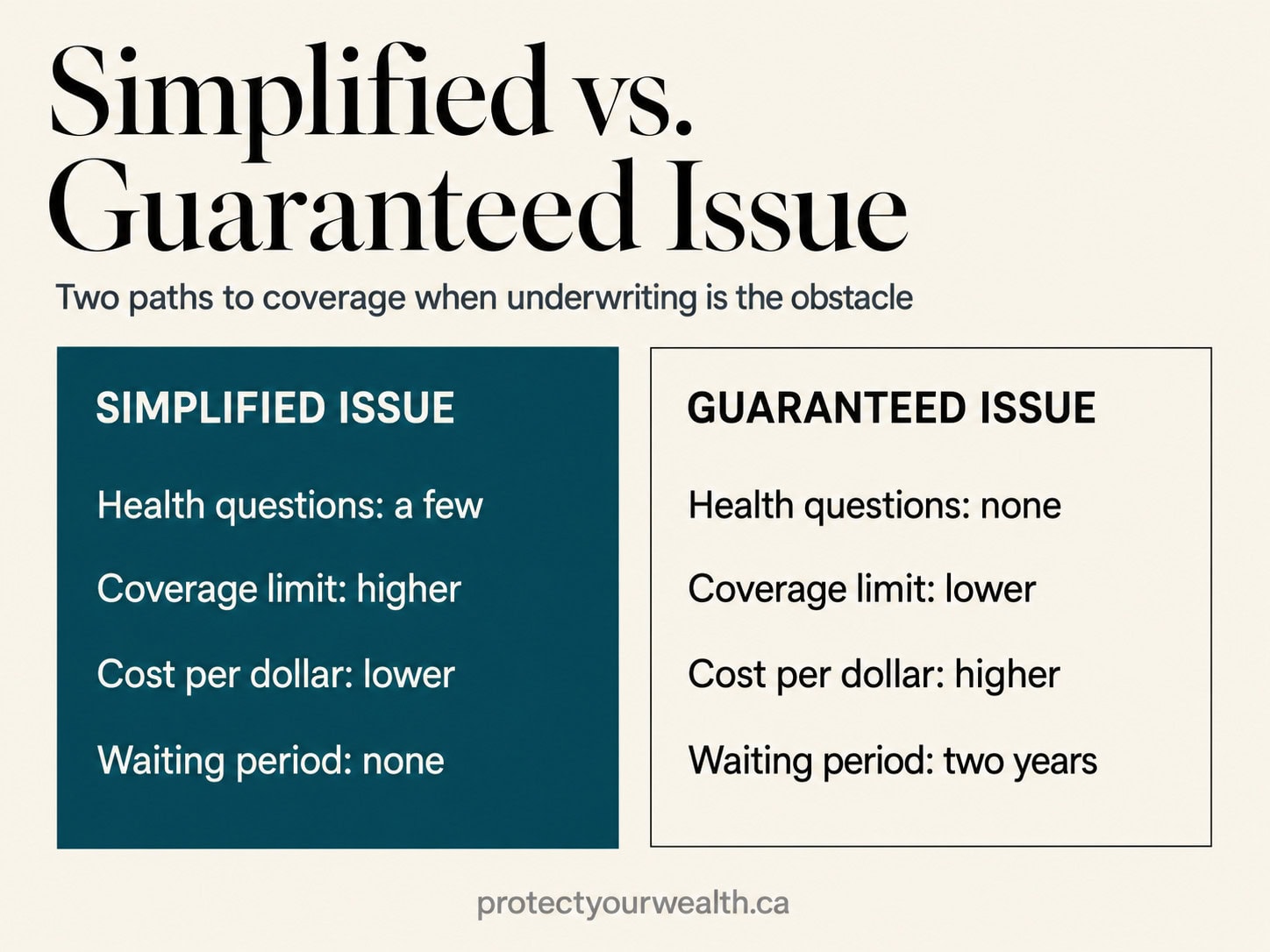
Simplified vs. Guaranteed Issue: Which Is Better?
Simplified issue is almost always the better product if you can qualify for it. Guaranteed issue exists for seniors who cannot pass even a basic health screen, and it carries real trade-offs worth understanding before you commit.
Here is the thing most seniors get wrong. They assume their health will not pass any questions, so they jump straight to guaranteed issue and pay more for less. In my experience, most seniors with managed conditions clear a simplified application just fine.
Simplified Issue
A short set of health questions, no medical exam. If your conditions are stable, you may be surprised how much you qualify for.
Coverage to $250,000 to $500,000 depending on carrier and age. Lower premiums per dollar than guaranteed issue. Benefits payable from day one, no waiting period.
Guaranteed Issue
No health questions, no exam, acceptance guaranteed within the eligible age range. Sounds appealing, but the trade-offs are significant.
Coverage typically capped at $25,000 to $100,000. Higher premiums per dollar. Almost always a two-year waiting period: pass away early and beneficiaries get premiums back, not the full benefit.
On the guaranteed issue side, the ceiling matters. One major carrier currently goes up to $100,000 on its guaranteed product, higher than most. Others cap closer to $25,000 to $40,000. For a senior who genuinely needs GI coverage, that difference is the whole ballgame. But before defaulting there, carriers like Assumption Life and iA run strong simplified options to age 85 that are worth checking first.
So the decision is simple. If you can answer no to a short list of health questions, start with simplified. More coverage, lower premiums, no waiting period. If your health history makes simplified unlikely, guaranteed issue is a solid fallback. Not the ideal product, but some coverage today beats no coverage at all.
Free, no-obligation
Not sure which senior plan actually fits you?
One licensed broker. Over 20 Canadian carriers compared side by side. We find the level-cost policy that matches your age, health, and budget, then tell you straight where you land before anything goes on record.
How a Broker Routes You to the Right Product
When a senior contacts me, I work backwards. I want the cheapest policy that actually fits, so I start at the top and only move down when I have to. Three steps. Most people stop at step two.
1
Fully underwritten
Medical questions, sometimes a nurse visit. Lower premiums, higher limits. Best for a healthy senior in their early 60s. Skip it if a rating or decline is likely.
2
Simplified issue
Where most of my senior clients land. A few health questions, no exam, fast approval. Coverage up to $250,000 to $500,000. Benefits from day one.
3
Guaranteed issue
Last resort. No questions, guaranteed acceptance, but higher cost, lower limits, and the first two years pay back premiums only.
The carriers I lean on most for step two are Assumption Life, Canada Protection Plan, Industrial Alliance (iA), and Beneva. Each one weighs health conditions differently, and knowing those differences is the whole job.
Here is what I see when seniors shop alone. They land in products that look good in an ad but are not. Premiums that climb every year. Fine print that bites a decade in. The common thread is a premium that does not stay level, and the loudest advertisers often have the weakest structures. I broke that down in our post on the hidden costs behind heavily advertised senior policies.
One last thing, and I push hard on this. Do not wait for your health to improve before applying. The risk is today, not in six months. A new condition can close a door that is open right now. Get covered now, and if your health improves later, we reassess. Think of it as a bridge.

Estate Planning and Final Expense Coverage for Seniors
Most seniors do not understand their own tax liability at death: how it works, or which assets actually get taxed. That is the gap life insurance fills better than almost anything else. It drops a tax-free lump sum into your estate at exactly the moment the estate needs cash.
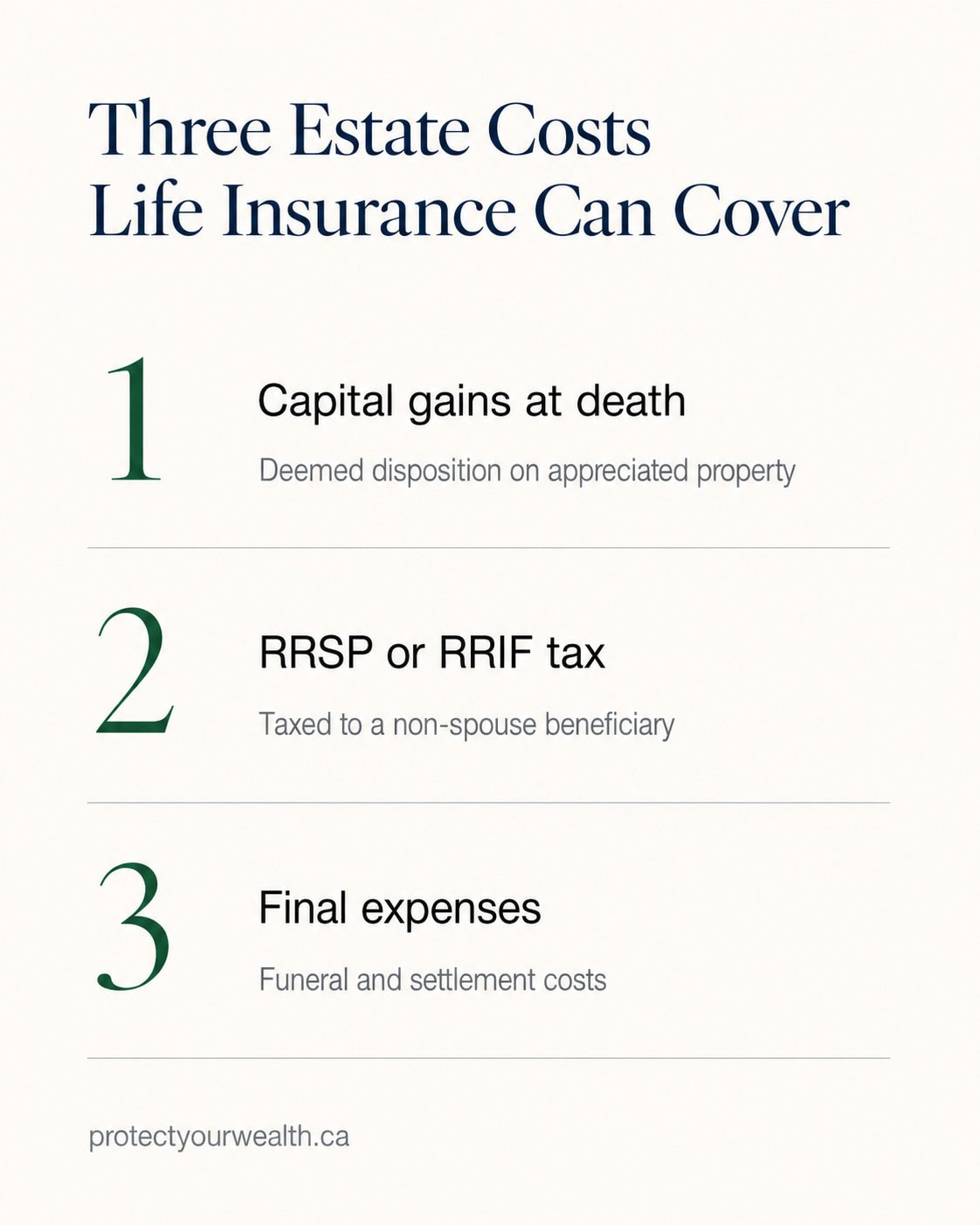
The piece that catches people off guard is what the CRA does with capital gains when you die. Own a cottage, a rental, or non-registered investments that have grown in value? The CRA treats it as a deemed sale on the day you pass, as if you sold everything that morning. The tax bill lands on the estate before a dollar reaches your heirs. Insurance is often the cleanest way to cover it without forcing the family to sell the cottage they wanted to keep.
Where the tax actually hits
Registered accounts. An RRSP or RRIF passing to a non-spouse beneficiary gets added to your income in the year of death. The whole remaining balance, taxed at once. A policy structured for this offsets the hit and preserves the inheritance you meant to leave. The CRA explains the mechanics in its guide on the death of an RRSP annuitant.
Capital property. Cottages, rentals, and non-registered gains are deemed sold at death. The estate pays the gain. Insurance covers it so assets stay in the family.
Not sure what your own registered accounts would cost the estate? Run your numbers through the calculator below to see the tax bill your RRSP, RRIF, or LIRA could trigger at death.
Final expenses are simpler but just as real. A funeral runs $10,000 to $15,000 and it needs paying fast. A small simplified or guaranteed issue policy earmarked for it keeps that off the family during a hard week.
One last piece people skip: pair the policy with a current will and clean beneficiary designations. A policy with no named beneficiary falls into the estate, which means probate delays and possible legal costs before the money lands where you wanted. Getting those details right is part of the conversation I have with every senior client. It is also why I lean on joint last-to-die policies for couples planning an estate transfer, since they are often the most efficient way to fund that future tax bill.
Registered Assets at Death Calculator
See how much of your RRSPs, RRIFs, LIRAs, LIFs, and pension will be lost to income tax at death, and how permanent life insurance can cover the bill so your family receives the full value.
Using Tax Year 2026 Information
Tax data last verified April 2026. Sources: CRA T4127 Payroll Deductions Formulas, KPMG Personal Tax Tables (Jan 2026), TaxTips.ca, provincial budget documents.
Enter current values. If you have multiple accounts of the same type, enter the combined total. Leave blank any that do not apply.
Only if you have a defined benefit pension and would take a lump-sum commuted value at death rather than rolling to spouse.
Calculator assumes the full registered balance is deemed income in the year of death.
Includes CPP, OAS, pension income, and any employment or investment income earned in the year of death before the deemed disposition. Leave at $0 if the client is fully retired with no other taxable income.
This is the single biggest factor. Flipping this dropdown can shift your family from near-zero tax to maximum tax.
What Happens if Your Life Insurance Application Gets Denied
A denial is not a dead end. It is a routing problem. The question was never whether you can get coverage, it is which product and carrier fit your actual situation. That is a different conversation than most seniors expect when they call me after a decline.
Applications get denied for a handful of reasons: missing or inaccurate information, applying outside a policy’s age limits, asking for more coverage than your income or net worth supports, or health answers that raise a flag. The other common triggers are worth knowing, and each one has a path around it.
What most seniors do not know: every formal application you submit gets recorded on your file with the Medical Information Bureau (the shared database insurers use). Stack two or three declines and the next application gets harder, not easier.
So the first thing I tell anyone who has been declined: do not just reapply somewhere else without understanding why. Find the exact reason first. Sometimes it is a small fix. Sometimes it means a different product entirely.
That is where working with a broker makes a real difference. A broker can do a preliminary assessment before anything goes on record. I contact underwriting directly with your general profile, no names, completely anonymous, and get a read on where you would likely land before submitting a formal application. That protects your file and gives you a realistic picture before you commit.
If fully underwritten coverage is not available, simplified issue is usually the next step. Carriers like Assumption Life, Canada Protection Plan, and iA build simplified products specifically for health histories that do not fit standard underwriting. Guaranteed issue is the fallback if simplified is also off the table. Either way, coverage is almost always available. It is just a matter of finding the right fit.
Life Insurance Rates for Seniors in Canada
Fully underwritten term rates: seniors aged 60-75
Here are sample monthly premiums for non-smoking Canadian seniors for a 10-year term with $100,000 in coverage through fully underwritten plans. These rates assume standard health classification. If you have health conditions, your actual rate may differ depending on the carrier and product type.
Female monthly premiums:
| Insurance Company | Age 60 | Age 65 | Age 70 | Age 75 |
|---|---|---|---|---|
| Empire Life | $37.98 | $60.75 | $104.76 | $259.74 |
| Assumption Life | $39.60 | $63.63 | $110.70 | $261.72 |
| BMO | $39.42 | $64.44 | $110.88 | $262.53 |
| Canada Life | $40.37 | $65.23 | $115.76 | $205.45 |
Male monthly premiums:
| Insurance Company | Age 60 | Age 65 | Age 70 | Age 75 |
|---|---|---|---|---|
| Empire Life | $50.67 | $81.09 | $150.66 | $312.93 |
| Assumption Life | $54.36 | $86.22 | $161.64 | $329.67 |
| BMO | $54.36 | $86.85 | $163.53 | $336.87 |
| Canada Life | $55.38 | $88.38 | $172.56 | $336.92 |
protectyourwealth.ca
A few things worth noting here. Monthly premiums jump significantly between age 70 and 75, particularly for males. If you’re approaching 70 and considering term, locking in sooner rather than later makes a meaningful cost difference. Canada Life shows an unusually low female rate at age 75 compared to the other carriers, which is worth flagging when shopping at that age specifically.
Simplified issue term rates: seniors aged 60-75
Here are sample monthly premiums for non-smoking Canadian seniors for a 10-year term with $100,000 in coverage through simplified issue plans. No medical exam or nurse visit required. These rates assume no serious health conditions that would trigger a decline on the simplified application.
Female monthly premiums:
| Insurance Company | Age 60 | Age 65 | Age 70 | Age 75 |
|---|---|---|---|---|
| Assumption Life | $36.50 | $54.68 | $93.60 | $163.26 |
| Canada Protection Plan | $35.01 | $54.68 | $98.96 | Not eligible |
| Beneva | $29.57 | $49.37 | $78.48 | Not eligible |
Male monthly premiums:
| Insurance Company | Age 60 | Age 65 | Age 70 | Age 75 |
|---|---|---|---|---|
| Assumption Life | $44.73 | $75.60 | $143.91 | $278.69 |
| Canada Protection Plan | $46.53 | $79.07 | $154.85 | Not eligible |
| Beneva | $34.92 | $62.06 | $111.42 | Not eligible |
protectyourwealth.ca
A couple of things stand out here. Beneva is consistently the lowest-cost simplified option at ages 60-70, but doesn’t offer simplified term beyond that age. If you’re 75 and need simplified term coverage, Assumption Life is the only carrier in this comparison that goes there. Canada Protection Plan also stops at 70 for simplified term eligibility.
Simplified whole life rates: $25,000 coverage, seniors aged 60-85
Here are sample monthly premiums for non-smoking Canadian seniors for $25,000 in simplified whole life coverage. No medical exam or nurse visit required. This product is permanent, meaning coverage and premiums are fixed for life. These rates are commonly used for final expense planning.
Female monthly premiums:
| Insurance Company | Age 60 | Age 65 | Age 70 | Age 75 | Age 80 | Age 85 |
|---|---|---|---|---|---|---|
| iA | $64.19 | $83.72 | $105.16 | $201.35 | $306.85 | Not eligible |
| Canada Protection Plan | $66.85 | $87.71 | $110.23 | $158.63 | $220.25 | Not eligible |
| Beneva | $67.91 | $84.26 | $123.39 | $177.32 | $246.04 | Not eligible |
| Assumption Life | $69.19 | $89.03 | $116.08 | $166.30 | $230.99 | $407.48 |
Male monthly premiums:
| Insurance Company | Age 60 | Age 65 | Age 70 | Age 75 | Age 80 | Age 85 |
|---|---|---|---|---|---|---|
| iA | $76.23 | $105.66 | $147.71 | $243.05 | $371.00 | Not eligible |
| Beneva | $77.06 | $100.35 | $149.54 | $218.81 | $304.13 | Not eligible |
| Canada Protection Plan | $77.90 | $108.59 | $151.85 | $222.21 | $304.31 | Not eligible |
| Assumption Life | $79.52 | $103.55 | $140.60 | $211.37 | $307.35 | $507.89 |
protectyourwealth.ca
A few things stand out here. iA is the lowest-cost option for females at ages 60-70 but shows a sharp jump between 70 and 75, nearly doubling from $105.16 to $201.35. Canada Protection Plan is consistently competitive at ages 75-80 for females. For males, the carriers are closely priced across all ages. And Assumption Life is the only carrier in this comparison offering simplified whole life coverage at age 85, which matters significantly for seniors shopping in that age range.
How Health Conditions Affect Senior Life Insurance Rates
Most seniors I speak with have at least one health condition, and it almost never means you cannot get coverage. What it means is that product and carrier selection matters more, and walking in blind with a formal application is the wrong first move.
On a fully underwritten plan, the insurer reviews your full medical history. Two seniors with the same diagnosis can get completely different answers at two different carriers. That is not random. It comes down to how each carrier’s underwriting guidelines are written and what they weigh hardest.
Often routes to simplified
Well-managed type 2 diabetes, controlled blood pressure, certain cancers past a waiting period. Carriers like Assumption Life, Canada Protection Plan, iA, and Beneva built products for exactly these histories. No exam, no nurse visit.
May point to guaranteed issue
Some carriers automatically decline applicants on insulin or with recent cardiac surgery, even on simplified plans. Here, guaranteed issue is not a compromise. It is the right product, with a two-year waiting period as the trade.
Before I submit anything formal for a senior with health conditions, I do a preliminary assessment. I contact the carrier’s underwriting desk with a general profile, no names, completely anonymous, and get a read on where they would land. That keeps unnecessary declines off your record, and since stacking declines makes the next application harder, that step matters more than people think.
If you have a pre-existing condition and you are not sure where you would land, the right first step is a conversation with a broker who knows the difference between underwritten, simplified, and guaranteed issue, and which carriers are likeliest to approve your specific profile. That is a different thing than filling out an online form and hoping.
Frequently Asked Questions
Q1
What age is considered a senior when buying life insurance in Canada?
Most Canadian insurers draw the line at 60. That is when rate bands shift, product eligibility changes, and your options start narrowing. I see a lot of clients wait until their early 60s to start thinking about it and then realize they missed a window where premiums were meaningfully lower. If you are 58 or 59 and on the fence, that birthday matters more than most people think.
Q2
What is the maximum age to get life insurance in Canada?
It depends on the product. Fully underwritten term typically stops accepting new applicants at 75. Simplified issue plans from carriers like Assumption Life extend to 85, higher than most. Guaranteed issue generally goes to 80, with a few exceptions. The older you are when you apply, the fewer options and the higher the premiums, so applying sooner matters.
Q3
What is the most affordable life insurance for seniors?
Simplified issue, for most seniors. What frustrates me is how often seniors default straight to guaranteed issue because they assume their health will not pass any questions. In my experience, most seniors with managed conditions (controlled blood pressure, well-managed diabetes, past issues beyond a waiting period) qualify for simplified issue and pay significantly less per dollar of coverage. Guaranteed issue should be the last option you consider, not the first call you make.
Q4
What life insurance is best for seniors?
Best is the wrong question. Right fit is the right one. A 62-year-old in good health has completely different options than a 74-year-old managing two conditions. I work backwards every time: fully underwritten if it makes sense, simplified if the underwriting burden does not, guaranteed issue only if everything else is off the table. The carrier matters as much as the product. Assumption Life, Canada Protection Plan, iA, and Beneva all weigh the same conditions differently. Knowing those differences is where a broker earns their keep.
Q5
What is the two-year waiting period on life insurance?
The two-year waiting period, sometimes called a deferred benefit period, applies to guaranteed issue and some simplified issue plans. If you pass away within the first two years, your beneficiaries receive a return of the premiums you paid, not the full death benefit. After two years, full coverage applies. It is not a reason to avoid these plans entirely, but you need to understand it before signing. If immediate full coverage is a priority, ask specifically about plans with no waiting period.
Q6
Do life insurance premiums increase as you get older?
It depends on the product structure. Term and permanent plans with fixed premiums lock in your rate at the time of application, and it never increases regardless of age or health. That is one of the main advantages of getting covered sooner. Where seniors get into trouble is with yearly renewable products, often the ones advertised most aggressively to seniors. They start with a low premium that climbs every year, sometimes steeply, as you age. Always confirm whether your premium is fixed or renewable before signing anything.
Q7
Can I get life insurance in Canada if I have been declined before?
Yes, in most cases. A decline from one carrier does not mean you are uninsurable. It means that carrier’s underwriting guidelines did not fit your profile. Different carriers weigh conditions differently, and simplified and guaranteed issue products exist specifically for applicants who do not qualify for traditional underwriting. The important thing is to not keep submitting formal applications after a decline. Every formal application goes on your record, and multiple declines make future applications harder. Talk to a broker first, get a preliminary read on where you would qualify, then apply strategically.
Q8
Is life insurance worth it for seniors over 80?
It depends on what you are trying to accomplish. If the goal is final expense coverage (covering funeral costs and leaving something for the family) then yes, it is worth it. A $25,000 simplified whole life policy from Assumption Life is available at 80 and provides permanent coverage with fixed premiums. The monthly cost is higher than it would have been at 70, but the coverage is real and the premium never increases. If the goal is income replacement or large estate planning, the math gets harder at 80 and the options thin out. The conversation is worth having either way.
Finding the Right Life Insurance for Canadian Seniors
The seniors market has more options than most people realize, and more variation between carriers than you would expect. The right product at 65 is often not the right product at 75, and what works for someone in good health looks nothing like what works for someone managing two or three conditions. That is not a reason to feel overwhelmed. It is the reason to work with a broker who knows the differences.
2007
Helping Canadians since
20+
Canadian carriers
0
Bias toward any one company
At Protect Your Wealth, we work across fully underwritten, simplified, and guaranteed issue products. Our job is to find what fits your age, health, and budget, not to push a product that works for us.
Contact Protect Your Wealth or call 1-877-654-6119 to talk to a licensed broker today. We are based in Hamilton and serve clients across Ontario, Alberta, British Columbia, Manitoba, New Brunswick, Nova Scotia, and Saskatchewan, including St. Catharines, Nanaimo, Lethbridge, and Winkler.