

Applying for Life Insurance with a Criminal Record in Canada
Learn how having a criminal record can impact your ability to obtain life insurance in Canada.
18 Minute read
Originally published: July 12, 2021
Updated: March 22, 2024

Applying for Life Insurance with a Criminal Record in Canada
Learn how having a criminal record can impact your ability to obtain life insurance in Canada.
18 Minute read
Originally published: July 12, 2022
Updated: March 22, 2024
Having a criminal record can affect your life in many ways so it’s normal to wonder how it may affect the process of obtaining life insurance. Many Canadian insurers do consider a criminal record when determining life insurance eligibility, premium rates, and coverage amounts. If you want to know how a criminal record might affect you, this guide will outline everything you need to know about applying for life insurance with a criminal record in Canada.
In this article:
- Can I Get Life Insurance With a Criminal Record
- Factors Life Insurance Companies Consider if You Have a Criminal Record
- Life Insurance Companies That Ask Applicants About Criminal Records
- Types of Life Insurance Available to Canadians With Criminal Records
- Disclosing a Criminal Record to an Insurance Provider
- What to Do if Your Application is Denied
- Case Study Examples
- Frequently Asked Questions (FAQs) About Applying for Life Insurance With a Criminal Record
Can I Get Life Insurance With a Criminal Record?
Not too long ago, there was a client we were working with who, after a needs analysis, determined he was interested in applying for a term life insurance policy with a 10 year term so that he could provide financial protection to his family. He was in good health, under 40 years old, and had no pre-existing conditions, meaning he was an ideal candidate for a traditionally written policy with affordable premiums. However, after beginning the life insurance policy application through the insurer he was interested in, he was automatically disqualified. This is because he had a previous criminal record, something that wasn’t mentioned until this point. But not all hope was lost! Now that we had all the information, we were able to help this client be approved for a simplified issue life insurance policy, with the option to apply in the future to a traditionally underwritten policy once more time had passed and his record was less recent.
Thankfully, it is still possible to get life insurance in Canada with a criminal record. That being said, it may be more challenging to obtain coverage with a criminal record. Some candidates may find that depending on the specific circumstances of their criminal record, policy eligibility, coverage maximums, and premium costs may be affected. This is why many candidates apply for policies such as simplified issue or guaranteed issue life insurance as these policies ask fewer questions and are made for more difficult to insure Canadians.
Factors Life Insurance Companies Consider if You Have a Criminal Record
Life insurance companies will generally consider a variety of factors to assess the risk of insuring specific individuals and how strongly each factor is considered can vary between insurers. The main factors that insurance companies consider when evaluating a life insurance application from an individual with a criminal record include:
- Relevant Dates: You may be asked the date the criminal offence took place, when you were charged or if a charge is pending, and any dates related to the start and end of a probation or parole period.
- Relevant Locations: You might be asked what country or province in which the offence occurred and where you were convicted.
- Details About the Criminal Offence: You will likely be asked what you were convicted of with details about the circumstances and nature of the offence.

If you have been convicted of a misdemeanor, you will likely still be eligible for most policies and will not see your premium rates affected. However, if you have been convicted of a felony the life insurance process may become more complicated. If you have been convicted of a felony, whether or not you are affected will depend on specifically how long ago the date of conviction and end of your sentence were. Different life insurance providers will have different standards on how a felony will affect coverage and how long ago these dates must have happened.
If you recently incurred a charge, are on trial for a criminal offence, are currently in jail or prison, or are on parole or probation you are not likely to be eligible for life insurance through most insurers.
Life Insurance Companies That Ask Applicants About Criminal Records
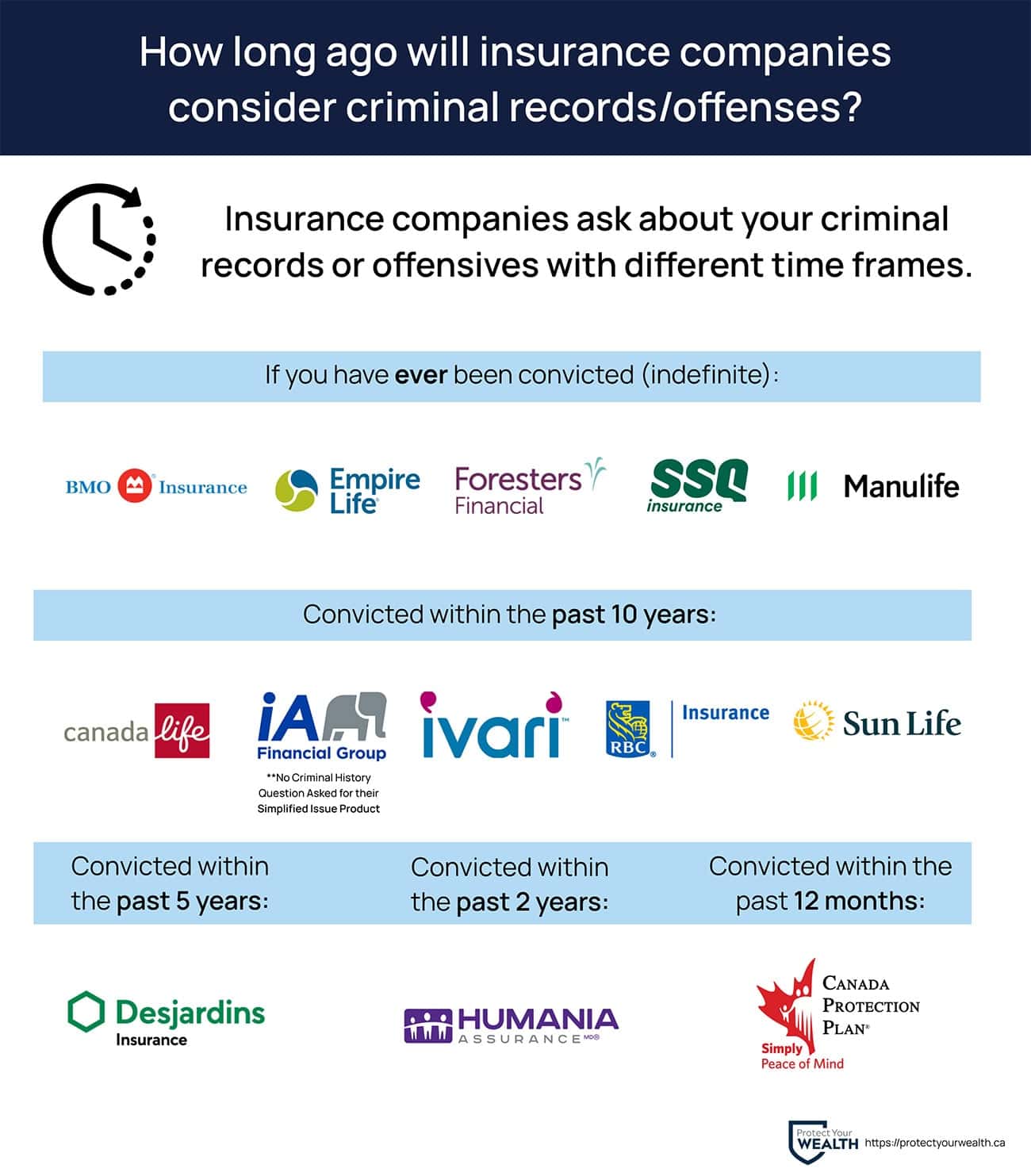
The wording used to ask about previous or current criminal offences can vary between life insurance providers. Some insurers may only ask about any offences within the last 12 months while others may inquire within a time frame of 5-10 years or any criminal offence you’ve committed in your lifetime.
The questions asked by specific insurance providers are as follows:
Beneva (Formerly SSQ Insurance)
“Have you ever been charged with or convicted of a criminal offence? If yes, provide the date, the circumstances, the charge(s), and the sentence (beginning date and date of probation, as the case may be).”
BMO Insurance
“Have you ever been charged or convicted of any criminal offense? (If yes, provide details.)”
Empire Life Insurance Company
“Have you ever had, or been told that you had: been charged with a criminal offense? Other than previously mentioned, have you ever been charged with any criminal offense, or are there any charges pending?”
Foresters Financial
“Have you ever been charged with or convicted of a criminal offence, or is a criminal charge pending?”
Manulife Financial
“Have you ever been charged with any criminal offence? (If yes, provide details, including the nature of each offence, the date charged, the sentence, and the date the sentence and any probation was completed.)”
Canada Life Assurance Company
“Within the past 10 years, have you been convicted of, or charged with, any criminal offences in Canada or elsewhere? Do you have any criminal charges pending? If yes (to either) provide details, dates, and nature of offence(s), prohibition end-date(s), and jail sentence (include exact dates)”
iA Financial Group (Industrial Alliance)
“In the last ten (10) years, have you been incarcerated, charged, or convicted for any criminal offence? For criminal record: Nature of the criminal act, date, type of conviction, probation (start and end date), etc.”
Ivari
“In the last 10 years, have you been convicted of any criminal offence or fraudulent financial charges, or do you have any charges pending? If “yes”, provide reasons(s), date(s), and type(s) of offence(s).”
RBC Insurance
“Has the proposed insured been found guilty of a criminal offence within the last 10 years or are there any criminal charges pending? If yes, please explain fully.”
Sun Life Financial
“In the last 10 years, have you been charged with, convicted of, or imprisoned for any criminal offence; or are you currently on probation, parole, or statutory release?”
Desjardins Insurance
“Within the past 5 years, been convicted or accused of infractions or criminal offences, including driving with a blood alcohol content above the legal limit, or is awaiting trial for such a criminal offence or infraction?”
Humania Assurance
“Have you been convicted of any criminal offence within the past two years?”
Canada Protection Plan (CPP)
“Within the past 12 months, have you been convicted of, awaiting sentencing for, incarcerated for, or on probation for a criminal offence; or do you currently have any criminal charges pending?”
The following chart summarizes which insurers ask about convictions within a time frame of 12 months, 2 years, 5 years, 10 years, and indefinitely:
Types of Life Insurance Available to Canadians With Criminal Records
Depending on the details of your criminal record and which insurer you apply for insurance through, there are different policy types offered that you may qualify for. The standard policy types are traditionally underwritten term life insurance or traditionally underwritten permanent life insurance. However, term and permanent life insurance can also be underwritten as a guaranteed issue or simplified issue life insurance policy, as these policies are tailored for difficult-to-insure individuals.
Which type of life insurance is right for you will depend on your coverage needs and financial goals. The types of life insurance available to Canadians with criminal records are outlined below.
Guaranteed Issue Life Insurance
Guaranteed issue life insurance is a great choice for Canadians who are difficult to insure due to criminal history, medical conditions, hazardous occupations, etc. Unlike traditionally underwritten policies, an attending physician’s statement (APS), medical examination, and medical questions are not required as part of the application process. This type of policy typically does not ask applicants about any criminal offences that occurred more than a year ago and is more concerned with any recent criminal activity that may adversely affect an applicant’s health or insurability. However, because of the increased risk to the insurer, this type of coverage tends to be more costly and offers less maximum coverage than a fully underwritten policy.
Benefits of Guaranteed Issue Life Insurance
- Easier to qualify for than traditional policies
- No medical examination, questions, or APS required
- Shorter waiting periods for approval
- Simplified and more accessible application process
Simplified Issue Life Insurance
Simplified issue life insurance is another great option for difficult to insure Canadians. This is because, similar to guaranteed issue life insurance, this policy type asks applicants fewer questions and does not require a medical exam or attending physician statement (APS) to qualify. Simplified issue life insurance policies are also easier to qualify for if you have a criminal record as they only consider recent criminal activity within the last few years if they believe it may adversely affect your health or insurability.
The main difference is that simplified issue life insurance considers criminal activity within a slightly larger time frame than guaranteed issue life insurance and also requires applicants to answer limited medical questions to qualify. Since this decreases the risk to the insurer, simplified issue life insurance policies typically offer more maximum coverage and lower premium rates than guaranteed issue life insurance. This makes it a great option for those with more distant criminal records who may still struggle to qualify for traditionally underwritten life insurance.
Benefits of simplified life insurance
- Easier to qualify for than traditional policies
- More affordable than guaranteed issue life insurance
- No medical examination or APS is required
- Medical questions are limited
Term Life Insurance
Term life insurance is a type of life insurance that offers coverage during a specified term length, often 10, 20, or 30 years. With term life insurance, you pay premiums monthly or annually so that if you pass away while the policy is still active, your beneficiaries receive a death benefit payout. Often these policies can be renewed for a new term up to a specified age and may also be convertible into permanent insurance. This type of insurance is the most popular in Canada as it allows you to gain coverage during times when you need it most and is also the most affordable option for life insurance.
Term life insurance policies can be underwritten as simplified issue life insurance, where insurers are typically concerned with very recent criminal activity. However, if applicants seek traditionally underwritten term life insurance, eligibility can become more challenging, as approval will depend on the specific insurer’s rules around criminal records and may look much farther back into an applicant’s history.
Benefits of term life insurance
- Typically the most affordable type of life insurance
- Flexible term lengths, coverage amounts, and optional riders
- Term lengths can align with current financial obligations
- Potential to renew terms as needed or convert to permanent life insurance
Permanent Life Insurance
Permanent life insurance is a permanent type of life insurance that offers lifetime protection to policyholders. This type of policy also has the potential to accumulate a cash value amount through universal or whole life insurance policies. Due to the permanent nature of this type of policy, premiums tend to be more costly than term life insurance policies.
Permanent policies may be offered as guaranteed issue or simplified issue life insurance, meaning insurers will look into an applicant’s recent criminal activity. However, with a traditionally underwritten policy insurers typically take a more extensive look into an applicant’s background and eligibility will depend on the specific insurer’s requirements.
Benefits of permanent life insurance
- Lifetime coverage often with level premiums
- Flexible premium payment options
- Potential to accumulate a cash value within the policy
- Can be used when estate planning as a tool to offset capital gains taxes
Disclosing a Criminal Record to an Insurance Provider
When applying for life insurance in Canada, it is crucial to disclose any criminal record you may have to your insurance provider. While it may be tempting to withhold this information due to concerns about increased premiums or potential denial of coverage, being accurate and honest in your application is essential for several reasons.
Life insurance providers gather comprehensive personal information from applicants and outside sources when necessary. For some applicants, this can include checking for a criminal record. This is necessary as it allows for the insurance provider to accurately understand any relevant information that can help them understand the risk involved with insuring specific individuals. How a criminal record will affect your application will be determined on a case-by-case basis and for most misdemeanors and certain felony convictions you likely won’t be affected.
It’s important to note that failing to disclose a criminal record can have serious consequences. If the insurer discovers that information was inaccurately reported or omitted, they reserve the right to terminate your policy and deny your beneficiaries the death benefit. Not providing truthful and accurate information on a life insurance application can also impact your ability to obtain life insurance in the future. By providing accurate and complete information, you can ensure that your loved ones are protected and that your coverage remains intact.
What to Do if Your Application is Denied

The main reasons life insurance applications are denied are:
- The applicant unintentionally or intentionally omitted or provided false information.
- The applicant does not meet the specified age requirements for the policy they applied for.
- The applicant applied for more coverage than they are deemed financially able to pay based on annual income, net worth, and credit history.
- Medical exam, attending physician‘s statement, or answers to medical questionnaire flagged the applicant as ineligible.
- Lifestyle factors such as obesity, smoking, hazardous occupations, or dangerous hobbies.
- Current addiction issues such as drug addictions or alcoholism.
- Having a recent or serious criminal record or issues with your driving history such as a DUI.
If your life insurance application is denied it can make it more difficult to obtain life insurance in the future, so it’s important to ensure that you are applying for a policy you are eligible for.
After an application has been denied, there are three steps you will need to take before applying again:
1. Discover the reason for your application’s rejection
After your application has been denied, the first step you should take is to contact the life insurance provider to determine a reason for the denial. Discovering why you were denied will help you better understand what steps to take moving forward. If your application was denied due to a criminal record, aspects of your lifestyle, your health, financial reasons, etc. then you will likely need to reassess the type of life insurance you are eligible for and submit an application for a different policy.
2. Discuss your options with a licensed life insurance agent or broker
If your application was denied for reasons beyond your control, the next step you should take is to reach out and discuss your options with a licensed insurance agent or broker. While an insurance agent works directly for a specific life insurance provider and a life insurance broker represents consumers and can help you determine which policy is best from a variety of providers, either will be able to explain which policies best suit your needs from the insurance provider(s) they represent.
By speaking with an agent or broker you can get expert insight into your specific situation, receive advice on which policies you will likely qualify for, and get help with the application process to decrease the risk of another application denial. This can also be done at no cost to you, as life insurance brokers are paid a commission from the life insurance provider you decide to get a policy through.
If you are interested in discussing your situation with an expert financial advisor, you can always contact us online or give us a call at 1-877-654-6119 so that we can help you discover which policies best represent your insurance needs and help prevent any future application denials.
3. Apply for a policy that better represents you
After speaking with a life insurance agent or broker you should better understand the types of policies that represent your life insurance needs that you are eligible for. Using this knowledge, you can apply for a policy you are more certain you will qualify for based on your age, medical history, lifestyle factors, criminal record, and so on.
Case Study Examples
Here are two helpful case studies that outline the process of applying for life insurance in Canada if you have a criminal record.
Case Study #1: Meredith

Meredith is a 45 year old married woman with two children, interested in purchasing a life insurance policy. However, she has a criminal record due to misdemeanor charges she incurred ten years ago including petty theft and petty larceny.
First, Meredith determines her coverage needs by considering the following:
- Meredith is a stay-at-home parent and anticipates that the cost of childcare and expected loss of income her husband would experience if she passed away would be around $20,000.
- Meredith decides to leave each of her children $20,000 that they can put towards their education in the event of her death, totaling $40,000.
- Meredith anticipates her funeral expenses to cost around $10,000.
- Meredith expects her children to become financially independent in the next five years and anticipates needing to reevaluate her insurance needs at that time.
With all of this in mind, she determines she will need $70,000 of coverage for her family if she were to pass away unexpectedly.
Now that Meredith understands her coverage needs, she works with a licensed insurance broker to better understand what policies she will be eligible for considering her criminal record. Since Meredith is in excellent health with no pre-existing conditions, her crimes were minor and didn’t pose a risk to her health, she has already completed her sentence, and her criminal record is not recent, her ability to get life insurance is not impacted.
With the help of her life insurance broker, she gets approved for traditionally underwritten term life insurance with a 5 year term and $70,000 in coverage with standard premium costs for someone of her age and health status.
Case Study #2: Joshua

Joshua is a 55 year old widowed man with an adult daughter and grandson. He is interested in purchasing life insurance so that he can help take care of his family and offer a donation to a non-profit charity he works for in the event of his death. He was convicted of crimes relating to possession and distribution of controlled substances for which his sentence ended 20 years ago.
To determine his coverage needs, Joshua considers the following:
- Joshua would like to provide financial support for his daughter as she still occasionally relies on him financially. He determines that $30,000 would provide her with adequate financial support.
- Joshua wants to contribute financially to his grandson’s future education and goals and decides to leave $20,000 to help support him in the future.
- Joshua works at a non-profit charity that helps support recovering addicts and their families. He decides he would like to list this charity as a beneficiary to leave a donation of $50,000 in the event of his death.
Joshua determines that he would need $100,000 of coverage to achieve his financial goals. Since Joshua is a convicted felon and recovering addict, he is worried that his past might affect his ability to obtain life insurance. Because of this, Joshua reaches out to a licensed insurance broker to discuss what options are available to him.
Some life insurance providers are not willing to offer Joshua insurance due to his previous addiction and criminal offences as these factors increase his risk to insure. However, since he is currently in good health, has been sober since he was convicted, and his sentence ended 20 years ago there are still providers that are willing to offer him life insurance.
While Joshua’s premiums are higher than standard to reflect the increased risk his previous addiction issues have on his current health, he is able to get a term life insurance policy with $100,000 in coverage and the option to convert the policy to permanent life insurance before he turns 75.
Frequently Asked Questions (FAQs) About Applying for Life Insurance With a Criminal Record
Depending on a variety of factors, such as the details and nature of the criminal offence as well as when and where the criminal offence and sentencing took place, your ability to get life insurance may be affected.
Typically misdemeanors do not affect life insurance eligibility, coverage maximums, or premium costs. However, being convicted of a felony can negatively affect all of these aspects. Most applicants with criminal records are considered on a case-by-case basis and will be affected differently depending on which insurer they choose to purchase life insurance through. If you would like information pertaining to your specific circumstances, feel free to contact one of our expert financial advisors for advice, at no cost to you.
A peace bond is a protection order that can be made that prohibits a defendant from specified actions that may cause harm. Since a peace bond is not considered a criminal conviction, it won’t show up in a criminal record check and you should be able to get life insurance without issue. However, disobeying a peace order is considered a criminal offence that will go on your record and can negatively affect your ability to get life insurance the same way a felony would.
In Canada, restraining orders and no contact orders can be given to order an individual to stay away from another individual. While a restraining order is not a criminal conviction in itself, if you were convicted of a crime or are being convicted of a crime alongside a restraining order, obtaining life insurance may be more difficult. Breaching a restraining order or no contact order is considered a criminal offence, meaning it will show up in a criminal record check and may negatively impact your ability to get life insurance the same as other felony charges.
Yes, most life insurance companies will check if you have a criminal record. However, there isn’t a standard time frame in which they consider a criminal record relevant. Some companies want to know if you were convicted more recently while others want to know about any convictions that occurred within your lifetime.
Unfortunately, life insurance companies typically do not provide life insurance to anyone currently on or awaiting trial as well as any individual currently on parole or probation. Most life insurance companies will have a specific waiting period, such as 5-10 years after a conviction before they will consider your application.
Find a solution that’s right for you
Finding a life insurance policy with a criminal record in Canada can be difficult. Avoid application denial and ensure you get the right policy for your financial needs by working with one of our expert financial advisors.
At Protect Your Wealth, we work with and compare policies and quotes from the best life insurance companies in Canada to ensure the best solution for you and your needs. We provide expert life insurance solutions, including no medical life insurance, critical illness insurance, term life insurance, and permanent life insurance to build the best package for you and your family.
Contact us online or call us at 1-877-654-6119 to talk to an expert advisor today. We’re proudly based out of Hamilton, and service clients anywhere in Ontario, Alberta, Manitoba, and British Columbia including areas such as Stoney Creek, Airdrie, Brandon, and Nanaimo.



Leave A Comment