·
· 
When Is Life Insurance Taxable in Canada? Real CRA Rules
By Parvesh Benning, Licensed Life Insurance Broker
The death benefit is tax-free. Everything else depends on how you structure the policy, access the cash value, and who owns it.
Updated: April 30, 2026

When Is Life Insurance Taxable in Canada? Real CRA Rules
By Parvesh Benning, Licensed Life Insurance Broker
The death benefit is tax-free. Everything else depends on how you structure the policy, access the cash value, and who owns it.
Updated: April 30, 2026
Most Canadians hear “life insurance is tax-free” and stop asking questions. For the death benefit, that is correct. But the moment you cash in a permanent policy, borrow against it, transfer ownership, or receive employer-paid coverage, CRA has a different set of rules for each scenario. The distinction between a policy loan and a straight withdrawal alone can mean the difference between a tax-free payout and a five-figure tax bill.
When It’s Tax-Free
Death benefits paid to a named beneficiary. Collateral loans against cash value when structured properly. Spousal rollovers under ITA Section 148(8.1). Cash value growth inside an exempt policy.
When CRA Taxes It
Cash withdrawals exceeding your adjusted cost basis. Full policy surrenders. Ownership transfers that trigger a deemed disposition. Employer-paid group life insurance premiums paid on your behalf.
Depends on Structure
Corporate-owned policies route through the Capital Dividend Account. Whole life dividends depend on how they are used. Non-exempt policies lose their tax-sheltered growth. The details matter.
Tax Rules by Scenario
- Are Life Insurance Death Benefits Taxable in Canada?
- Are Life Insurance Premiums Tax-Deductible?
- How CRA Taxes Cash Value Withdrawals and Surrenders
- Why Policy Loans and Withdrawals Are Taxed Differently
- How Policy Transfers Create a Taxable Event
- How Employer-Paid Life Insurance Affects Your Taxes
- Using Life Insurance as a Tax Planning Tool
- Frequently Asked Questions
Are Life Insurance Death Benefits Taxable in Canada?
Death benefits paid to a named beneficiary are not subject to income tax in Canada. The full amount goes to the person or people listed on the policy, whether the coverage is term, whole life, or universal life. CRA’s official position is unambiguous: most amounts received from a life insurance policy following someone’s death are not reported or taxed.
This is the foundation of why life insurance works as an estate planning tool. The payout arrives as a tax-free lump sum, outside of probate, directly to whoever was named as the beneficiary. No T-slip is issued for the death benefit itself. The beneficiary does not declare it as income. The funds can be used immediately for funeral costs, mortgage payoff, replacement income, or any other purpose with no tax consequence on receipt.
Where the answer changes is in how the policy was structured: who owns it, who is named, and what happens after the payout lands. Three common structures cover almost every situation in Canada, and each carries different implications.
| Beneficiary Type | Income Tax on Death Benefit | Probate Exposure | Privacy |
|---|---|---|---|
| Named individual | Tax-free | None | Yes, details stay private |
| Estate | Tax-free as income, but counts toward estate value | Yes, included in probate fees | No, becomes part of public record |
| Corporation (corporate-owned policy) | Tax-free to corporation, flows to shareholders via Capital Dividend Account | None at the corporate level | Yes |
The table tells the default story. The exceptions are where most tax problems show up, and they are usually structural decisions made years before the death benefit is ever paid out.
Two situations that change the default
Interest earned after death: If the insurance company holds the payout for any period before disbursing (waiting on documentation, beneficiary disputes, delayed claims), any interest earned during that holding period is taxable to the beneficiary, even though the principal is not. The insurer issues a T5 slip for the interest portion only.
Policy assigned as collateral: If the policy was assigned to a lender as security for a loan, the lender is repaid first from the death benefit. Whatever remains then flows to the named beneficiary tax-free. The amount used to repay the loan does not create a tax bill for the beneficiary, but it reduces what they receive.
For most Canadians, naming a person directly on the policy is the cleanest path. It avoids probate, preserves privacy, and ensures the funds arrive within weeks rather than months. If you are weighing whether to name a person versus your estate as the beneficiary in your estate plan, the decision is rarely about taxes on the death benefit itself, it is about probate exposure, privacy, and timing.
Are Life Insurance Premiums Tax-Deductible?
Life insurance premiums are not tax-deductible for most Canadians. Whether you hold a term policy or a permanent policy, the premiums you pay each month or year are treated as a personal expense by CRA, the same way your home insurance or phone bill would be.
The reason is the trade-off built into the system. Because premiums are paid with after-tax dollars going in, the death benefit comes out tax-free on the other side. If CRA allowed premium deductions on the way in, it would have grounds to tax the payout on the way out. The current arrangement gives families certainty: the full coverage amount arrives intact, with no income tax bill attached.
Default rule
Personal life insurance premiums are not deductible on your tax return. This applies to term, whole life, universal life, and joint policies. Sole proprietors and partners cannot deduct premiums as a business expense.
There are three situations where premium deductibility actually changes. None of them apply automatically. Each has specific structural requirements that have to be met before CRA recognizes the deduction.
Exception 01
Policy used as collateral for a business loan
Under paragraph 20(1)(e.2) of the Income Tax Act, the lesser of the premiums paid or the net cost of pure insurance is deductible if the policy is collaterally assigned to a restricted financial institution (bank, trust company, insurer, credit union) and the loan interest is otherwise deductible.
Exception 02
Charitable donation of the policy
If you donate ownership of a policy to a registered charity, premiums paid after the transfer generate annual donation tax credits. Alternatively, naming a charity as beneficiary produces no annual credit but creates a credit on your final tax return for the full death benefit when paid.
Exception 03
Corporate-paid group premiums for employees
A corporation can deduct premiums paid for group life coverage on employees as a compensation expense. The trade-off is the employee receives a taxable benefit on their T4 equal to the premium amount paid.
A common misconception is that self-employed Canadians can deduct life insurance premiums as a business expense. They cannot, unless the policy meets the collateral assignment requirements above. Running income through a sole proprietorship or partnership does not change the personal-expense classification. The premiums stay personal, and the death benefit stays tax-free.
The cleanest test is whether the policy serves a personal purpose (replacing income, covering debts, providing for family) or a structured business purpose tied to a specific lender or charitable arrangement. Personal purpose means no deduction. Structured business or charitable purpose may qualify, but only if the paperwork supports it.
How CRA Taxes Cash Value Withdrawals and Surrenders
Any withdrawal above the policy’s adjusted cost basis counts as income, and CRA taxes it accordingly. This is the rule that catches most clients off guard, because the assumption “life insurance is tax-free” gets stretched to the cash value too. It should not be. The death benefit is tax-free. The cash value, when you actually pull it out, is a different conversation.
The simplest way to understand ACB is this: it is your premiums paid minus the cost of insurance. That is the formula. The insurance company calculates it, tracks it, and reports it on request. Your ACB is the maximum amount you can withdraw from a permanent policy without triggering any tax bill at all. Anything above ACB is taxed as ordinary income.
Here is what the math looks like in practice. The numbers below are illustrative, but the structure applies to every permanent policy with cash value.
Illustrative example: $40,000 cash value withdrawal
Premiums paid over 10 years
$30,000
Net cost of insurance
$5,000
ACB (premiums minus cost of insurance)
$25,000
Total withdrawal
$40,000
Tax-free portion (return of ACB)
$25,000
Taxable portion (counted as income)
$15,000
The same math applies whether you take a partial withdrawal or surrender the policy entirely. With a partial withdrawal, you pull cash out while keeping the policy in force. With a surrender, you cancel the policy and receive the full cash surrender value in exchange for ending coverage. In both cases, the amount above your ACB is treated as ordinary income on your tax return.
T5 reporting
The insurance company issues a T5 slip for the taxable portion. You report the amount on Line 13000 of your T1 return, and CRA taxes it at your marginal rate, the same rate that applies to your employment income.
The most common surprise comes from clients who do a straight withdrawal without knowing their ACB. They had built up significant cash value in an old whole life policy over 20 or 30 years, assumed tax-free meant tax-free across the board, and got hit with a five-figure T5 the following spring. By the time they call, the surrender has already happened and CRA is already aware of it.
This is why the question of how you access cash value matters as much as whether you access it. A straight withdrawal triggers the tax mechanics above. A policy loan structured against the same cash value works on a completely different set of rules. The next section walks through why CRA treats them so differently, and why most clients in this position should never withdraw without considering the loan option first.
Why Policy Loans and Withdrawals Are Taxed Differently
If a client wants to take money out of their permanent policy, this in itself is not an issue. It is just a question of what is the most tax efficient way of doing it. The reality is that I need to understand the ACB value, the cash surrender value, and what the client actually needs the money for. Once those three pieces are on the table, the choice between a withdrawal and a loan against the policy is usually obvious.
The mechanism difference is straightforward. A withdrawal pulls cash out of the policy permanently, and any amount above your ACB is taxed as ordinary income. A loan structured against the cash value is treated by CRA as borrowed funds, not as income, so the money is received tax-free. The cash value stays inside the policy as security for the loan, and it continues to grow exactly as illustrated.
The reason CRA draws the line here is that a loan creates a repayable obligation. You can repay it during your lifetime, or it gets settled out of the death benefit when you pass. Either way, the borrowed amount is not income to you, because at some point it has to be paid back. A withdrawal has no repayment obligation. The money is yours, permanently, and CRA wants its share of any amount that exceeds your ACB.
There are two ways to borrow against a permanent policy, and the tax treatment depends on which one you use. Both can be received tax-free if structured correctly.
Policy loan from the insurer. The insurance company lends you money against the cash value at a stated interest rate, with the policy itself as security. Funds are received tax-free up to the ACB. Any amount above ACB taken as a policy loan creates a policy gain and is reported on a T5. For most clients with mature whole life policies, the available loan amount sits well within ACB, so the entire loan is tax-free.
Collateral loan from a bank. A third-party lender (typically a chartered bank) extends a line of credit using the cash value as collateral. The full amount is received tax-free regardless of ACB, because the loan comes from an outside party rather than the insurer. This is the structure most often used for larger balances and for clients who want flexible access without locking into a fixed insurer loan rate.
In practice, the conversation with a client starts with three questions. How much do you actually need? What is your ACB on the policy today? And what is the access timeframe, immediate cash or recurring draws? The answers to those three determine whether a withdrawal makes sense (rare), an insurer policy loan makes sense (common for moderate amounts within ACB), or a third-party collateral loan makes sense (common for larger balances, especially in retirement planning).
Where the strategy matters most
For larger balances, especially in retirement planning, the collateral loan structure becomes the dominant choice. A client borrowing significant amounts against a corporate-owned or personally-owned permanent policy receives the funds tax-free, while the cash value continues to grow as illustrated. The same access via withdrawal would generate a substantial T5 and a corresponding tax bill at marginal rates. Over a multi-year retirement drawdown, the difference compounds into six figures of preserved capital.
This is why I never recommend a straight withdrawal as the default answer. The withdrawal is the right call only when the amount needed is at or below ACB and the client wants the policy reduced in size. Anything above ACB, anything in retirement-income territory, or anything where the policy is doing real estate-planning work, the loan structure wins on tax mechanics every time.
Cash value access decisions are some of the easiest to get wrong without seeing your policy’s current ACB and surrender value. The choice between a withdrawal and a loan structure is reversible only before the paperwork is signed. Before initiating either request, get the current ACB and cash surrender value directly from your insurer, and treat the conversation as a structured tax decision, not a transaction. A broker who has executed both kinds of cash value access can identify which structure fits in a single phone call.
How Policy Transfers Create a Taxable Event
Where I see clients caught off guard most often is when a policy gets transferred from corporate ownership to personal, or personal to corporate, without anyone running the tax math first. There is a value to the policy at the time of transfer, and CRA treats the change in ownership as a deemed disposition. The result is a tax bill the client did not see coming.
For income tax purposes, transferring ownership of a permanent life insurance policy to anyone other than your spouse or common-law partner triggers a deemed disposition. The transferor is treated as having sold the policy at its fair market value, which may be based on cash surrender value but can be higher depending on the insured’s health, policy features, and valuation facts at the time of transfer. Any amount above the policy’s adjusted cost basis is taxed as ordinary income on the transferor’s return for the year of the transfer.
The math works the same way as a withdrawal.
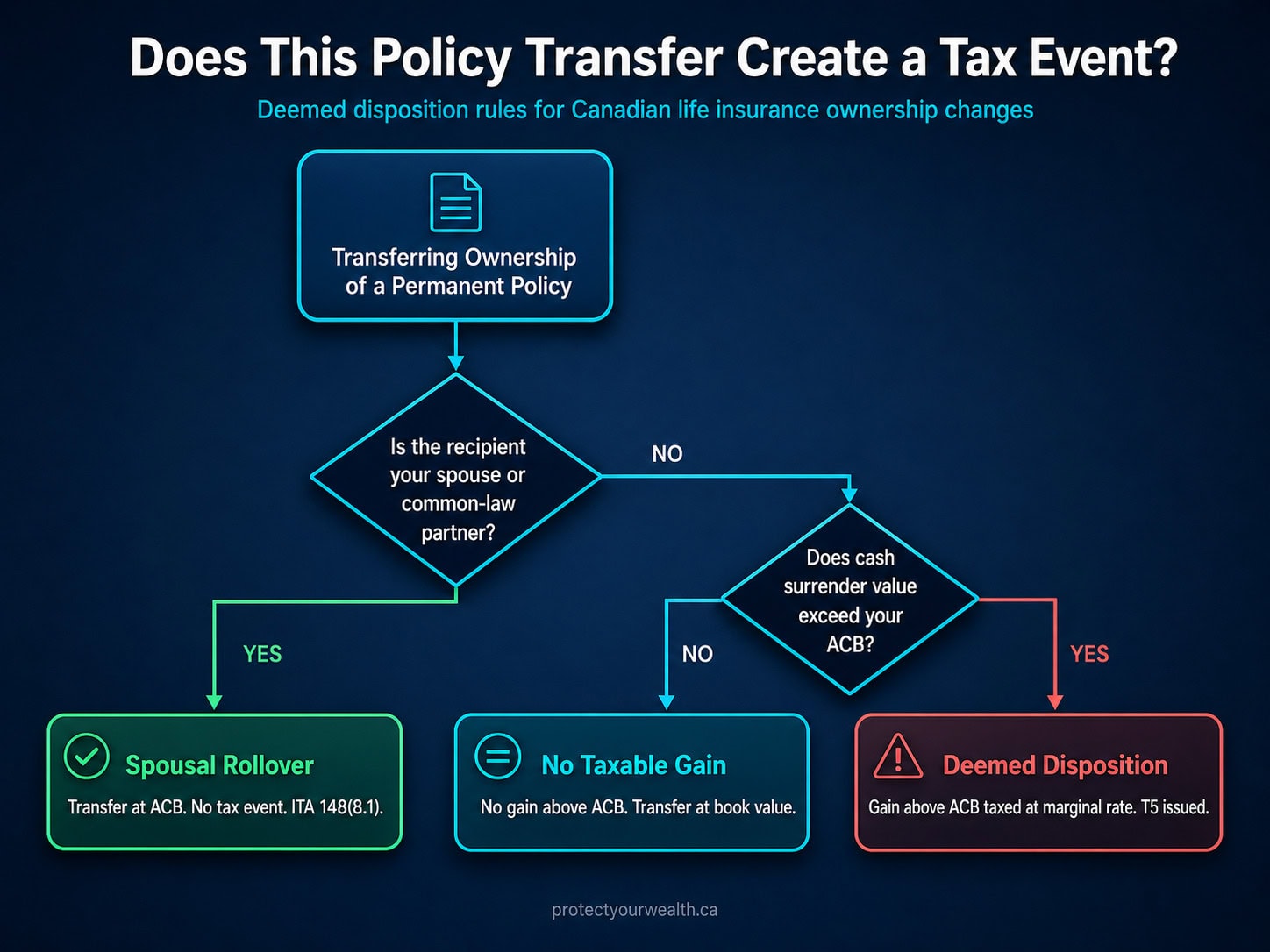
Deemed proceeds (cash surrender value at transfer date) minus the policy’s ACB equals the taxable gain. If a policy has $50,000 in cash surrender value above a $30,000 ACB and you transfer ownership to your adult child, you create a $20,000 taxable income event in the year of transfer, even though no actual cash changes hands. The transferor pays tax at their marginal rate. The receiving party takes over ownership at the cash surrender value as their new ACB going forward.
Statutory exception
ITA Section 148(8.1) spousal rollover. Transfers between spouses or common-law partners move at ACB, not at cash surrender value. No taxable gain is realized. The receiving spouse takes over the policy at the same ACB the transferor had. The rollover applies automatically unless the parties jointly elect otherwise on their tax returns.
The spousal rollover is the only meaningful exception to the deemed disposition rule. For couples who hold joint last-to-die policies structured for estate planning, the rollover provision is what allows ownership to move between spouses without tax friction at each transfer point. The same applies for couples consolidating multiple individual policies into a single ownership structure as part of estate planning.
The transfer trap
A corporate-owned policy transferred to the shareholder personally, or vice versa, is the most common transfer trap. Both directions trigger a deemed disposition at fair market value. On a mature policy with significant cash value, the resulting tax bill can run into five or six figures. The tax is owed in the year of the transfer, regardless of when the policy eventually pays out. Most of these transfers should run through both the corporate accountant and the broker before any paperwork is signed.
The corporate-to-personal direction usually shows up when a business owner is preparing for retirement, restructuring the corporation, or simplifying ownership before selling the business. The corporation is treated as having disposed of the policy at fair market value, and any gain above ACB is taxed as corporate income that year. The receiving individual takes over the policy at fair market value as their personal ACB going forward.
The reverse direction, transferring a personally-owned policy into a corporation, follows the same deemed disposition mechanic with different reporting. The transferor pays tax on the gain on their personal return. The corporation acquires the policy at fair market value as its new ACB. In both directions, the tax bill arrives the same year as the transfer, not when the policy actually pays out, which is what makes these transfers a cash-flow problem if they were not planned for.
Before any policy transfer that is not between spouses, get the current ACB and cash surrender value directly from the insurer and run the deemed disposition math. If the transfer is to a corporation, an adult child, a sibling, a trust, or anyone other than your spouse or common-law partner, fair market value is the deemed sale price the day of transfer. The structural decision matters more than the timing. Calling first, structuring properly, and then transferring is the only sequence that protects against the tax bill that catches most clients off guard.
How Employer-Paid Life Insurance Affects Your Taxes
Employer-paid premiums for group life insurance are a taxable benefit in Canada. Whether your employer covers $50,000 of group coverage or $500,000, every dollar of premium they pay on your behalf is added to your taxable income for the year. This catches most employees off guard because the money never lands in your bank account, the employer pays the insurer directly, and yet CRA treats it as if it were additional salary.
The reason is structural. Under paragraph 6(1)(a) of the Income Tax Act, the value of any benefit received from your employer is included in your employment income unless a specific exception applies. Group life insurance does not fall under any of the exceptions for health, dental, or wage-loss replacement plans. The coverage you receive has economic value to you, equivalent to compensation, and CRA treats it accordingly. There is no minimum exemption: every dollar of employer-paid premium is taxable to you.
Yes
Employer-paid group life premiums are a taxable benefit, with no minimum exemption.
Box 40
Where active employees see the reported amount on their T4 slip.
Code 119
Where retired or former employees see the reported amount on their T4A slip.
$0
Tax owed on the death benefit itself if you pass away while covered.
The taxable benefit is more than just the premium dollars. CRA includes the premium amount your employer paid, plus any applicable provincial sales taxes or excise taxes that applied to your insurance coverage, plus any provincial insurance levies (Manitoba’s 7% provincial levy, for example). The total of those three components is what shows up on your T4 as the taxable benefit. From there, it is taxed at your marginal rate alongside your regular employment income.
Important distinction
Only the premium is taxable, not the coverage itself. If you pass away while covered under your employer’s group life plan, your named beneficiary receives the full death benefit tax-free, the same way they would under a personal policy. The taxable benefit applies only while you are alive and the employer is paying premiums.
If you want to see what you have been taxed on, look at Box 40 of your T4 (Other Information area, marked “Other taxable allowances and benefits”). Any group life insurance premiums your employer paid will be included there and rolled into Box 14 (Employment Income). For most employees with modest group coverage, the annual taxable benefit lands in the low hundreds and barely shifts the bottom-line tax bill. For executive-level coverage where premiums can run into the thousands annually, the impact is more meaningful and worth verifying against your pay stubs.
The takeaway: the premium gets taxed, the death benefit does not. If your employer has been paying premiums on your behalf for years, you have already been paying tax on those premiums each year through your T4. The coverage itself, the actual insurance protection, costs your beneficiary nothing in tax when it eventually pays out.
Using Life Insurance as a Tax Planning Tool
Life insurance is not just a payout that arrives on death. Properly structured, it works as one of the most tax-efficient estate transfer tools available in Canada. The death benefit pays tax-free to the beneficiary. The cash value can grow tax-sheltered while the policy is in force. And for corporate owners, the policy can move money out of a corporation and into the hands of family members or heirs at rates no other corporate investment can match.
How effective the strategy is depends on three structural questions. Who owns the policy. Whether it is structured as exempt or non-exempt. And how the cash value, if any, is accessed during the policyholder’s lifetime. Most of the tax planning value sits inside permanent policies (whole life and universal life), not term policies. Term coverage protects against premature death; it does not create the tax-sheltered accumulation that drives the planning conversation.
The 54% Estate Tax Problem That Life Insurance Solves
For high-net-worth Canadians, the tax bill that lands at the second death of a couple can reach 54% on certain assets. The most common drivers are deemed disposition of capital property, deemed cash-out of registered retirement accounts (RRSPs and RRIFs), and the personal taxation of any retained earnings withdrawn from a private corporation. None of these get prepaid during life. They all land on the final tax return.
54%
Top combined estate tax exposure
Approximate top-bracket tax on registered accounts and corporate retained earnings at the second death of a couple. Life insurance is the only asset that delivers a tax-free lump sum specifically positioned to cover this bill.
Life insurance helps solve this because the death benefit can arrive outside the estate, outside probate, and generally free of income tax when structured properly. The premiums paid during life are a fraction of the eventual payout. The math works because the insurance company is pricing the risk across thousands of policyholders, while the tax bill at the estate is pricing 54% against a single family’s assets. The structural mismatch is what makes the strategy effective at scale.
Personal Life Insurance for RRSP and RRIF Inheritance Tax
The RRSP and RRIF inheritance tax bomb is one of the most common reasons Canadian families discover they need life insurance. While both spouses are alive, registered retirement accounts roll over to the surviving spouse tax-free. On the second death, the entire balance gets deemed cashed out and added to the deceased’s final tax return as ordinary income. A $1 million RRIF can generate over $500,000 in tax owed in a single year, all of it pushing into the top marginal bracket.
Life insurance fills that gap. A second-to-die joint life policy is structured to pay out on the second death, exactly when the tax bill lands. The death benefit arrives tax-free to the children or designated beneficiaries at the moment they need it most, used to cover the estate’s tax bill so the registered assets transfer intact rather than being eroded by half.
Calculate Your Exposure
Estimate in under a minute
Run your own registered-asset tax bill before reading further
The 54% number is industry shorthand. Your actual exposure depends on your registered balances, your province, and your projected age at second death. Run the math against your own RRSP and RRIF balances below, then compare against the without-insurance scenario that follows.
Registered Assets at Death Calculator
See how much of your RRSPs, RRIFs, LIRAs, LIFs, and pension will be lost to income tax at death, and how permanent life insurance can cover the bill so your family receives the full value.
Using Tax Year 2026 Information
Tax data last verified April 2026. Sources: CRA T4127 Payroll Deductions Formulas, KPMG Personal Tax Tables (Jan 2026), TaxTips.ca, provincial budget documents.
Enter current values. If you have multiple accounts of the same type, enter the combined total. Leave blank any that do not apply.
Only if you have a defined benefit pension and would take a lump-sum commuted value at death rather than rolling to spouse.
Calculator assumes the full registered balance is deemed income in the year of death.
Includes CPP, OAS, pension income, and any employment or investment income earned in the year of death before the deemed disposition. Leave at $0 if the client is fully retired with no other taxable income.
This is the single biggest factor. Flipping this dropdown can shift your family from near-zero tax to maximum tax.
Compare the number above against the side-by-side scenario that follows. The first column shows the outcome with no life insurance in place. The second shows what changes when a properly structured policy is sized to cover the projected tax bill.
Without insurance
$1M RRIF deemed cashed out at second death. Roughly $500K in tax owed on the final return. Heirs receive approximately half of the registered account.
With second-to-die life insurance
Tax-free death benefit pays out at the second death, sized to cover the projected tax bill. The benefit provides liquidity to offset the projected tax bill, helping preserve more of the registered-account value for heirs.
Corporate-Owned Life Insurance and the Capital Dividend Account
For business owners with retained earnings sitting inside a corporation, corporate-owned life insurance is not just another corporate investment. It is an extremely tax-efficient estate transfer tool that no other corporate asset can replicate. The biggest difference is not the rate of return. It is the after-tax result to the estate.
The mechanism works through the Capital Dividend Account, a notional CRA account that tracks tax-free amounts a corporation can flow out to shareholders. When a corporately-owned permanent life insurance policy pays out, the death benefit minus the policy’s adjusted cost basis credits the corporation’s CDA. From there, the corporation declares a capital dividend to shareholders, the estate, or the named family beneficiaries. Capital dividends are received tax-free by Canadian residents.
How the CDA flow works
Insured passes away. The insurance company pays the death benefit directly to the corporation, tax-free.
Death benefit minus the policy’s ACB credits the corporation’s Capital Dividend Account.
Corporation declares a capital dividend equal to or less than the CDA balance.
Capital dividend flows to shareholders, the estate, or named family beneficiaries, received tax-free.
The result can be a highly tax-efficient movement of corporate dollars to shareholders or the estate, provided the CDA credit is calculated properly and the capital dividend is declared correctly. A regular corporate investment account or GIC pays tax annually on growth, then pays tax again when funds are withdrawn personally or distributed at the shareholder’s death. Corporate-owned life insurance moves dollars out of the corporation, past the personal tax that would normally hit retained earnings, and into the family’s hands without an income tax bill at any stage of the journey.
During the policy’s lifetime, the cash value also grows tax-sheltered inside the corporation. This is why corporate-owned life insurance for investing is sometimes described as a corporate TFSA in industry conversations. A regular corporate investment account creates taxable income each year on interest, dividends, or capital gains. An exempt life insurance policy does not. The cash value compounds without an annual tax drag, which means the effective rate of return is meaningfully higher than the equivalent rate on a non-registered investment account, even before the death benefit is considered.
The cash value is also accessible during the business owner’s lifetime through collateral loans against the policy, as covered in the policy loans section earlier in this guide. The result is a multi-layered approach: tax-sheltered growth, tax-efficient access during life, and tax-efficient transfer to the next generation at death. For business owners with surplus retained earnings that are not needed for daily operations, the strategy has no equivalent in the corporate investment universe.
How MTAR and Exempt Policy Testing Affect Tax-Sheltered Growth
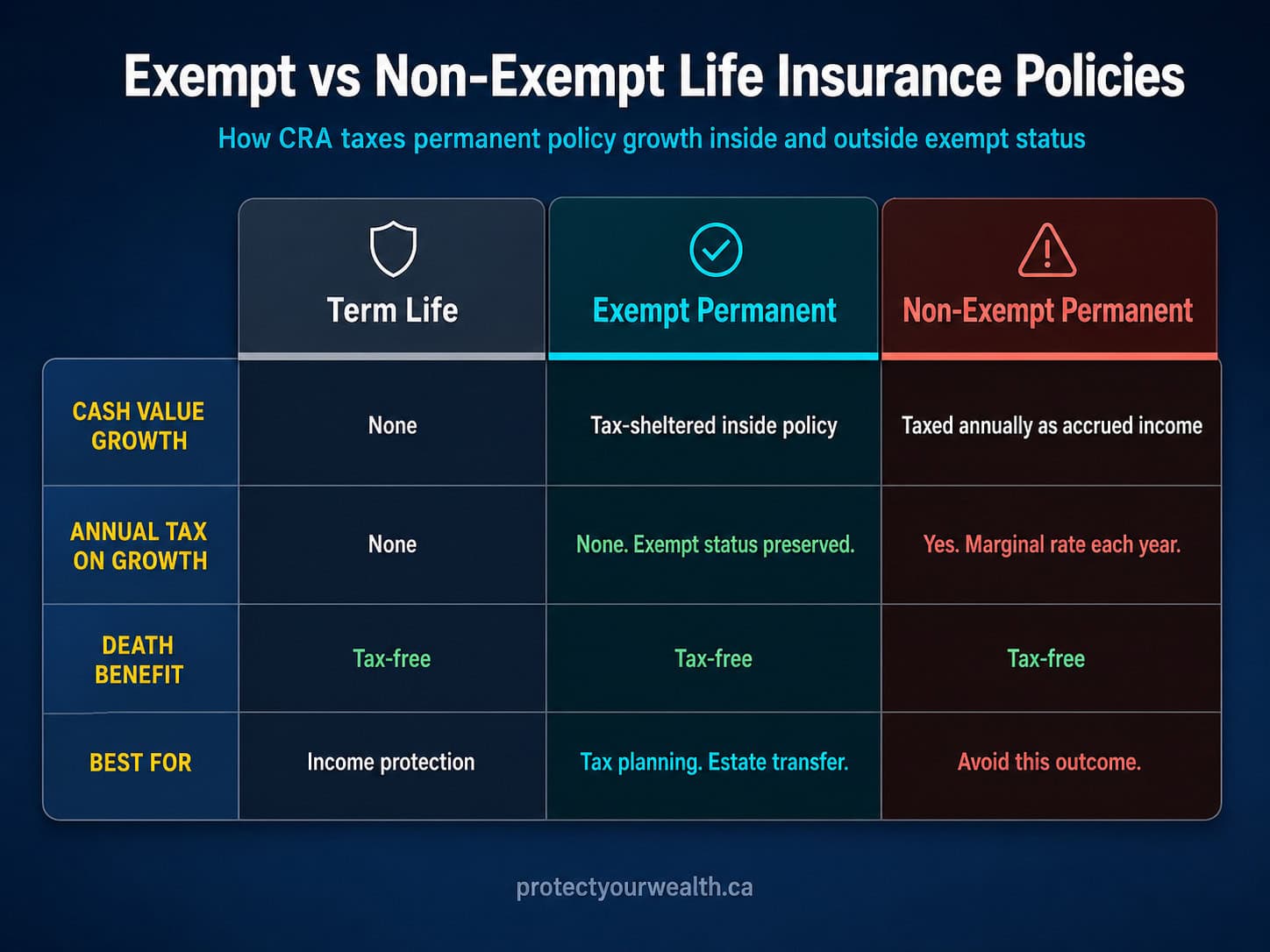
The reason cash value inside a permanent life insurance policy grows tax-sheltered comes down to a CRA mechanism called the Maximum Tax Actuarial Reserve, or MTAR. Every permanent life insurance policy in Canada is tested annually against this benchmark. If the policy stays within the MTAR limit, it qualifies as an exempt policy and the cash value compounds without tax. If the cash value grows above the limit, the policy becomes non-exempt and the growth above MTAR is taxed each year as accrued income.
MTAR at a glance
Term: Maximum Tax Actuarial Reserve, also called the MTAR line or MTAR rule.
Function: The CRA-defined ceiling on how much cash value a permanent life insurance policy can accumulate while still qualifying as an exempt policy.
Why it exists: CRA limits how much non-insurance investment value can sit inside a tax-sheltered insurance policy. The MTAR test prevents over-funding a policy purely as a tax shelter rather than as insurance.
2016 reform: CRA tightened the MTAR calculation in 2016. Policies issued before that date are grandfathered under the old rules. Policies issued from 2017 onward use the updated formula.
In practical terms, almost every standard whole life or universal life policy stays within MTAR by design. Insurance companies build their products to meet the exempt-policy test. The risk only arises with universal life policies that have heavy deposits relative to insurance coverage, where the cash value side can outgrow the insurance side enough to fail the test.
For most Canadians, MTAR is invisible. The insurance company manages the test, alerts the policyholder if a deposit would push the policy over the line, and adjusts the structure as needed. The reason it matters at the planning stage is that some advanced strategies (large overdeposits, deferred income strategies, certain estate freeze structures) bump up against MTAR limits and need careful structuring to preserve the exempt status. For standard policies, the cash value grows tax-sheltered without the policyholder needing to think about the test at all.
Whether the goal is personal estate planning, corporate retained earnings management, or both, the structuring choices made when the policy is issued determine how much tax planning value the policy actually delivers. Term coverage handles the protection function. Permanent coverage is where the tax planning happens. The decision between the two, the ownership structure, the funding strategy, and the beneficiary designations should be designed at issue, not retrofitted later. Each one of those choices materially affects the final tax outcome at every life stage from policy issue to death benefit payout.
Frequently Asked Questions
01
Does my beneficiary have to report the death benefit on their tax return?
No. The death benefit paid to a named beneficiary is not income for tax purposes in Canada. Beneficiaries do not declare it on their T1 return, do not receive a T-slip for it, and do not include it in any income calculation. The only exception is interest earned after death if the insurer holds the payout for any period, which is reported separately on a T5 slip.
02
Are life insurance policy dividends taxable in Canada?
It depends on what you do with them. Whole life policy dividends are not taxable as long as they remain inside the policy. If you take the dividend in cash, the amount is taxable to the extent it exceeds the policy’s adjusted cost basis. If you use the dividend to buy paid-up additions or to reduce future premiums, no current tax applies. The dividend option you choose at policy issue, and can usually change later, controls the tax treatment.
03
What is a taxable gain on a life insurance policy and how is it calculated?
A taxable gain arises when you withdraw cash, surrender the policy, or transfer ownership and the amount received exceeds the policy’s adjusted cost basis (ACB). The gain equals the proceeds (cash received or fair market value at transfer) minus the ACB. The insurer issues a T5 slip for the taxable portion, and you report it on Line 13000 of your T1 return. The gain is taxed as ordinary income at your marginal rate, the same rate that applies to your employment income.
04
Do I pay tax if I cash out my life insurance policy?
Only on the amount above your ACB. Up to the ACB, the cash you receive is treated as a return of your premiums and is tax-free. Anything above the ACB is taxed as ordinary income. This is why many policyholders with mature whole life policies use a policy loan or collateral loan structure instead of a straight cash-out, especially when the cash surrender value substantially exceeds the ACB.
05
Is life insurance taxable in Ontario, or does it differ by province?
The federal tax rules apply across Canada, including Ontario. Death benefits are tax-free, premiums are not deductible, and cash withdrawals above ACB are taxed as ordinary income at marginal rates regardless of province. Provincial differences appear in two places: provincial sales taxes or insurance levies on premiums (Manitoba’s 7% provincial levy is the highest), and probate fees on amounts that flow through an estate rather than directly to a named beneficiary. Ontario’s probate fee, called the Estate Administration Tax, is among the highest in Canada at 1.5% on estate value above $50,000.
06
Can I sell my Canadian life insurance policy to a third party?
In most provinces, no. Selling a Canadian life insurance policy to a third party is prohibited under provincial insurance acts everywhere except Quebec, which permits life settlements through licensed intermediaries. If you sell a policy in Quebec, the proceeds are taxed: any amount above the policy’s ACB is reported as taxable income to CRA and Revenue Quebec. Your insurance company can still buy back the policy for its cash surrender value (a surrender), but a third-party sale is the distinction.
07
Do I owe tax on interest earned on a delayed life insurance payout?
Yes. The principal death benefit is tax-free, but if the insurance company holds the payout for any period before disbursing (waiting on documentation, beneficiary disputes, delayed claims), any interest accrued during the holding period is taxable to the beneficiary. The insurer issues a T5 slip for the interest portion only. The principal amount is not affected by this.
08
How do I find the adjusted cost basis (ACB) of my permanent policy?
The insurance company calculates and tracks the ACB on every permanent life insurance policy. You can request a current ACB statement from your insurer at any time. The basic formula is premiums paid minus the cumulative net cost of insurance, plus or minus any policy loans, dividends, or coverage changes. Most insurers include the ACB on annual policy statements, but if it is not visible, contact your advisor or the insurer directly. Knowing your ACB before any cash value access is essential for tax planning.
Note: This article is general information only. Tax outcomes depend on ownership, policy values, province, corporate structure, and CRA rules. Confirm your situation with a licensed insurance advisor and tax professional before making policy changes.