 ·

Life Insurance With High Blood Pressure or High Cholesterol in Canada
By Parvesh Benning, Licensed Life Insurance Broker
If your blood pressure or cholesterol is managed, many insurers treat it as routine rather than a major underwriting concern, and the route most people skip is often the cheapest one.
Being on a pill for blood pressure or cholesterol rarely moves the needle on a life insurance application. What actually decides your rate is whether the condition is controlled, and which insurer you apply to.
Updated: June 16, 2026

Life Insurance With High Blood Pressure or High Cholesterol in Canada
By Parvesh Benning, Licensed Life Insurance Broker, Updated: June 16, 2026
If your blood pressure or cholesterol is managed, many insurers treat it as routine rather than a major underwriting concern, and the route most people skip is often the cheapest one.
Being on a pill for blood pressure or cholesterol rarely moves the needle on a life insurance application. What actually decides your rate is whether the condition is controlled, and which insurer you apply to.
Here is the part that surprises people: when these two conditions are controlled, a managed applicant usually qualifies at standard rates on a fully underwritten policy, and that is normally cheaper than the no-medical coverage they were about to settle for.
This guide covers what underwriters actually weigh, the readings and ratios that move you between rate classes, real monthly price ranges across Canada, and the options that exist if a decline ever happens. The goal is simple: the right coverage at the lowest honest price.
What this guide covers
- Can you qualify with high blood pressure or cholesterol?
- What underwriters actually look at
- How these files get routed before applying
- What counts as high blood pressure
- What counts as high cholesterol
- What it actually costs across Canada
- Options if you are declined or want to skip the exam
- How to improve your rate before you apply
- What if you have had a heart attack or stroke?
- Frequently asked questions
Can You Qualify for Life Insurance With High Blood Pressure or Cholesterol?
Yes. When blood pressure and cholesterol are managed and under control, insurers actually view that as a positive, and on their own these two conditions rarely have much impact on getting approved.
That is the part most people get backwards. They assume a diagnosis works against them. What underwriters are really reading is the opposite signal: you know about it, a doctor is treating it, and the numbers are steady. That tells them the risk is being handled.
Controlled, on medication, stable
Often standard rates, with preferred rates possible when the full file supports it. The medication is read as management, not as a strike against you.
Borderline or recently diagnosed
Often still standard, sometimes a short wait for a few stable readings. A broker can preview this before anything goes on record.
Uncontrolled or other conditions present
This is where it gets navigated case by case. The blood pressure is rarely the whole story; what else is on the file matters more.
If there are other underlying conditions in the mix, we navigate that accordingly, and there are still paths through it, including no-medical life insurance options. But on its own, elevated blood pressure or cholesterol is simply not a major concern when it comes to qualifying.
What Underwriters Actually Look At (and What Most People Get Wrong)
Underwriters are reading patterns, not the diagnosis label. With blood pressure and cholesterol, they care far more about whether it is controlled and steady than about the fact that you have it at all.
Here is the line that decides your rate. Same diagnosis, two completely different files.
That last point matters most. The blood pressure on its own is rarely what changes the outcome. It is what else is on the file.
If your readings swing in a clinic but sit normal at home, flag it, because white coat syndrome is something insurers can work around with home readings or a retest.
This is where an independent broker earns their keep. Knowing which insurer reads a managed file generously, before anything goes on record, is the whole game. See how that works in our guide to getting the best life insurance rates in Canada.
How These Files Get Routed Before Applying
The routing decision happens before a single application goes in, and it is what protects your rate and your record. The same managed condition can be sent to very different insurers depending on what else is on the file.
Controlled on medication
Fully underwritten first. It is usually the lowest cost for a documented, stable file.
White coat readings
Document home readings or arrange a retest before locking in a rate class.
Recent medication change
Confirm a stretch of stability first. A short track record reads better than a brand-new prescription.
Plus diabetes
Carrier choice matters more here. The combination is weighed differently than either condition alone.
Plus prior stroke or heart attack
Prescreen with the insurer before submitting. This is a different risk class and needs the right home.
Recent decline
Review the reason first. Reapplying to the wrong insurer puts another decline on record.
None of this requires a commitment. It is a preview against several insurers so the application goes to the one most likely to approve it cleanly, the first time.
What Counts as High Cholesterol for Life Insurance?
Most insurers treat total cholesterol under 200 mg/dL as standard territory, but the single number underwriters watch most closely is your cholesterol-to-HDL ratio. A ratio under 5.0 is generally read as low risk.
High cholesterol, or hyperlipidemia, means elevated LDL (the “bad” cholesterol) in your blood. Left unmanaged it raises cardiovascular risk, which is why insurers look at it. Managed and stable on treatment, it lands the same way controlled blood pressure does: usually routine rather than a major concern.
<200
Total cholesterol (mg/dL), standard territory
<130
LDL, the “bad” cholesterol (mg/dL)
<5.0
Cholesterol-to-HDL ratio, low-risk read
Figures are illustrative of common Canadian underwriting thresholds. Each insurer sets its own limits and weighs the full picture, so borderline numbers are not a verdict.
If your levels are borderline or high, documentation of treatment and recent follow-up does the heavy lifting. The story underwriters want to see is a number that is being managed, not ignored.
What Life Insurance Actually Costs With Managed Blood Pressure or Cholesterol
For a managed case, the fully underwritten route is usually both available and cheaper than the no-medical coverage people often default to. That is the cost reversal worth knowing before you apply.
The figures below are non-smoker, 20-year term, standard rates, illustrative only and subject to underwriting and change. Term premiums for these carriers are filed nationally, so they read the same across the provinces we serve.
Fully underwritten, standard rates
from $27/mo
Male, age 40, $250,000, 20-year term
from $44/mo
Male, age 40, $500,000, 20-year term
from $32/mo
Female, age 40, $500,000, 20-year term
Now compare the no-medical route for a similar profile (male, age 45, $250,000, 20-year term). No-medical can start around $50 per month, while comparable simplified-issue plans commonly run from the mid-$60s to mid-$70s per month. A managed applicant who qualifies fully underwritten at standard, around $42 per month for that same profile, typically pays less by being assessed properly.
Sample premiums are for illustration only and assume non-smoker status, standard underwriting, no additional health concerns, and current carrier rates at the time of quoting. Final premiums depend on age, sex, province, amount, term length, health history, and insurer approval.
The point is not that no-medical is bad. It is the right tool when speed matters or when an exam is genuinely a barrier. But if your blood pressure or cholesterol is the only flag, paying a no-medical premium to avoid an exam you would likely pass at standard is money left on the table. You can compare both directly: term life quotes and no-medical quotes.
Options If You Are Declined, or Want to Skip the Exam
A flat decline on blood pressure or cholesterol alone is uncommon. When a decline happens, it is almost always a combination of factors, and there is still a clear path to coverage.
If other underlying conditions are in the mix, that is where we navigate it accordingly. Here is the order most managed applicants should think in, best price first.
Fully underwritten term or permanent
Best rates for a managed, documented case. This is the default to aim for, not the fallback.
No-medical (simplified issue)
A short health questionnaire, no exam. Worth knowing: many simplified applications focus more on major cardiac events, hospitalizations, cancer, dialysis, or serious complications than on controlled blood pressure or cholesterol alone, so a managed reading often is not the barrier people expect.
Guaranteed issue
No health questions at all, lower coverage caps, higher cost. A genuine last resort, and rarely needed for blood pressure or cholesterol on their own.
That second point is the one most people miss. If your only worry is a blood pressure or cholesterol pill, many no-medical plans are screening for bigger events, not that. The difference between simplified and guaranteed issue is worth understanding before you choose, and we break it down in guaranteed issue vs simplified issue life insurance explained.
Before you settle for a higher no-medical premium, it is worth having someone preview your file against several insurers first. A managed reading that one company rates, another may take at standard. That comparison is free, and it is the whole reason to use a broker rather than apply to one company direct.
How to Improve Your Rate Before You Apply
The single biggest lever is showing a managed, documented condition, so anything that demonstrates control before you apply tends to pay off. You do not need perfect numbers. You need steady ones with a paper trail.
Take the medication as prescribed
Consistent refills are proof of management. A treated condition reads better than an untreated one, every time.
Get a few recent, steady readings on record
A short run of stable results carries more weight than one good day at the clinic.
Bring the everyday basics into line
More activity, less sodium, heart-healthy food, better sleep, and stress kept in check all show up in the numbers over time.
Flag clinic-only spikes
If your readings jump in a doctor’s office but sit normal at home, tell your advisor. Insurers can allow home readings or a retest.
Whether you start a month before applying or a year, the direction matters more than the timeline. And always answer honestly on the application. A disclosed condition can usually be handled properly, while a material health detail left off an application can create problems later, including issues at claim time.
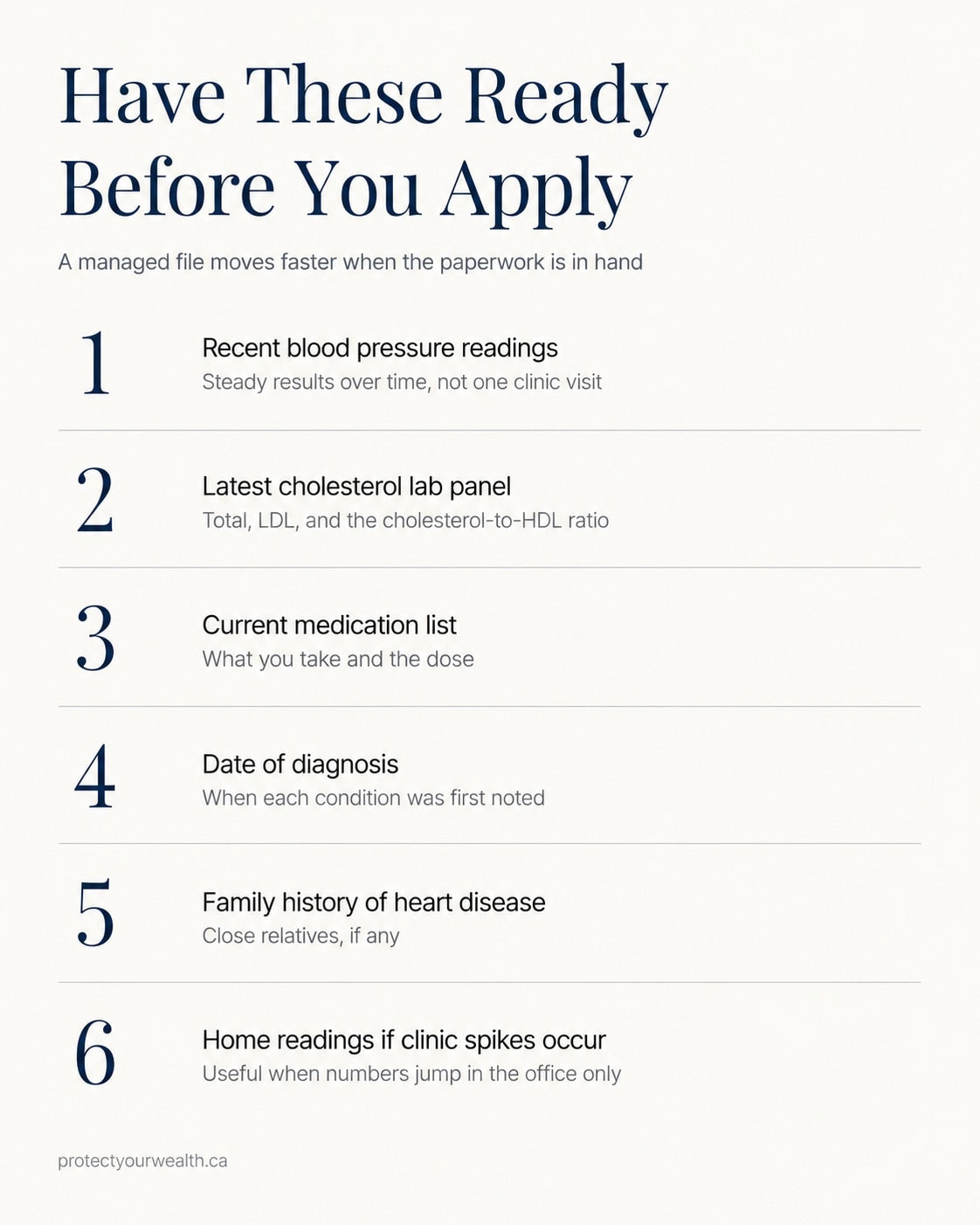
When you apply, expect questions on when you were diagnosed, what you take, whether your levels have been stable, your lifestyle, and any family history of heart disease. Having recent labs and your medication list ready up front keeps the file moving and helps you land the right rate class the first time.
What If You Have Had a Heart Attack or Stroke?
This is where blood pressure and cholesterol stop being the headline. A past heart attack or stroke changes the file from a managed risk factor to an actual cardiac event, and insurers price those very differently.
For a cardiac event, the file is assessed on its own terms: time since the event, recovery, what your specialist reports, and what else sits alongside it. Coverage is still very much available, it often just takes the right insurer and sometimes a stabilization period.
We cover the specifics in applying for life insurance with heart conditions and life insurance after a heart attack.
If that is your situation, do not apply cold to one company and risk a decline on record. Map the right carrier first. It is a short, free conversation, and it is the difference between a clean approval and a file that follows you around.
Frequently Asked Questions
Q1
Can I get life insurance with high blood pressure?
Yes. When blood pressure is controlled, many applicants qualify at standard rates, with preferred rates possible when the full file supports it. Term, whole life, and permanent life insurance are all on the table. Your rate depends on how steady your readings are and what else is on your file, not the diagnosis by itself.
Q2
Can I get life insurance with high cholesterol?
Yes, and usually at competitive rates if your cholesterol is managed with medication or lifestyle changes. Insurers look closely at your cholesterol-to-HDL ratio, and a controlled, documented case is often treated as routine rather than a major underwriting concern.
Q3
What do insurers consider high blood pressure or high cholesterol?
Most insurers treat blood pressure above 130/80 mmHg as elevated and total cholesterol above 200 mg/dL as above standard. These are guidelines, not hard cutoffs. How steady the numbers are and whether they are being treated matters more than a single reading.
Q4
Does being on medication hurt my application?
No, the opposite. Taking a prescribed medication and showing steady readings tells the underwriter the condition is being managed. That is read as a positive signal, not a penalty.
Q5
Do no-medical policies ask about blood pressure or cholesterol?
Most do not. Simplified and no-medical applications usually screen for serious events like stroke, heart attack, cancer, or dialysis, not managed blood pressure or cholesterol. If those two are your only concern, a fully underwritten policy is often the cheaper choice anyway.
Q6
What if I have been declined?
A decline on blood pressure or cholesterol alone is uncommon, and it is usually a combination of factors. The fix is to map the right insurer before reapplying, since a file one company rates, another may take at standard. A broker can preview that for you before anything goes on record.
Find the Right Policy for Your Situation
Whether you are actively treating high blood pressure or cholesterol or were just diagnosed, there is a path to affordable coverage. The difference is having someone compare insurers and preview your file before anything goes on record, so a managed condition lands at the right rate the first time.
Independent
We compare 20+ Canadian carriers, not one company’s shelf.
Since 2007
Life insurance and segregated fund solutions for complex health files.
Coast to coast
Serving clients across seven provinces, from one place.
Talk to a broker directly. Call 1-877-654-6119 or get in touch for a no-pressure comparison.
Based in Hamilton, Ontario, and serving clients across Ontario, British Columbia, Alberta, Manitoba, Saskatchewan, New Brunswick, and Nova Scotia. Options include term, permanent, and no-medical life insurance, built around your needs.





