·
· 
Top 5 Best Disability Insurance Companies in Canada
By Parvesh Benning, Licensed Life Insurance Broker
There is no single best disability insurance company in Canada, because the right one depends on your occupation, your income, and your health.
After 25 years placing disability coverage, here is what I tell people first: do not shop on the brand name, shop on the contract. What actually protects you is whether the policy pays when you cannot do your own job, not just any job, and whether the insurer can raise your premium or change the terms later. Get those two things right and the company name matters far less than you would think.
Updated: May 31, 2026

Top 5 Best Disability Insurance Companies in Canada
By Parvesh Benning, Licensed Life Insurance Broker, Updated: May 31, 2026
There is no single best disability insurance company in Canada, because the right one depends on your occupation, your income, and your health.
After 25 years placing disability coverage, here is what I tell people first: do not shop on the brand name, shop on the contract. What actually protects you is whether the policy pays when you cannot do your own job, not just any job, and whether the insurer can raise your premium or change the terms later. Get those two things right and the company name matters far less than you would think.

The five companies below all sell strong income protection, but they are built for very different people. Two (RBC and Canada Life) are non-cancellable contracts, meaning once you are approved the insurer cannot raise your premium or rewrite the terms. One (Desjardins) is a flexible plan that suits the self-employed and business owners. And two (iA and Humania) skip the medical exam, which makes them the route for trades, higher-risk jobs, or anyone who has been turned down through standard health screening.
Knowing which of those three groups you belong in is the whole game. Below I walk through what disability insurance actually covers, then break down all five companies and who each one is genuinely the best fit for.
The quick version, matched to who each company actually fits:
Own occupation, locked terms
RBC and Canada Life
Best fit for professionals and higher earners who want the policy to pay when they cannot do their own job, with premiums and terms the insurer cannot change later.
Flexible, built around your business
Desjardins
Best fit for self-employed people and business owners who want flexible coverage, with options to insure loans and overhead. Premiums are not guaranteed.
No medical exam
iA and Humania
Best fit for trades, higher-risk jobs, or anyone worried about being turned down through standard health screening. iA covers soft tissue injuries; Humania has no profession off-limits.
What this guide covers:
How the Top 5 Disability Insurance Companies Compare (and Who Each One Is Actually For)
The best disability insurance company is the one whose contract matches your job and your health, not the one with the biggest name. After 25 years of this, the questions I ask first are always the same. Is it own occupation, meaning it pays if you can’t do your specific job, not just any job? Are the rates guaranteed and the policy non-cancellable, so the insurer can’t change the deal later? And what are the limitations nobody points out until claim time?
Run the five through those questions and they stop looking interchangeable fast. Two are built for professionals who want their own job protected with terms locked for good. One is flexible and made for people who run their own thing. Two skip the medical exam entirely. Here’s how each one actually shakes out.
RBC Insurance
The Professional Series
RBC is the one I reach for when someone has a real profession to protect and wants the contract bolted down. The Professional Series is non-cancellable with guaranteed level premiums to age 65, which in plain terms means once you’re approved RBC cannot raise your rate, change your definitions, or cancel you, full stop. Add the own occupation benefit and you’re considered disabled if you can’t do your own job, even if you could technically go do something else.
What makes it stand out is the supporting cast. There’s a future income option so you can buy more coverage later without re-proving your health, a cost of living benefit while you’re on claim, and Medical Confidence, which gets you fast-tracked to Canadian specialists at claim time instead of sitting on a waitlist. Later in life you can even convert part of it to long term care coverage. It’s a serious contract for serious earners.
Best fit: doctors, lawyers, and other professionals who want their specific occupation protected with rates that never move.
The catch: own occupation and the richer riders cost more, and lower-risk office classes pay less than hands-on trades. Worth pricing properly before you commit.
Canada Life
Lifestyle Protection Plan
Canada Life sits in the same tier as RBC, and for a lot of professionals it comes down to whose numbers land better on the day. The Lifestyle Protection Plan is also non-cancellable and guaranteed renewable, with the disability definitions locked in the contract so they can’t be quietly rewritten. The own occupation rider does the same job here: you’re covered for your own occupation even if you take on other work.
I’ll flag one thing the old version of this page got wrong, because it matters. Canada Life is not “one of only two” insurers offering a non-cancellable contract. RBC offers one too, and so do others. So don’t pick on that line alone. Where Canada Life earns its spot is the rider depth, a return of premium option that pays you back if you never claim, a built-in benefit for healthcare workers who can’t practise due to an infection like HIV or hepatitis, and strong residual coverage for a partial return to work. For anyone in healthcare especially, it’s a natural look.
For the full breakdown of their riders and claims reputation, see our Canada Life Insurance Review.
Best fit: professionals and healthcare workers who want own occupation coverage plus a deep rider shelf and money back if they never claim.
The catch: professional-grade coverage prices like it, and full underwriting can take a few weeks. Not the fast route.
Desjardins
SOLO Disability Income
Desjardins is where I send people who run their own thing and want flexibility over a locked-down professional contract. SOLO Disability Income is built around the self-employed, business owners, and employees with or without a group plan. You pick the monthly amount, the waiting period, the benefit period, and bolt on what you need. There’s also an exchange privilege, so if you later land a job with group coverage you can swap into loan insurance without re-proving your health.
Two honest things to know before you assume it’s the same as RBC or Canada Life. First, the premiums are leveled but not guaranteed. Desjardins can’t single you out, but it can adjust rates for a whole class of insureds, which the two contracts above cannot do. Second, it’s own occupation for the first 24 months only, then it shifts to a replacement occupation test, meaning a job you’re reasonably qualified for that pays at least 60 percent of your old income. That’s not a knock, it’s just a different animal than a true own-occ-to-65 contract, and you should know which one you’re buying.
Best fit: self-employed people and business owners who value flexible, customizable coverage and the option to insure loans down the road.
The catch: premiums aren’t guaranteed, and the own occupation window is 24 months. Mental health and stress claims can also be limited if you’re between jobs when disability strikes.
iA Financial Group
Acci-Jet Program
iA is my no-medical-exam answer for people the other four would make sweat through full underwriting. The Acci-Jet Program covers disability from accident or soft tissue injury with just three questions, and illness coverage with nine. No bloodwork, no fluids, no paramedical for the accident side. Coverage runs $500 to $6,000 a month, ages 18 to 69, and here’s the part that actually matters: soft tissue injuries like strains, sprains, tendinitis and bursitis are included, and iA says those make up 42 percent of claims. A lot of cheap accident plans quietly carve those out.
This is the one for trades, manual workers, truck and taxi drivers, and anyone who has been told their job or their health makes them hard to insure. There’s even an overhead expense option to keep a small business running while the owner is laid up. iA does offer a fully underwritten income protection line as well if you qualify for it, but Acci-Jet is the route when speed and easy approval are the point.
Best fit: trades, manual and higher-risk occupations, and self-employed workers who want fast, no-exam coverage that actually pays for soft tissue injuries.
The catch: mental health conditions are excluded outright, and the soft tissue benefit is time-capped by occupation class. It’s protection, not a professional own-occ contract.
Humania Assurance
IWME Income Protection
Humania is the other no-medical option, and the line I lean on most is that no profession is off-limits. Their simplified-issue income protection runs on a short set of health questions instead of an exam, so there’s no waiting around for labs and a paramedical. For someone in a job most insurers treat as too risky, or someone who just wants coverage without all the bloodwork and exams, that’s the door that’s actually open.
The trade-off is scale. The no-medical route caps the monthly benefit lower than a fully underwritten contract would, so it tends to fit modest income replacement rather than a high earner’s full paycheque. For the right person though, some coverage you can actually get beats perfect coverage you’ll never qualify for.
Best fit: people in higher-risk or unusual occupations, and anyone who wants income protection without a medical exam.
The catch: benefit maximums are lower than fully underwritten plans, so it suits partial income replacement more than full coverage for a high earner.
Five companies, five different right answers. The reason a broker matters here is simple: going direct to one insurer gets you that one insurer’s verdict. We run your job, income, and health across all of them and tell you which contract actually fits, in the same time it would take you to fill out a single application. Talk to a broker directly.
What Disability Insurance Actually Covers
Disability insurance replaces a portion of your income, tax-free, when an illness or injury stops you from working. That’s the whole job. Most policies cover somewhere between 60 and 85 percent of your income, because insurers deliberately leave a gap so there’s always a reason to get back to work.
The part people miss: a disability isn’t always something you can see. I’ve placed coverage for plenty of broken backs and surgeries, sure. But the claims that catch people off guard are the invisible ones, chronic pain, a mental health condition, an autoimmune flare that won’t let you sit at a desk. Those count too, depending on the contract.
One distinction worth getting straight, because people mix these up constantly:
Disability insurance
Pays you a monthly amount, month after month, for as long as you can’t work (up to your benefit period). It replaces a paycheque.
Critical illness insurance
Pays one lump sum when you’re diagnosed with a covered condition. You spend it however you want. It doesn’t care whether you can still work.
They solve different problems, and plenty of people carry both. If you want to weigh that side by side, our guide to the top critical illness insurance companies in Canada breaks it down.
Quick word on where your coverage comes from, because it changes everything. A workplace or group plan is usually cheaper and easier to get, but it can change or vanish the day you change jobs, and the payout is often taxable. An individual policy you own follows you anywhere and the benefit is typically tax-free if you paid the premiums yourself. We get into that trade-off properly in our breakdown of group versus individual disability insurance.
How Disability Insurance Works, From Application to Payout
Disability insurance works in four moves: you set up the coverage, you pay a monthly premium, you file a claim if you’re disabled, and after a waiting period the monthly cheques start. When you recover or hit the end of your benefit period, the payments stop. Simple on paper. The two numbers that decide everything are the waiting period and the benefit period.
1
Set your coverage
Pick your monthly benefit, your waiting period, your benefit period, and any riders. This is where a broker earns their keep, because the wrong waiting period can sink an otherwise good policy.
2
Pay your premium
Monthly, usually. On the locked contracts from RBC and Canada Life, that premium is guaranteed not to move.
3
File a claim
You become disabled, you submit the claim, the insurer assesses it against the policy’s definition of disability. This is exactly why that own-occupation definition matters so much.
4
Wait, then get paid
After the waiting period clears (the gap between when you’re disabled and when benefits start), the monthly payments begin and continue until you recover or the benefit period ends.
Short-term versus long-term coverage
Short-term disability usually pays for up to six months and most often comes through an employer. If your workplace doesn’t offer it, Employment Insurance is the fallback, and EI is thinner than people expect.
Long-term disability is the one that actually carries households through. It typically kicks in after short-term coverage, EI, and any sick leave run out, replaces 60 to 70 percent of your income, and can run for years, often all the way to 65. The individual policies from the five companies above are built for this long haul. That’s the gap most Canadians don’t realize they have until they need it.
Why Disability Insurance Matters More Than People Realize
Your income is the single asset everything else is built on, and disability insurance is the only thing that protects it. People insure their house, their car, even their phone, then leave the paycheque that pays for all three completely exposed. That’s the gap I see most often.
And the odds aren’t abstract. Roughly one in three working Canadians will face a disability lasting 90 days or longer before they turn 65, and when one of those hits, it lasts on average more than two years. Two years with no income is not a rough patch, it’s a financial wipeout for most households.
1 in 3
working Canadians face a disability of 90+ days before age 65
2+ yrs
a long-term disability claim often lasts more than two years
60-85%
of income a typical policy replaces while you’re off work
Here’s the part that frustrates me most. The best time to get this coverage is while you’re healthy and don’t think you need it, because the day something shows up on your file, your options shrink and your price climbs. Wait too long and a condition you develop in the meantime can make coverage harder to get or pricier to keep, which is exactly the wall people hit when they try to buy disability insurance with a pre-existing condition. Locking it in early is the whole point. Cheaper, easier, and it’s there before you need it instead of after.
Frequently Asked Questions About Disability Insurance
Q1
How much does disability insurance cost in Canada?
Disability insurance generally runs about 1 to 3 percent of your annual income. What moves the price is your occupation, your age, whether you smoke, the size of the monthly benefit, the waiting period, and the riders you add. A desk job costs less to insure than a roofer. The fastest way to know your real number is to have a broker price you across several insurers at once.
Q2
Are disability insurance benefits taxable?
If you pay the premiums yourself on an individual policy with after-tax dollars, the monthly benefit is usually tax-free. If your employer pays some or all of the premiums on a group plan, the benefit is typically taxable. That tax difference is a big reason people add an individual policy on top of whatever they get through work.
Q3
Where can I buy disability insurance?
Three places: through your employer or a group plan, through a professional association, or on your own as an individual policy. Group and association coverage is usually cheaper and easier to qualify for, but it can change or end when you leave, and it often isn’t enough on its own. An individual policy costs more but it’s yours, it follows you between jobs, and the benefit is usually tax-free.
Q4
Can I get disability insurance with no medical exam?
Yes. Simplified-issue products from iA and Humania use a short set of health questions instead of bloodwork and a paramedical, so you can get covered without the full medical workup. The trade-off is lower benefit maximums and some excluded conditions. It’s the right route for trades, higher-risk jobs, or anyone worried about being declined through standard underwriting.
Q5
What does own occupation actually mean?
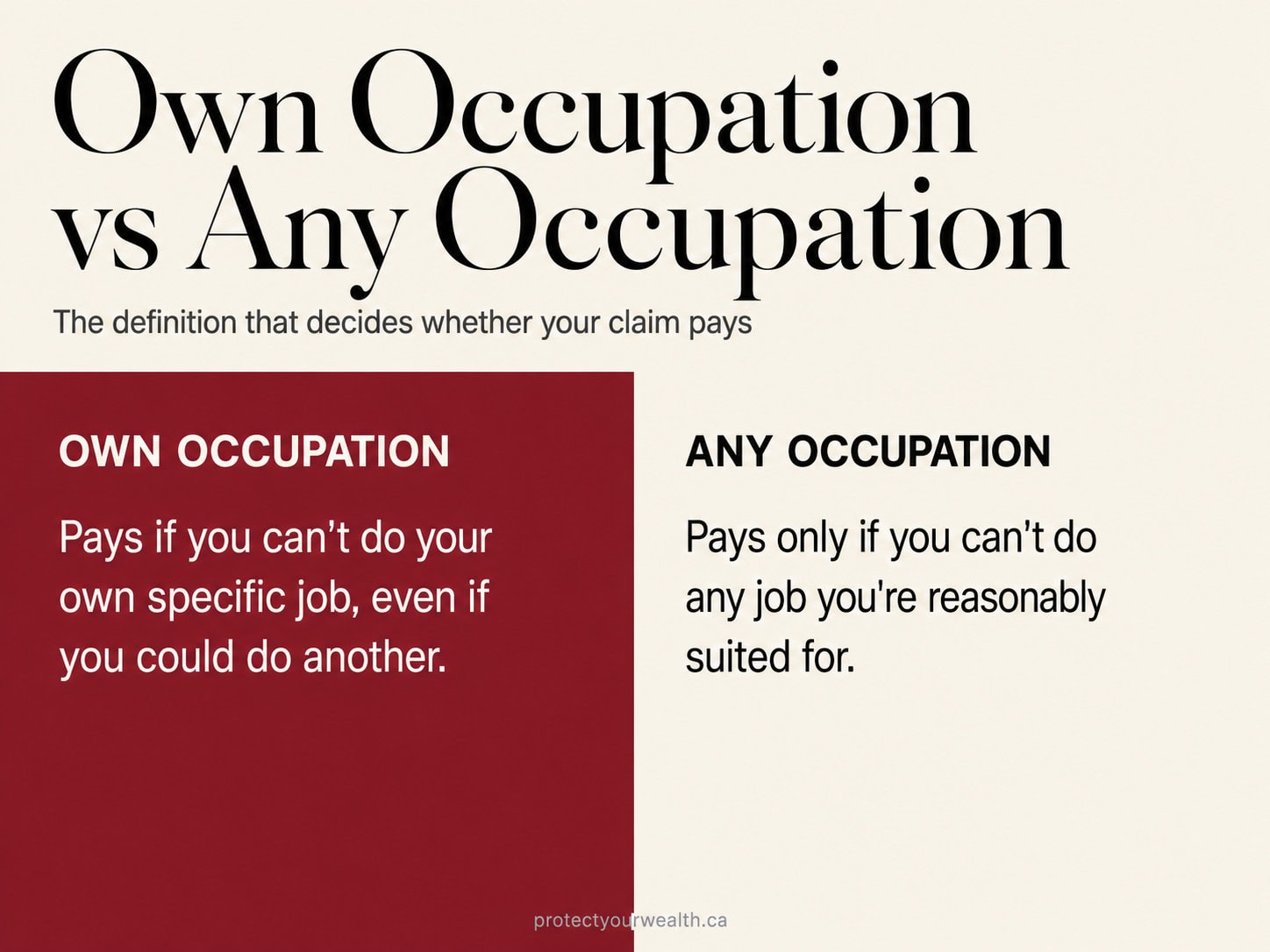
Own occupation means the policy pays if you can’t perform your specific job, even if you could work at something else. A surgeon who can’t operate but could teach still collects. That’s different from an any-occupation definition, which only pays if you can’t work at all. Own occupation is the gold standard for professionals, and it’s the single feature I check first.
Q6
How long does disability insurance pay out?
It depends on the benefit period you choose. Short-term coverage runs up to about six months. Long-term policies can pay for 2 or 5 years, or all the way to age 65, which is what most individual contracts are built for. The longer the benefit period, the higher the premium, and for income protection the long benefit period is usually the one worth paying for.
One income. Five contracts. One right fit.
Find the disability coverage that actually fits your job and your health
Your income is the one asset everything else rides on. Going direct to a single insurer gets you that insurer’s verdict and nothing else. We compare all five companies against your occupation, income, and health, then tell you which contract is genuinely the best fit, in the same time it would take you to fill out one application.