 ·

Life Insurance with a Mental Health Diagnosis in Canada
By Parvesh Benning, Licensed Life Insurance Broker
Most carriers treat anxiety as routine, but bipolar, schizophrenia, and psychosis change the routing completely.
This guide breaks down how Canadian insurers actually assess mental health applications, which diagnoses qualify for standard fully underwritten coverage, and where a simplified or guaranteed path makes more sense based on your stability level.
Updated: May 22, 2026

Life Insurance with a Mental Health Diagnosis in Canada
By Parvesh Benning, Licensed Life Insurance Broker
Most carriers treat anxiety as routine, but bipolar, schizophrenia, and psychosis change the routing completely.
This guide breaks down how Canadian insurers actually assess mental health applications, which diagnoses qualify for standard fully underwritten coverage, and where a simplified or guaranteed path makes more sense based on your stability level.
Updated: May 22, 2026
Coverage is available for the majority of mental health conditions in Canada. The real question is which path fits your situation: fully underwritten, simplified issue, or guaranteed. That depends on your diagnosis, your stability, and which carrier’s questionnaire works in your favour.
This page covers how underwriters actually assess mental health, what the carrier rating tables look like from the inside, and where the line falls between a standard offer and a simplified route. If you have been declined or are unsure where to start, this guide walks through that too.
Inside This Guide
- How Mental Health Affects Life Insurance
- GAF Score: What It Means for Life Insurance
- Mental Health Conditions That Affect Underwriting
- How Carriers Actually Assess Mental Health Applications
- Proving Stability to Improve Your Rates
- Does Therapy or Seeing a Psychologist Affect Life Insurance
- No-Medical Options: Guaranteed vs Simplified vs Immediate
- What Happens if You Are Declined
- What Happens if You Fail to Disclose a Mental Health Diagnosis
- Frequently Asked Questions
How Mental Health Affects Life Insurance
A mental health diagnosis does not disqualify you from life insurance in Canada. Usually, there is a solution available. What changes is the path: fully underwritten, simplified issue, or guaranteed, and which carrier sees your file most favourably.
Insurers evaluate mental health the same way they evaluate any other health condition. They want to know the diagnosis, the severity, how long treatment has been stable, and whether there have been hospitalizations or time off work. A single episode of mild depression treated with counselling looks very different on an application than recurrent bipolar disorder with recent medication changes.
The premium impact ranges widely. Applicants with stable, well-managed conditions often qualify at standard rates through fully underwritten coverage. More complex files can see ratings from 50% to 300% above standard, depending on severity and carrier. That range is exactly why the choice of insurer matters: the same person, same diagnosis, same treatment history can get a standard offer at one company and a 150% rating at another.
Why applying without a plan creates problems
A single decline stays on your record through the Medical Information Bureau (MIB), and insurers share that information with each other. Applying for life insurance with a mental health condition requires planning, similar to getting a pre-approval before applying for a mortgage. Working with a broker who understands carrier-specific mental health underwriting means knowing the likely outcome before a formal application is submitted.
The process starts with understanding the full picture, not just the diagnosis. Smoker status, age, other health conditions, current medications, and work history all factor in. From there, the right carrier and product type become clear. Most people with mental health conditions do not need to settle for the most expensive option available.
GAF Score: What It Means for Life Insurance
The Global Assessment of Functioning (GAF) score is a 0 to 100 scale that clinicians have historically used to rate how well a person manages daily life, work, and relationships. Some Canadian insurers still reference it during underwriting, even though the DSM-5 replaced it with other assessment tools in 2013.
A GAF score above 70 generally signals mild symptoms and good overall functioning. Scores between 50 and 70 suggest moderate difficulty. Below 50 indicates serious impairment. Where you fall on that range can influence whether an underwriter offers standard rates, applies a rating, or postpones.
71-100
Mild or no symptoms. Typically standard rates at most carriers.
50-70
Moderate symptoms. Rated offers likely, or postponement if recent instability.
Below 50
Serious impairment. Fully underwritten coverage unlikely. Simplified or guaranteed paths.
That said, underwriters are after patterns, not a single number. A GAF score from three years ago carries less weight than your current treatment stability, medication adherence, and work history. The score is one data point in a larger picture. If your clinician’s notes show consistent improvement since the score was assigned, that trajectory matters more than the number itself.
Not every insurer uses the GAF scale, and not every applicant will have one on file. If yours is documented, it will likely surface when the insurer requests an Attending Physician’s Statement (a report from your doctor or specialist). Knowing where you fall gives you a clearer picture of what to expect before applying.
Mental Health Conditions That Affect Underwriting
Canadian life insurance underwriters review a wide range of mental health diagnoses, but they do not treat all of them the same way. Often something like anxiety would have no impact on your application and you would go through standard fully underwritten coverage. Bipolar disorder, schizophrenia, and psychosis are typically the situations where the routing changes completely.
The real complicating factor is rarely the diagnosis alone. It is what else is on your file: substance history, disability claims, hospitalizations, time off work, multiple medications. Those are the things that shift an otherwise manageable application into rated or postponed territory.
Typically fully underwritten at standard or mild rating
- Anxiety disorders (generalized, social, panic)
- Depression (single episode, situational, mild to moderate recurrent)
- ADHD
- OCD
- Eating disorders (stable, in recovery)
- Adjustment disorder
May require simplified, guaranteed, or careful carrier selection
- Bipolar disorder
- Schizophrenia
- Psychosis
- Borderline Personality Disorder
- PTSD (severity dependent)
- Dissociative disorders
- Addiction and substance use disorders
These groupings are not rigid. A well-managed bipolar case with two years of stability, consistent medication, and no time off work may qualify for fully underwritten coverage at a rating. And a mild anxiety diagnosis complicated by a recent hospitalization and substance use could end up on the simplified path. The grouping above reflects the starting point, not the final answer.
Severity and functional impact drive the real outcome. Underwriters consider diagnosis subtype, treatment adherence, time since last episode, and whether you are currently working. A label gets the file opened. Everything else determines where it goes.
How Carriers Actually Assess Mental Health Applications
Each carrier uses its own internal underwriting guide for mental health, and the ratings for the same condition vary significantly from one company to the next. Once the expected rating goes past 50%, it is often cheaper and easier to go a simplified route, so that is the first decision point when a mental health file comes in.
Before submitting anything formally, I contact carriers anonymously with the client’s details but no identifying information. The carrier is not bound by their response, but it gives a strong indication of the likely outcome. It works like a pre-approval on a mortgage: you know where you stand before committing to an application that could result in a decline on your permanent record.
Here is what the actual underwriting guides show for common mental health conditions. These are the tables I reference when routing a file, not generic advice from a website.
That is five carriers with five different approaches to the same diagnosis. A person with mild depression diagnosed over a year ago might qualify standard at Assumption Life, get standard at Canada Life, and face a 150% rating at Empire depending on the full file. Same person, same condition. The carrier choice is the variable.
This is why medication stability matters so much in the process. A recent change in antidepressants, even if clinically appropriate, can shift a file from standard to postponed at carriers that track medication history within 6 to 12 months. Timing the application matters.
Each situation is specific and should be handled with care to match the right coverage. Most of the time there is a solution available. It is rare to not have one based on experience.
Proving Stability to Improve Your Rates
Demonstrating consistent treatment and stable functioning over 12 months or more is the single most effective way to improve your underwriting outcome on a mental health application. Most insurers view a long history of treatment as a positive signal, not a negative one.
What underwriters actually look for comes down to a short list. Are you working? Has your medication been stable? Have you stayed out of the hospital? These matter more than the diagnosis itself. A medication change within the last 6 to 12 months can have a real impact, in particular on fully underwritten coverage. For simplified products, the window is shorter, sometimes 90 days.
What to have ready before you apply
01
Clinician letter
A letter from your treating doctor or therapist summarizing your diagnosis, treatment plan, and how you are functioning day to day. This is the single most useful document for underwriting.
02
Medication list
Current medications with dosage and start dates. Fewer recent changes reads as lower risk. Pharmacy printouts work if your doctor does not provide a formal list.
03
Appointment history
Records showing consistent follow-up with your care provider. Gaps in care raise questions. Even a summary printout showing visit dates is helpful.
04
Work or school confirmation
Steady employment or enrollment signals functional stability. A supervisor letter or enrollment verification supports your file if requested.
05
Recovery evidence (if applicable)
If substance use is part of your history, evidence of sustained recovery, program completion, or negative tests as advised by your clinician.
Timing the application matters. If you recently switched medications, had a workplace stress leave, or went through an episode, waiting until you can show several months of stable results improves the outcome. Applying during a transition period is the most common way a manageable file turns into a postponement.
Know which product you are targeting before you start gathering documents. The stability threshold for a simplified application is different from fully underwritten, which is different again from critical illness. Preparing for the wrong timeline wastes months.
Does Therapy or Seeing a Psychologist Affect Life Insurance
Seeing a therapist or psychologist is typically not an issue from an underwriting standpoint. Most insurers would view it as generally positive, especially if there is a long history of treatment of one year or more.
This is one of the most common concerns I hear from clients. They worry that having a therapist on file will count against them. The short answer: it does not. An insurer wants to see that you are managing your condition. Consistent therapy is evidence of exactly that. It signals stability, not risk.
Therapy or counselling may come up as part of a mental health questionnaire on the application. If it does, disclose it. But understand that the underwriter is looking at the full picture: how long you have been in treatment, whether your symptoms are controlled, and whether you are functioning well in daily life. A year of consistent therapy with no hospitalizations and no time off work is one of the strongest stability signals you can present.
Where it can get complicated is if therapy started very recently in response to a crisis, a hospitalization, or a new diagnosis. In that case, the insurer may want to see more time pass before making an offer. That is not the therapy causing the problem. It is the recency of the event that triggered it.
If you are currently seeing a therapist and considering applying for life insurance, do not stop treatment to avoid disclosure. That is the worst possible move. Gaps in care raise more questions than consistent treatment ever will.
No-Medical Options: Guaranteed vs Simplified vs Immediate
No-medical life insurance lets you get coverage without bloodwork, a nurse visit, or a full medical exam. Instead, insurers rely on short questionnaires or basic eligibility checks. For applicants with a mental health diagnosis, these products offer a faster path to coverage when fully underwritten is not the right fit.
There are three common paths. Each involves trade-offs in price, coverage limits, and when the full death benefit kicks in.
G
Guaranteed issue
No health questions, no exam. Approval regardless of mental health history. Highest cost per dollar of coverage. Coverage typically $5,000 to $50,000. Two-year waiting period on non-accidental death benefits (return of premium plus interest during that window). Best for applicants with severe or unstable mental health history, multiple declines, or very recent crises.
S
Simplified issue
Short health questionnaire, no exam. May ask about recent hospitalizations, suicide attempts, or disability leave. Mid-range premiums, roughly 20 to 30% higher than fully underwritten. Coverage up to $500,000 depending on insurer and age. Some plans include full benefits from day one if you meet the health statements. Works well for managed conditions like depression or anxiety where you can answer the questionnaire favourably.
I
Immediate (non-med) issue
More yes/no health questions than simplified, but clears applicants for day-one full coverage if all answers are favourable. Coverage up to $750,000 at some carriers. Often the best balance for applicants with well-controlled conditions and no recent ER visits or medication changes. Lower premiums than guaranteed, often competitive with basic underwritten policies.
Many clients start with simplified or guaranteed coverage to get insured quickly, then reapply later for fully underwritten coverage once stability is established. That staged approach balances immediate protection with long-term savings. It is not settling for less. It is getting covered now while the file strengthens.
In complex situations, some simplified carriers are more accommodating than others. iA Access Life, for example, tends to have more lenient questions on their application, which can make a difference when other simplified carriers would trigger a decline or deferral based on how they word their health statements. The specific questions on the application matter as much as the underwriting behind them.
What Happens if You Are Declined
A decline does not mean you are uninsurable. It means the carrier you applied to did not accept your file based on the information in front of them. A different carrier, a different product, or a different timing can change the outcome entirely.
The first thing I do when someone calls after being declined is find out why. Who was the carrier? What was the reason? Was it a bank? Banks have been known to be quite conservative with mental health applications, and a decline from a bank does not mean the broader market would respond the same way.
I never go directly to simplified issue after a decline. My goal is always to see if there is an option that makes sense from a fully underwritten perspective first. Simplified is not where you start. It is where you go after confirming that fully underwritten is off the table for now.
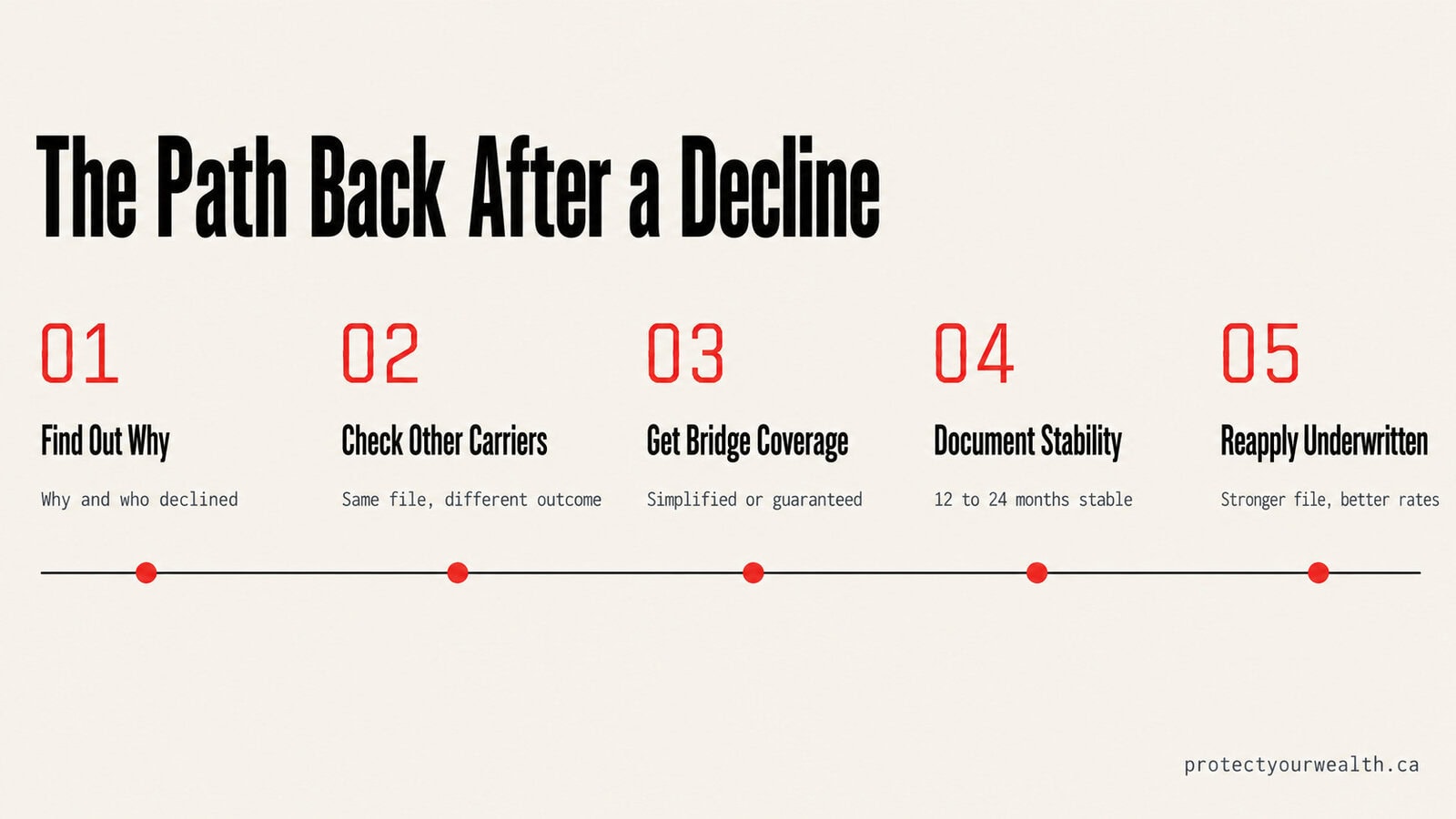
Here is why that sequence matters. A fully underwritten policy is almost always cheaper for the same coverage amount. If you skip straight to simplified without checking, you could be overpaying for the life of the policy. The decline from one carrier does not automatically mean every fully underwritten carrier would say no.
That said, the decline itself creates a complication. Insurers share information with each other through databases like the Medical Information Bureau. A decline on your record can follow you. Some simplified carriers ask directly whether you have been declined in the last 1 to 2 years. Others do not. Knowing which carriers ask and which do not is part of the routing.
If fully underwritten coverage is not available right now, the typical path is to start with simplified or guaranteed issue, build 12 to 24 months of documented stability, and then reapply for fully underwritten coverage with a stronger file. It is not a permanent situation. It is a bridge.
What Happens if You Fail to Disclose a Mental Health Diagnosis
Failing to disclose a mental health diagnosis on a life insurance application can void your policy, result in a denied claim, or make future coverage significantly harder. It is never worth the risk.
The border crossing rule
Think of the application like a border crossing. Answer what they ask, honestly and completely. Do not volunteer information they did not ask for, but never withhold something they did. If it asks whether you have been treated for depression in the last 5 years, answer truthfully. If it does not ask about something from 10 years ago, you are not required to bring it up.
Insurers verify what you disclose. They can request a report from your doctor, check the Medical Information Bureau (a database where insurers share applicant history), and investigate the original application in detail if a claim is made within the first two years.
Policy cancelled
Insurer voids the contract for misrepresentation. Premiums paid may not be refunded.
Claim denied
Death benefit refused if the non-disclosure materially affected the underwriting decision.
Future coverage blocked
That insurer and affiliated companies may refuse to cover you going forward.
This is especially relevant with mental health. Clients sometimes forget a short course of therapy years ago or a medication they stopped taking. If it was on your medical file, assume it can surface.
Full disclosure does not mean a worse outcome. It means the insurer can match you to a policy that actually pays out when your family needs it. A claim denied because of non-disclosure is worse than a slightly higher premium on a policy that holds up.
Frequently Asked Questions
01
Can I get life insurance with a diagnosed mental illness?
Yes. Most Canadians with mental health diagnoses qualify for some form of life insurance. Applicants with well-managed anxiety or depression often access fully underwritten coverage at standard rates. More complex conditions like bipolar disorder or schizophrenia may require simplified or guaranteed issue products, but coverage is almost always available through one path or another.
02
Will taking antidepressants affect my life insurance application?
Taking antidepressants does not automatically disqualify you. Consistent medication use is typically viewed as a positive stability signal. What matters is how long you have been on the medication, whether the dosage has been stable, and whether symptoms are well controlled. A recent medication change within the last 6 to 12 months may result in a postponement at some carriers until stability is re-established.
03
Will my premiums be higher because of my diagnosis?
It depends on the diagnosis, the severity, and the carrier. Stable applicants with consistent treatment and no recent hospitalizations can qualify at standard rates on fully underwritten policies. Premiums for mental health conditions can range from standard to 300% above standard depending on the full file. Simplified and guaranteed products carry higher premiums by design, but they exist as a bridge while you build stability for a better rate later.
04
Does life insurance cover suicide in Canada?
Most life insurance policies in Canada exclude suicide within the first two years of the policy (the contestability period). After that period, the death benefit is paid regardless of cause of death. This applies to both fully underwritten and simplified products. The two-year clause is standard across the industry.
05
Can I get disability insurance with a mental health condition?
Disability insurance is significantly harder to qualify for than life insurance with a mental health condition. The claims rate on disability is higher, so underwriters are more conservative. Many disability policies will exclude mental health entirely or apply a mental health limitation. This is a separate product with separate underwriting, and the two should not be confused.
06
How long should I wait after a mental health episode before applying?
There is no universal answer, but most fully underwritten carriers want 6 to 12 months of stable medication, consistent treatment, and no hospitalizations or time off work. Simplified carriers may accept as little as 90 days. Critical illness coverage often requires 2 or more years free of episodes. Applying too early is the most common mistake, because a postponement on your record can limit options at other carriers.
Finding the Right Life Insurance for You
Mental health is common and each situation is specific. Whether you are dealing with anxiety, depression, bipolar disorder, or another diagnosis, the process should be handled with care to match the right coverage to your stability level. The vast majority of the time, there is a solution available.
What working with an independent broker gets you
At no cost to you. We are paid by the carrier, not by you.
15+
Carriers compared for your specific health profile
Anonymous
Preliminary assessments before anything goes on your record
Since 2007
Helping Canadians with complex health profiles find the right coverage
Talk to a broker directly or call 1-877-654-6119.
Based in Hamilton. Licensed across Ontario, Alberta, British Columbia, Manitoba, Saskatchewan, New Brunswick, and Nova Scotia, including Oshawa, Maple Ridge, St. Albert, and Portage la Prairie.





