 ·

AMA Life Insurance vs Individual Plans for Alberta Doctors
By Parvesh Benning, Licensed Life Insurance Broker
AMA group coverage can end when you leave the association, and the conversion window often closes before a physician thinks to check it.
This comparison looks at AMA group life insurance through ADIUM against individual coverage an Alberta physician owns directly, and where each one genuinely fits across a career.
Updated: June 1, 2026

AMA Life Insurance vs Individual Plans for Alberta Doctors
By Parvesh Benning, Licensed Life Insurance Broker, Updated: June 1, 2026
This comparison looks at AMA group life insurance through ADIUM against individual coverage an Alberta physician owns directly, and where each one genuinely fits across a career.
The AMA group life plan, administered through ADIUM and underwritten by Manulife, is built for one job: fast, low-cost coverage for residents and early-career physicians who need protection without a medical exam. It does that job well. Where it runs into limits is later, when your income climbs, you incorporate, or you start planning past the day you leave the association.
You will see how the AMA plan actually works, its $5 million coverage ceiling, its end at age 75, and how its conversion option is structured, then how it stacks up against individual policies from carriers like Manulife, iA, and Beneva that a physician owns outright. The point is not to talk you out of group coverage. It is to show you when it earns its place, and when owning your own policy does more for you.
Quick answer: which fits an Alberta physician?
Resident or early career
AMA group works as a low-cost starter.
Healthy, wanting control
An owned individual policy usually wins long term.
Incorporated
Weigh personal vs corporate ownership with your accountant.
Health issue
Keep AMA, but compare before you assume you cannot do better.
Near retirement or age 70
Review the conversion window now, before it closes.
Most physicians supplement early and shift toward ownership as income and practice grow. The sections below show why.
On this page
- AMA Group Life Insurance Overview
- What Individual Life Insurance Offers Alberta Physicians
- Cost and Value in Alberta, AMA Group vs Individual
- Conversion, Portability, and Ownership Differences
- Insurer Comparison for Alberta Doctors, Manulife, iA, Beneva
- Riders and Add-ons Physicians Commonly Choose
- When to Supplement vs Replace Your AMA Coverage
- Application and Underwriting Journey in Alberta
- Beneficiaries, Taxes, and Practice Considerations in Alberta
- Get Personalized Advice for Alberta Physicians
- Frequently Asked Questions
AMA Group Life Insurance Overview: What It Covers and Where It Stops
AMA group life insurance is association-owned term coverage, administered through ADIUM and underwritten by Manulife, available to Alberta physicians up to age 75. It has run for almost 70 years, and for a resident or a doctor in the first few years of practice it does one thing very well: gets you covered fast, at a low entry price, usually with no medical exam.
There is an AMA Premium Credit, but treat it as a maybe, not something you bank on. It depends on how the whole group performs in a given year, it is not guaranteed, and it has not been paid in recent years. So the real cost is the premium you actually pay, not the premium minus a refund that may never show up.
Coverage ceiling
Up to $5 million, issued in $50,000 increments
Eligibility
Coverage available up to age 75
Premium structure
Annual renewable, steps up every 5 years
Ownership
Held under the AMA group master contract
Underwriter
Manulife (The Manufacturers Life Insurance Company)
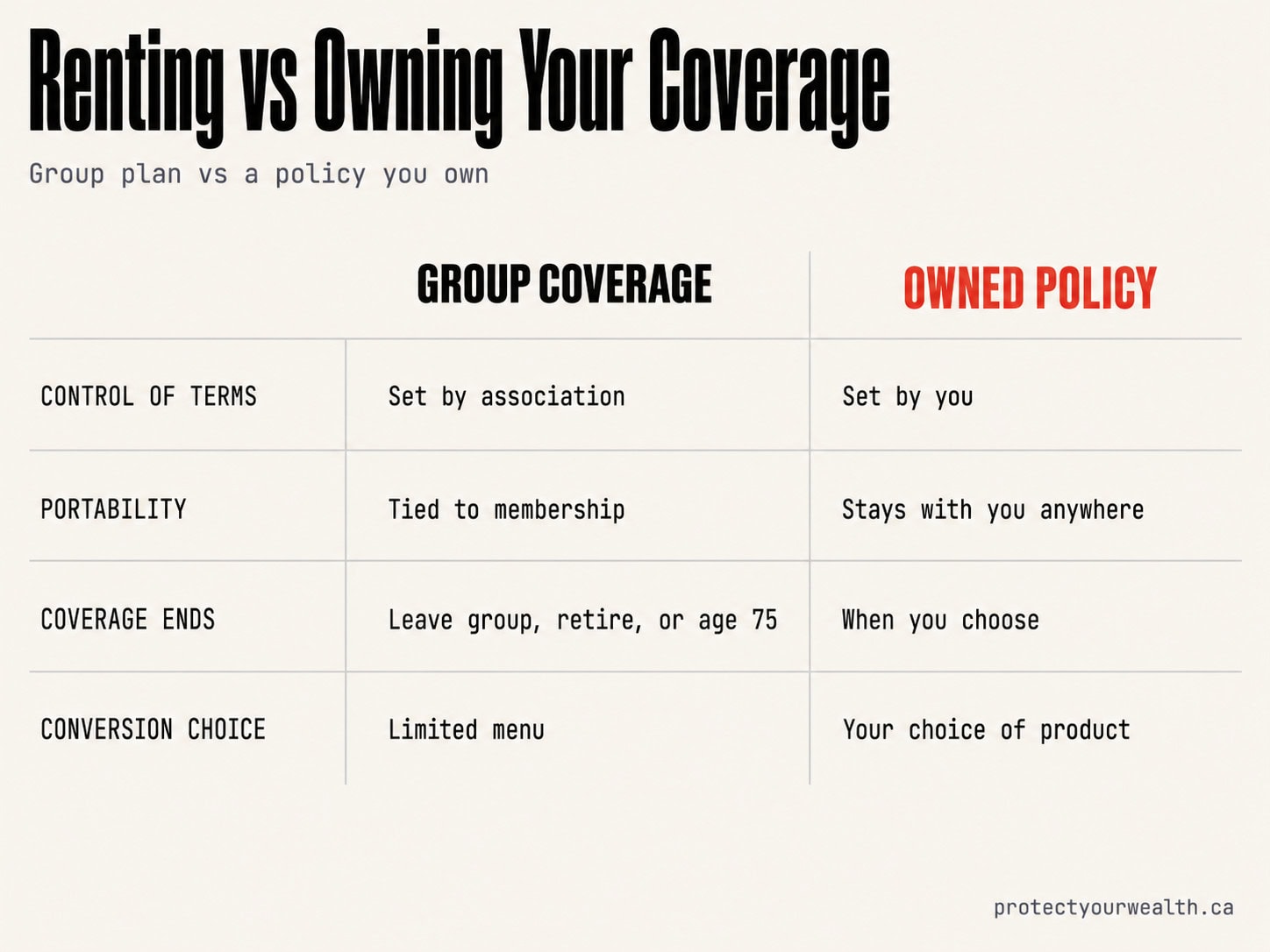
Here is the part most physicians get wrong about portability: leaving Alberta does not end your AMA coverage on its own. The plan is tied to your membership, so it ends when you retire, reach age 75, or leave the association, not because you changed provinces. There is also a conversion privilege into permanent coverage, but how that conversion is routed and which products qualify has shifted in recent years, so confirm the current terms before you assume a specific permanent plan is waiting for you.
The thing to hold onto is that this is coverage held under a group master contract, not a policy you own. With AMA you are renting protection through the association, and the terms move with the group, not with you. That is fine early on. It matters more as your income, your practice, and your family grow past what a group plan was built for.
What Individual Life Insurance Offers Alberta Physicians
Individual coverage gives you two things a group plan cannot: a real choice of product, and a policy that stays yours. Group is one shape for everyone. Owned coverage starts with picking the right tool for the job.
TermThe cheapest way to cover a fixed obligation, like a clinic loan or mortgage, for a set number of years.
Whole LifePermanent coverage with guaranteed cash value that builds over time.
Universal LifePermanent coverage with flexible premiums and an investment side you control, often funded through a corporation.
Then you choose who owns it, you or your professional corporation, which changes the tax picture. A resident with a student loan needs a very different setup than a 45-year-old partner with a clinic and three kids. Individual coverage flexes to both. Group does not.
Conversion, Portability, and Ownership: What Changes When the Plan Is Not Yours
Group coverage can change, and the terms can change at any time. That is the whole thing in one sentence. I have watched physician groups in other provinces have their plan terms shift out from under them, and the members did not get a vote. When you own your policy, personally or through your corporation, the contract terms are not tied to association membership or to future group-plan changes. You can convert, you are not locked to one provider, and you can shop the market when it makes sense.
With AMA, the coverage is tied to your membership. It does not end because you moved provinces, that is the myth I correct most often, your AMA term coverage is portable across Canada while you remain a member. What ends it is leaving the association, retiring, or reaching age 75. Those are the real walls, and they tend to arrive right when you are scaling back or restructuring your practice, which is the worst possible time to be re-shopping coverage.
The conversion window most physicians miss
Here is a pattern I have seen play out more than once. A doctor leaves their group plan, figuring they will sort out permanent coverage later. Later arrives, a health issue shows up in the meantime, and the guaranteed conversion they assumed was waiting is gone. They are now applying fresh, with that new diagnosis on the file. The window was open the whole time. They just did not know it was closing.
AMA does offer a conversion privilege. You can convert your term coverage to one of the permanent plans Manulife offers, as long as you do it before age 70, through an ADIUM advisor. Worth knowing, but read it carefully: it is a limited menu, not the open market, and the new premium is built on your age at conversion, not the age you started. Late conversions get expensive. AMA also points members toward Scotia Wealth for permanent solutions bought new, which is a separate path from converting your existing term.
Compare that to a policy you own outright. It stays in force whether you change jobs, change provinces, or leave any association. You decide how long it runs and when to adjust it. And if you want permanent coverage down the road, you are converting on your terms, into your choice of product, not whatever a group menu happens to allow that year. That is the flexibility a group plan structurally cannot give you, because the plan was never built around you in the first place.
Cost and Value in Alberta: AMA Group vs Individual
AMA group is cheaper the day you sign, and that is exactly why the cost question fools people. The group rate is a snapshot, not a lifetime number. It is low while you are young, steps up every five years, and you never own anything at the end. An individual policy costs a little more at 30 and locks that rate level for the whole term. Run it across a career and the math usually flips.
The two plans do not just cost different amounts. They cost in completely different shapes, and the shape is what physicians need to see.
AMA Group Cost Shape
Low entry premium, then a step up every five years. The AMA Premium Credit is not guaranteed and has not been paid in recent years, so budget on the premium you actually pay. Coverage ends at age 75, and the cost climbs fastest in the years a gap hurts most. You are renting, so nothing accrues to you.
Individual Cost Shape
A bit more at the start, then the rate holds level for the full term you choose. You are priced as an individual, not a pooled average, and you own the policy. No step-ups, no association renegotiating the contract over your head, and the option to build permanent cash value if it fits your plan.
The reason behind the shapes is simple. A group plan prices the pool and re-rates the pool, so your premium moves with decisions you had no vote in. An owned policy prices you once, and that number is yours to keep. The honest comparison is not this month’s premium against that month’s premium. It is what you pay across twenty or thirty years, and whether you walk away owning something or owning nothing.
For a healthy Alberta physician, locking a level individual rate young often beats a stepped group premium over the full horizon, and you get control on top of the savings. The only way to know your real number is to price both side by side, which is the comparison a broker runs for you at no cost.
Here is the part that surprises most physicians: owning your own term policy is cheaper than people assume. For a healthy 35-year-old non-smoking doctor, a 20-year term policy with the rate held level for all 20 years often lands here:
$500,000 coverage
$22 to $30
per month, 20-year term
$1,000,000 coverage
$37 to $52
per month, 20-year term
Example figures for a non-smoker in good health, based on current rates. Your actual premium varies with age, health, coverage amount, and carrier.
Set that against a group premium that steps up every five years and ends at 75. The owned policy costs a little more at the start and then stops moving, while the group cost climbs through exactly the years you can least afford a gap. That is the whole case for ownership in two numbers, and it is the comparison worth running before you assume group is the cheaper path.
Insurer Comparison for Alberta Doctors: Manulife, iA, and Beneva
The right insurer for a physician depends on what you are buying, not which company is best, because there is no single best. When I place individual coverage for physicians, I route by product type. Term gets shopped across the whole market every time, because term is a commodity and the price moves. Permanent is where the carrier choice actually carries weight, and there I have clear preferences for clear reasons.
These are not rankings. They are the lanes I actually use. A carrier I would not reach for on whole life can be the first one I reach for on universal life. Different tools, different jobs.
Whole life
Manulife, with Sun Life and Canada Life close behind
For participating whole life, Manulife is the one I reach for most. Sun Life and Canada Life are right there too. This is long-horizon coverage with guaranteed cash value, so the strength and history of the par account matter more than a few dollars of first-year premium.
Universal life
Beneva, Manulife, and BMO
For universal life, Beneva sees a lot of my UL placements, and I use Manulife and BMO UL often as well. UL is about flexible premiums and the investment side, so the fit depends on how the physician wants to fund and structure it.
Term
Shopped across the full market
Term I shop everywhere, every time. iA, Manulife, Beneva, and the rest all compete here, and the winner changes case to case. No loyalty on term, just the best fit on price and conversion options for that physician.
That is the difference between a broker and a single channel. AMA routes you to its own arrangements. I am not routing you anywhere in particular, I am matching the product to the carrier that does it best for you, and on term I am putting the whole market to work on your behalf.
Here is the practical version of all this. A broker can compare the relevant carriers for you, at no cost, in about the same time it would take you to fill out a single application direct. ADIUM is one channel offering one set of arrangements. There is no downside to seeing what other carriers offer before you commit. Get in touch and we will run the comparison together.
Riders and Add-ons Physicians Commonly Choose (and Which Ones Actually Earn Their Cost)
The riders worth paying for are the ones that protect your income and your insurability, not the ones that pad the premium. On an owned individual policy you get a wider, cleaner set of riders than a group plan offers, with definitions you can actually read. The job is simple: keep the base life coverage efficient, then add only what addresses a real risk in your situation. Our guide to life insurance riders walks through the full list, but here is what I see physicians use most.
Two of these do the heavy lifting for most doctors. A waiver of premium keeps the policy paid if you become disabled and cannot work, which for a surgeon or any hands-on specialist is not a nice-to-have. A guaranteed insurability option lets you buy more coverage later with no new medical, which matters enormously when your income and obligations are still climbing and you cannot predict your future health.
The riders physicians ask about most
- Waiver of premium: policy stays in force if you are disabled and unable to pay. Comprehensive on individual policies, basic at best on group.
- Guaranteed insurability: add coverage at set milestones with no medical evidence. Not offered under the AMA plan.
- Critical illness: lump sum on diagnosis of a covered condition. Broader definitions and more flexibility as an individual rider or standalone.
- Child term rider: low-cost coverage for all children under one rider, often convertible to their own policy later.
- Term rider (layered coverage): extra short-term protection for a clinic loan or mortgage that you drop once the debt clears. Individual policies only.
Group coverage gives you almost none of this flexibility. That is the trade-off with a one-size plan: it is simple because it does not bend. An owned policy bends to your career, your family stage, and your debt, and you add or drop riders as those change without touching the base coverage.
When to Supplement vs Replace Your AMA Coverage
Keep AMA mainly when your health makes qualifying for individual coverage a real challenge, that is the clearest case for holding the group plan. And even then, I would still compare. There are more options than most physicians realize, including carriers that underwrite difficult files, and you do not know what is available until someone shops it for you. Holding AMA because you assume you cannot get better is not the same as confirming you cannot.
For everyone else, the decision usually moves with your career stage. Early on, supplementing makes sense: keep the cheap group coverage for baseline protection and layer an owned individual policy underneath it, so you lock in level rates and ownership while you are young and healthy. As your income stabilizes and the group premiums start stepping up every five years, replacing AMA with coverage you own tends to win on both cost and control.
Keep AMA
When a health condition makes individual qualifying genuinely hard. Even here, compare first, do not assume.
Supplement AMA
Residency and early practice. Cheap group baseline plus an owned policy to lock in young, healthy rates.
Replace AMA
Once income stabilizes and step-up premiums bite. Ownership, level rates, and full conversion control.
The thread through all three is the same point I keep coming back to: owning your policy gives you flexibility a group plan never can. This is not unique to Alberta either, physicians in other provinces face the same group-versus-individual call. The plan that fits at 30 is rarely the plan that fits at 50, and the difference between renting coverage and owning it is who gets to decide that.
Application and Underwriting: What Rate Class Should You Actually Expect?
Plan around regular rates and treat preferred as a bonus. I place hundreds of policies a year, and from where I sit preferred rates come through maybe 10% of the time. The exact number moves around, but the point holds: you are more likely to land at a standard rate than a preferred one, so it is the wrong thing to build your budget on. AMA says the same in its own way, apply for $250,000 or more and they will “consider” you for preferred or elite, considered, not promised.
That is not a knock on your health. Underwriting weighs a lot of factors, and preferred classes are deliberately narrow. When preferred lands, great, it is money saved. But quoting a client a preferred rate they have not been approved for sets them up for a surprise, and I would rather show you the regular rate up front and let the better outcome be the good news.
The application itself is more involved than AMA’s quick group enrollment, and that extra step is the point: it is what lets an insurer price you as an individual instead of a pooled average. Here is roughly how it runs:
1
Quote and application. Share age, coverage amount, and basic health and lifestyle details. You see estimated rates from multiple carriers before committing to anything.
2
Underwriting path. The insurer decides how much evidence it needs. There is no-medical (a short health questionnaire, no exam, used for smaller amounts) and there is fully underwritten (full health disclosure, used for larger coverage, and the path that can earn the lowest rates).
3
Medical evidence, if needed. Larger amounts may include a brief paramedical visit (vitals, blood, and a urine sample). Smaller amounts often need only the questionnaire.
4
Decision and rate class. The insurer sets your final rate. Standard is the realistic expectation; preferred is the bonus when it comes.
5
Issue. Once approved, the policy is delivered and coverage is yours, portable across Canada, for as long as you pay the premium.
Most applications wrap up in one to three weeks. The extra time versus group enrollment buys you something group cannot: a policy priced to you, owned by you, that does not reset its terms because the association renegotiated its contract.
Beneficiaries, Taxes, and Practice Considerations in Alberta
Who you name as beneficiary, and who owns the policy, decides how much of a tax-free payout your family actually keeps. The death benefit is tax-free in Canada; the structure around it is where Alberta physicians either protect that money or quietly give some back. Group coverage never makes you think about this. An owned policy lets you get it right.
Beneficiary designation
Name a person directly and the payout skips your estate, fast and private. Let it default to the estate and it can hit probate, adding fees and delay. Naming directly is the simple win.
Personal vs corporate ownership
Corporately owned permanent coverage can move the benefit out largely tax-free through the capital dividend account. A real advantage, set up with your accountant before the policy is issued.
Practice protection
Buy-sell coverage funds a partner buyout so survivors keep control. Key person coverage protects a clinic that leans on one physician’s revenue.
The one that bites people
A stale designation. I have seen payouts go to an ex-spouse, or a parent named fifteen years ago, because the form was never updated after a marriage, divorce, or new child. The policy did its job. The designation did not. Review it after every major life event and after you incorporate.
None of this is tax or legal advice: corporate-owned insurance should be reviewed with your accountant and tax advisor before you apply.
Independent multi-carrier broker
Get Personalized Advice for Alberta Physicians
Whether AMA group coverage or an individual policy fits comes down to your stage, your health, and whether you are incorporated. We compare quotes across Canada’s insurers so you see what the whole market offers an Alberta doctor before you commit to any one channel.
We work across term, whole life, and universal life, plus segregated fund solutions, for physicians and incorporated professionals. A broker walks you through ownership, conversion timing, and the corporate tax angle so the structure fits your career and your practice.
Beneva
iA
Empire Life
Canada Life
Prefer to talk? Call 1-877-654-6119 to speak with a licensed broker. Based in Calgary, working with physicians across Alberta, including Edmonton, Red Deer, and Lethbridge.
Frequently Asked Questions
Question 01
Is AMA group life insurance enough coverage for Alberta physicians?
For most doctors it is a strong start, not the finish. The AMA plan is cheap and fast early on, but it ends at age 75, the premium steps up every five years, and you never own it. Once your income, practice, and family grow, supplementing or replacing it with an individual policy adds the rate stability and ownership a group plan cannot.
Question 02
Can I keep my AMA coverage if I move out of Alberta?
Yes. This is the myth I correct most often. AMA term coverage is portable across Canada while you remain an association member, so changing provinces does not end it. What ends it is leaving the AMA, retiring, or reaching age 75. An individual policy you own goes further still: it stays in force regardless of membership, province, or career changes, as long as premiums are paid.
Question 03
Is it worth converting AMA coverage to a permanent plan?
It can be, if you want permanent coverage and you are still inside the conversion window, which runs before age 70 and is handled through ADIUM. Read it carefully though: it is a limited product menu, not the open market, and the new premium is built on your age at conversion, so late conversions get expensive. Many physicians find a fresh individual policy gives better pricing and more choice. Compare both before you assume conversion is the move.
Question 04
Do individual policies require a medical exam?
It depends on the coverage amount. Smaller policies often need only a health questionnaire, while larger amounts may include a brief paramedical visit with vitals, blood, and a urine sample. Many Alberta physicians are healthy enough to qualify well, but plan around a standard rate and treat preferred as the bonus, since preferred classes are deliberately narrow.
Question 05
Are life insurance proceeds taxable in Alberta?
No. A life insurance payout is tax-free in Canada when it goes to a named beneficiary. If it defaults to your estate instead, it can be exposed to probate fees and delay, which is why naming a beneficiary directly usually wins. Incorporated doctors can also hold coverage in their professional corporation for tax-efficient estate planning, a structure worth setting up with your accountant.
Question 06
How do I decide whether to supplement or replace my AMA coverage?
Let your career stage decide. Early on, supplement: keep the cheap group baseline and layer an owned individual policy underneath to lock in level rates while you are young and healthy. Once your income stabilizes and the group premiums start stepping up, replacing AMA with coverage you own tends to win on both cost and control. If a health condition makes individual qualifying hard, keep AMA, but still compare first rather than assume.
Question 07
Which insurer is best for an Alberta physician’s individual policy?
There is no single best, and any company claiming otherwise is selling you their one shelf. The right fit depends on the product. Manulife is among the strongest on participating whole life, Beneva sees a lot of universal life placements, and term is worth shopping across the whole market every time since the lowest price moves case to case. Matching the carrier to the product, rather than picking one company for everything, is exactly what an independent broker does for you at no cost.





