·
· 
Life Insurance Risk Classes in Canada: How They Actually Work
By Parvesh Benning, Licensed Life Insurance Broker
Most guides treat Preferred Plus like a target to aim for, but in my experience a true approval is closer to the exception than the rule.
Your risk class is the single biggest factor in what you pay for life insurance, and the same person can land in a different class at three different carriers on the same day. This guide walks through how Canadian insurers sort applicants, what each class means for your premium, and where a broker can move the result in your favour.
Updated: June 17, 2026

Life Insurance Risk Classes in Canada: How They Actually Work
By Parvesh Benning, Licensed Life Insurance Broker, Updated: June 17, 2026
Most guides treat Preferred Plus like a target to aim for, but in my experience a true approval is closer to the exception than the rule.
Your risk class is the single biggest factor in what you pay for life insurance, and the same person can land in a different class at three different carriers on the same day. This guide walks through how Canadian insurers sort applicants, what each class means for your premium, and where a broker can move the result in your favour.
Here is the part the textbook definitions skip: the class names are roughly the same at every Canadian insurer, but the rules to qualify for them are not. As their guidelines currently stand, Manulife wants about ten years tobacco-free for its top class. RBC will look at you after two. BMO wants five. That gap between carriers is exactly where knowing the market pays off.
Below is how the classes work, what each one means for your premium, and the moves that actually shift the result in your favour.
The short version
Canadian life insurers sort applicants into health-based risk classes, commonly Preferred Plus, Preferred, Standard, and rated (also called substandard). Your class sets your premium, and because each carrier writes its own rules for each class, the same person can land in a better class at one insurer than at another.
- In my experience the top preferred classes are uncommon and usually require a full medical, so for most people the non-smoker rate is the bigger saving.
- A rated or substandard offer still pays the full death benefit. It is a price adjustment, not a denial.
- If a rating climbs high enough, a no-medical (simplified) policy can actually cost less than a rated fully underwritten one.
- A broker compares where your profile lands best across carriers, at no cost to you.
What this guide covers
- How Canadian insurers assess your risk
- The life insurance risk classes in Canada, explained
- How your risk class affects your premium
- Health and lifestyle factors that set your class
- How to land in a better risk class (and what slows it down)
- Why honest disclosure protects your payout
- Shopping your risk class across carriers
- Frequently asked questions
How Canadian Insurers Assess Your Risk (and What They Weigh Most)
When you apply, a Canadian insurer is really trying to answer one question: how likely are you to make a claim sooner than expected. Everything in the application feeds that one estimate.
They do not weigh every factor equally. Age and smoking status move the number the most. The rest fills in the picture.
Age
The single biggest lever. Younger applicants generally see lower rates, and the cost climbs steadily as you get older.
Smoking and nicotine
Smoker rates can run far higher than non-smoker rates. Vaping and most nicotine products usually count too.
Health and family history
Your own conditions matter most. Family history of early heart disease or cancer can also nudge your class.
Build (height and weight)
Most insurers run your height and weight against their own build chart, and those charts are not identical.
Occupation and hobbies
A hazardous job or activity can raise the rate or bring an exclusion. Some carriers handle high-risk occupations far better than others.
Lifestyle and history
Driving record, alcohol or drug history, and certain travel can all factor in, depending on the carrier.
Here is the part people miss. There is no single national rulebook. Each insurer sets its own thresholds, so the same answers can produce a different class at a different company. Which is why where you apply matters as much as what you disclose.
One thing worth stressing: give them accurate information. A gap or an overstatement found later can stall a claim, and that is the opposite of what the coverage is for.
The Life Insurance Risk Classes in Canada, Explained
Canadian insurers usually sort applicants into four broad health classes: Preferred Plus, Preferred, Standard, and rated (often called substandard). Better class, lower premium. That part is simple.
What is not simple is qualifying. The names look the same across carriers, but the rules behind each one are not, and that gap is the whole game.
Preferred Plus
The lowest-risk tier and the cheapest rates. Excellent health, clean family history, ideal build, no risky habits. Genuinely hard to get.
Preferred
Very good health with a minor wrinkle or two, like well-controlled blood pressure or cholesterol. Rates a touch above Preferred Plus.
Standard
Average health and life expectancy. This is the baseline most healthy applicants actually land on, and it is a perfectly good place to be.
Rated (substandard)
A health condition or risk factor pushes the price up, usually as a percentage above standard. Still full coverage, just a higher premium.
Now the part that gets glossed over everywhere else. Look at what it takes just to clear the top non-smoker bar at three Canadian carriers:
Manulife
Top class (Healthstyle 1) wants 10+ years with no tobacco, nicotine, or marijuana in any form.
RBC
Its Optimum non-smoker class looks at you after about 24 months tobacco and nicotine free.
BMO
Preferred Plus on a term plan wants no tobacco for 5 years, plus a tighter BMI cutoff.
Same person, same history, three different answers on the same day. Criteria are current carrier guidelines and can change, so treat this as the shape of the gap, not a fixed rule.
And here is what I will tell you straight, because most guides will not. In practice I see a true preferred rate maybe 5% of the time, if that. It is a difficult thing to get. A preferred rate more often than not means a full nurse visit and blood work, where a lot of plans do not require any of that.
So do not anchor on Preferred Plus. For most people the bigger win is simply clearing the non-smoker bar, which can run a fraction of smoker pricing. Chase the class that actually fits your file, not the one on the brochure. If you want to see how those classes translate into real dollars by age and amount, that breakdown lives in our guide on how much life insurance costs in Canada.
Not sure which class you would land in, or whether one carrier would treat you better than another? That comparison is exactly what an independent broker does for you, at no cost. Get in touch and we will map it out before you ever sign an application.
How Your Risk Class Affects Your Premium
Your risk class is the biggest single driver of what you pay, after age and smoking status. Move up or down a class on the same coverage and the monthly number moves with it.
But here is how I frame it for a client who is bracing for a higher quote. The rate you are offered is the best perceived rate for someone with your health history and status. It does not mean you are not getting bang for your buck. It means the insurer has assessed the risk, and that is the price today. It can change later.
And the part that matters most: you are covered for the same amount either way. If something happens, your family is paid the full benefit. A higher class affects the price, not the payout.
Same coverage, different price by class
Lowest
Preferred Plus / Preferred, for the small share who qualify
Baseline
Standard, where most healthy non-smokers actually land
Higher
Rated, a percentage above standard based on the risk factor
Smoking is the clearest example of the gap. A smoker rate can run far above a non-smoker rate for the same person, which is why clearing the non-smoker bar is usually the first real saving, well before anyone worries about a preferred class.
On the rated side, the increase is normally quoted as a percentage above standard. A modest rating might add a little. A heavy one can add a lot. The exact figures depend on the carrier, the condition, and the full file, so any number here would be illustrative only and subject to underwriting.
One judgment call I make often: once an expected rating climbs past roughly 150% in my experience, a no-medical (simplified issue) policy can actually come in cheaper than the rated fully underwritten one. Below that, the fully underwritten route usually still wins on price if you are comfortable with the medical. That is a judgment, not a hard rule, and it is one of the comparisons worth walking through with a broker rather than guessing. There is more on that trade-off in our explainer on standard, rated, and simplified coverage.
Health and Lifestyle Factors That Set Your Class
A handful of specific factors decide which class you land in, and most of them you can speak to directly when you apply. Here is what insurers actually look at, and where a broker can route you to a more forgiving carrier.
None of these is automatically a dealbreaker on its own. What changes the result is the combination, and which carrier you put it in front of. That second part is the one you have the most control over, and it is the part people skip.
How to Land in a Better Risk Class (and What Slows It Down)
You can improve your risk class, but the biggest lever is the one most people overlook: get covered now, then optimize. Health can change, and the rate you lock in today is based on who you are today.
That is not a sales line. I have watched people wait to “qualify better later” and pick up a new condition in the meantime. Now they are insuring two things instead of one. Lock in insurability first, refine the price after.
With that said, here are the levers that actually move your class or your premium:
Clear the non-smoker bar
Twelve months nicotine-free moves most people off smoker rates, which is usually the single largest saving on the table.
Manage what is on file
Controlled blood pressure, healthier build, and stable bloodwork can lift you a class. Document the improvement before you re-shop.
Pay annually
Paying yearly instead of monthly saves roughly 9% on most policies. Same coverage, lower total cost, nothing to qualify for.
Use a multi-life policy
A couple can sometimes cover two lives under one policy and save the second policy fee. This is two insureds on one contract, not a joint first-to-die.
The 9% figure and the multi-life saving reflect how these typically work and are subject to the carrier and the plan, so confirm the exact numbers on your own quote. There is a fuller list in our guide on smart ways to lower your premiums, and the health side is covered in boosting your financial health to lower your costs.
One thing that genuinely slows you down: applying everywhere at once. Multiple applications can leave a trail on your record that makes the next one harder. Better to assess where you fit first, then apply once, in the right place.
And revisit it. A marriage, a new mortgage, a baby, a career change, or a real health improvement are all reasons to re-check your class and your coverage amount. If you are weighing how long to lock the rate in, our guide on choosing the right term length walks through it.
Why Honest Disclosure Protects Your Payout
Accurate disclosure is the one part of this you fully control, and it is the part that protects the payout you are paying for. Tell the insurer the real picture, and the policy does its job when your family needs it.
The risk is not the higher premium. The risk is a claim that gets questioned later.
What the contestability period means for you
In Canada, an insurer generally has the first two years of a policy to review the application if a claim comes in. A material misstatement or omission can create serious claim problems, and in some cases may allow the insurer to adjust or deny the claim. That is the scenario you never want your family to face, and it is entirely avoidable.
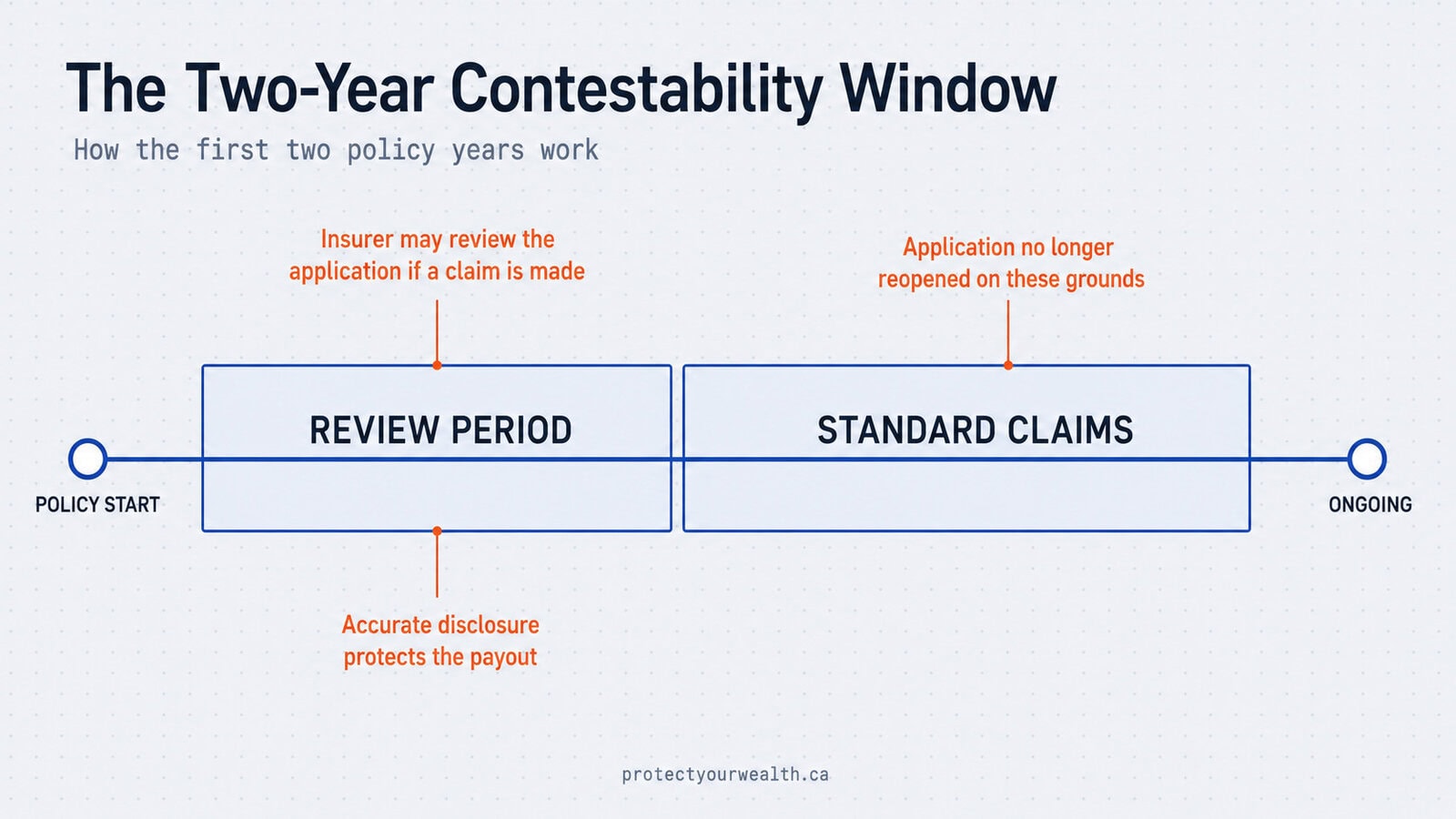
So when you apply, be straight about the things people are tempted to soften: smoking or vaping, alcohol, any conditions or medications, a risky job or hobby. A rated offer because of one of those is still full coverage. A claim denied because it was hidden is nothing.
There is a quieter upside too. Being upfront lets a broker steer your file to the carrier most comfortable with your situation, instead of guessing and hoping. That is often the difference between a clean approval and a decline you then have to work around.
If you are not sure whether something needs disclosing, the answer is almost always yes. Put it on the table and let the underwriting sort it out properly the first time.
Shopping Your Risk Class Across Carriers
The smartest way to shop a risk class is to compare carriers before you apply, not after you have a quote in hand. Because each insurer scores you differently, the same profile can land a better class somewhere you would not have guessed.
For me, the biggest factor in where a file goes is underwriting: who is easiest to get approved with for this specific person. Not who has the flashiest rate on a comparison site, the carrier most likely to give this client the class they actually deserve.
Here is the order I work in, and the order I would suggest you think in:
1
Size the need first. Figure out how much coverage actually protects your family or business before you look at a single price. Our guide on how much life insurance you need is the place to start.
2
Match the term and product to that need and your budget, by health and smoker status. If term is the fit, comparing term life in Ontario shows how options stack up.
3
Pre-assess where you fit before applying. A broker can read your profile against several carriers’ rules and point to the one likely to give you the best class.
4
Apply once, in the right place. If a full medical is not the right path for your health, a no-medical option may be the cleaner route.
This is also the honest answer to a fair question: why use a broker instead of going straight to one company? A single insurer can only offer you its own class on its own chart. An independent broker compares several at once, for free, and that is the entire point. You are not paying more to have someone find you the better class. You are paying the same and skipping the guesswork.
Frequently Asked Questions
Q1
What determines my life insurance risk class in Canada?
Your risk class is set mainly by age, smoking status, health and family history, build, and your occupation or hobbies. Each insurer weighs these against its own rules, so the same profile can land in a different class at different carriers.
Q2
How hard is it to qualify for Preferred Plus?
In practice it is uncommon. A true preferred rate shows up only a small share of the time and usually requires a full medical with bloodwork. For most people the larger and more achievable saving is simply qualifying for non-smoker rates.
Q3
What does a rated or substandard offer actually mean?
It means the insurer is charging a premium above standard because of a health or risk factor, usually expressed as a percentage. The coverage and the death benefit are the same. It is a price adjustment, not a denial.
Q4
Can I move to a better risk class after my policy starts?
Often yes. If you quit smoking for the required period, improve your build, or get a condition under control, you can ask to be reassessed or re-shop the policy. Quitting nicotine for 12 months is usually the change with the biggest effect.
Q5
Why do two healthy people get different rates for the same coverage?
Because each insurer scores risk a little differently and sets its own class thresholds. Two similar applicants can be placed in different classes at the same company, or the same class at different prices across companies. Comparing carriers is how you find your best fit.
Q6
What happens if I leave something off my application?
An insurer generally has the first two years to review the application if a claim is made. A material omission found in that window can let them adjust the policy or decline the claim. Full disclosure up front is what protects the payout.
Not sure which risk class you would land in?
That is the question worth answering before you apply anywhere. The same health profile can be scored differently at each carrier, and landing in a better class is often just a matter of putting your file in front of the right insurer the first time.
Protect Your Wealth has been an independent brokerage since 2007. We compare your profile across more than 20 Canadian carriers for life insurance and segregated fund solutions, at no cost to you, and map out where you fit best before a single application goes in.
We are based in Hamilton and licensed across Ontario, British Columbia, Alberta, Manitoba, Saskatchewan, New Brunswick, and Nova Scotia, including areas such as Kelowna, Waterdown, and Kitchener.
Prefer the phone? Call 1-877-654-6119 to talk to a broker directly.