·

Life Insurance on Antidepressants in Canada
By Parvesh Benning, Licensed Life Insurance Broker
Many people on antidepressants brace for a decline or a punishing premium. It often goes better than expected.
Insurers do not rate you for filling a prescription. They rate you for stability: a clear diagnosis, a steady dose, no recent crisis. This guide covers what that means for your approval, the ratings to expect across Canadian carriers, and the application path that gets you covered without surprises.
Updated: June 2, 2026

Life Insurance on Antidepressants in Canada
By Parvesh Benning, Licensed Life Insurance Broker, Updated: June 2, 2026
Insurers do not rate you for filling a prescription. They rate you for stability: a clear diagnosis, a steady dose, no recent crisis. This guide covers what that means for your approval, the ratings to expect across Canadian carriers, and the application path that gets you covered without surprises.
Here is the part most people get backwards: an insurer is usually more comfortable with someone who has been stable on the same medication than with someone who just came off it. Stability is what they are buying. So the first move is rarely to shop blind. It is to work out whether a fully underwritten policy makes sense, and when a file is borderline, to run it past a carrier anonymously before anything formal is submitted.
Yes, you can get life insurance while taking antidepressants. Many Canadians on a stable prescription can qualify, and they are often pleasantly surprised at how affordable the coverage is.
What actually moves your price is not the medication itself:
- How stable you are: a steady dose with no recent change counts for more than the diagnosis on its own.
- One medication or several: a single, stable prescription is straightforward; multiple medications or other conditions on file need a closer look.
- Recent events: time off work, a hospital visit, or a dose change in the last few months can shift the outcome, which is exactly when a broker prescreens carriers before you apply.
What this guide covers
- Can you get life insurance while taking antidepressants?
- Does it make life insurance more expensive?
- How insurers underwrite antidepressant use
- How an antidepressant application is actually routed
- Ratings to expect (and what changes them)
- Do you have to disclose antidepressant use?
- Underwritten vs simplified vs guaranteed
- How Canadian insurers compare on antidepressants
- Frequently asked questions
Does Taking Antidepressants Make Life Insurance More Expensive?
Often not, not if you are stable. That is the part people get wrong. Many clients call me braced for a decline or a punishing premium, and many are pleasantly surprised at how affordable it actually is to protect their family.
Here is what is really going on. The medication is not the thing being priced. Stability is. A single prescription you have held steady, regular follow-up, no recent hospital visit or time off work, that profile lands at standard rates more often than not. The price only moves when the file gets busier: a dose change in the last few months, a second medication, another condition sitting alongside it.
Stable, one medication
Steady dose, follow-up in place, no recent crisis. Standard rates are on the table, and preferred is not off it.
Recent change or a second factor
A dose change in the last few months, two meds, or another condition. Could still be standard, could be rated. This is where it pays to check before you apply.
And if you do get a rating, hear me on this: that is not a bad outcome. A rating just means we found you the best available offer for your real risk. You are covered, your family is protected, that is the win. I do not apologize for a rated offer and you should not feel discouraged by one. Where the cost actually gets decided is the carrier you land at, because they do not all read the same file the same way, which is the whole reason to work with a broker who knows the differences instead of going direct to one company.
How Insurers Underwrite Antidepressant Use (What They Actually Look At)
Insurers underwrite the stability of your condition, not the prescription on its own. When someone comes to me, the first thing I am pinning down is the full picture: the diagnosis, the date of onset, the dose, and how long you have held steady on that same dose. That last one matters more than people expect.
From there I am looking at the things that tell an underwriter whether life is on an even keel or not. Any time off work. Any ER visits or hospital stays. What treatment you are actually getting, medication alone or counselling alongside it. And whether there is any alcohol or drug history sitting in the background.
What an underwriter is weighing
- Diagnosis and onset: what was diagnosed, and when symptoms first showed up.
- The dose, and time on it: a steady, unchanged dose reads as control. A recent change raises a question.
- Treatment and follow-up: regular check-ins, counselling, a doctor who is actually in the loop.
- Time off or hospital visits: a stretch off work or an ER visit changes the read.
- What else is on file: alcohol or substance history, and any other condition alongside the depression.
Here is the thing most people miss. The depression rarely decides it on its own. It is the company it keeps. The single biggest swing factor is what else is going on, another condition, other medications, a rough patch that put you off work. If you are managing more than one prescription, that is worth understanding up front, and our guide on other medications that can affect a life insurance application walks through how that gets weighed. A clean, single, stable file is the easy version. Everything else is a conversation.
How an Antidepressant Application Is Actually Routed (My Process)
Fully underwritten is where I start, almost every time. If you are on one antidepressant, stable, working, no recent crisis, my belief is a standard fully underwritten policy is genuinely on the table, and that is the best price you will get. So before anyone fills out a formal application, I am confirming the basics: diagnosis, onset, dose, time on that dose, any time off work, any ER visits, what treatment you are on, whether there is alcohol or drug history. That tells me which lane you are in.
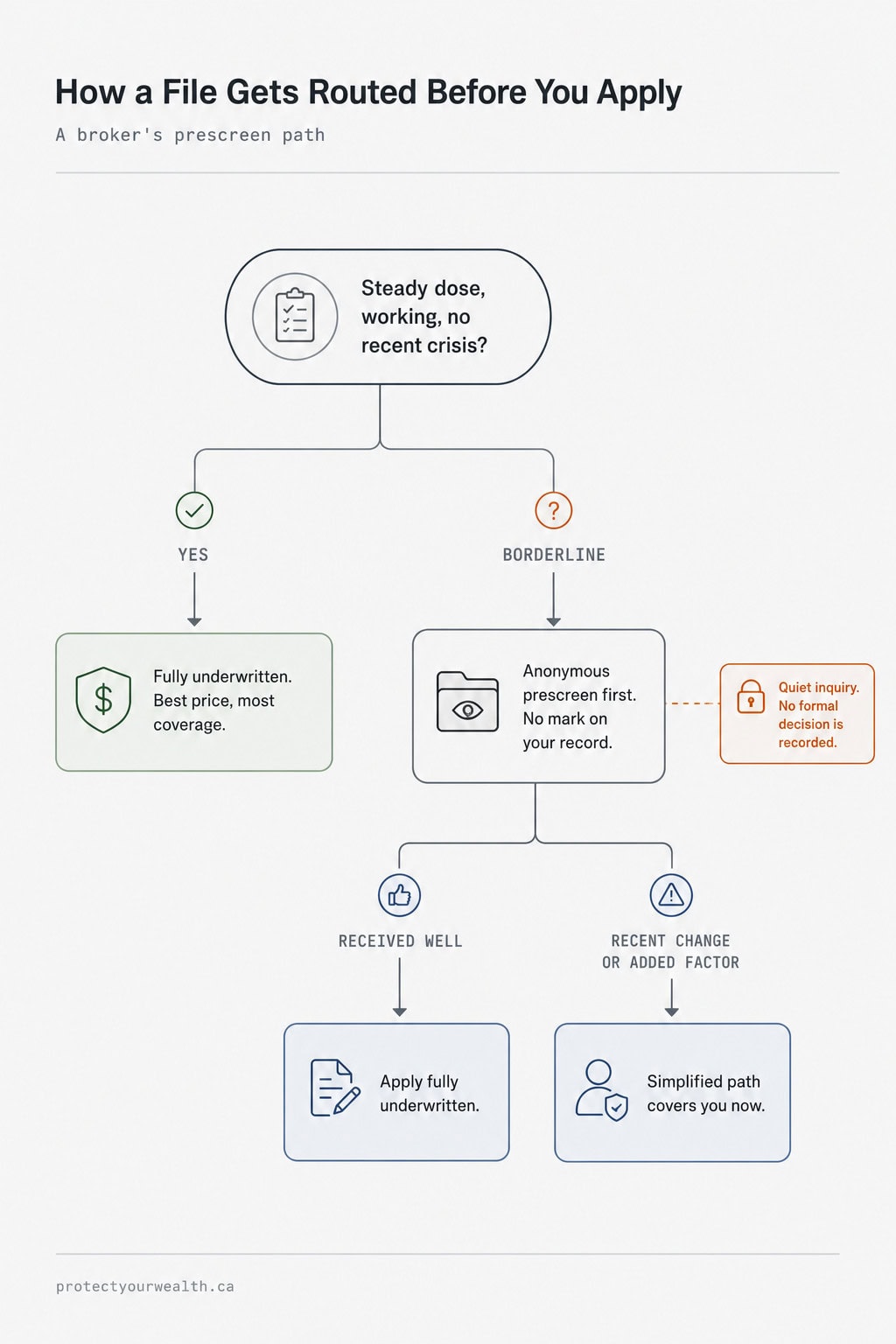
Now here is the part competitors cannot show you, because it does not happen on a public page. When a file is borderline, I run an informal prescreen first. I take your details to a carrier’s prescreening desk, anonymously, no name attached, before anything formal is ever submitted. Different carriers handle it differently. Some run a central prescreening intake that takes everything in. Others I reach straight through my back office contacts. Either way it is an anonymous inquiry, so we learn the likely answer without a single mark landing on your record.
Why that matters: a formal application that gets rated or declined follows you. A quiet prescreen is not a formal application decision, so it does not. We find out where you stand first, then we apply where we already know you will be received well.
A dose change three months ago. How I’d route it.
First question: why did it change? A routine optimization is a very different story than a relapse with worsening symptoms. So I am asking, was this just fine-tuning, or were things getting worse? Any new diagnosis? Any time off work?
Then I prescreen it. A recent change is exactly the case for checking with fully underwritten carriers anonymously first, to see who is comfortable before we commit.
Two meds plus something else on file? Same move, prescreen first. It could still come back standard. It could come back rated or postponed. And this is the kind of file where a simplified policy may make more sense, so I would pivot to a provider like CPP or Assumption Life if that is the cleaner path to getting you covered.
None of this is one size fits all. The whole point of doing it this way is that you find out what is real for your situation before you ever sign an application, and you end up at the carrier that actually fits your file. That is also why the same medication can land standard at one company and rated at another, which I get into next.
Ratings to Expect on Antidepressants (and What Changes Them)
Most stable, well-treated cases land Standard, and the milder ones can reach Preferred. The rating tracks how settled your condition is, not the label on the bottle. A single medication held steady, regular follow-up, no recent crisis, that is the profile carriers reward. The number only climbs when the file gets busier.
Roughly how it tends to break down, recognizing every file is its own thing:
Mild, situational, well controlled
Standard, often Preferred. One stable medication, follow-up in place, no hospitalizations.
Moderate, stable a year or more
Standard once you have held steady, no relapse, no medication change.
Recent change or recently diagnosed
A mild rating is common while things settle. Often improves once the dust clears.
Severe, hospitalized, or unstable
Could be rated or postponed while you build a track record. A simplified plan often covers you in the meantime.
Two things actually move you up these tiers. The first is time. Carriers want stability, so a recent medication change is the one thing I will sometimes tell a client to let settle. Three months is the bare minimum I look for. Six months is the sweet spot. For fully underwritten plans, frankly, I like to see closer to a year, because more than anything insurers are buying a steady track record. The second is the carrier itself, since the same file reads differently from one company to the next.
And if a rating does come back, do not read it as a loss. To me a rated offer is a positive. It is the best available option for your real risk profile, and it means your family is protected. That is the outcome that counts.
Not sure whether to apply now or let a recent change settle?
That timing call is worth getting right, and it is different for every file. Get in touch and we will look at whether now is the moment or whether a short wait gets you a better rate.
Do You Have to Disclose Antidepressant Use?
Yes, and you want to. Disclose it. Every time. Your prescription history shows up in underwriting anyway, so hiding it does not help you, it just hands the insurer a reason to question the whole application later.
Here is what people get backwards. They treat the disclosure like a confession, something to bury. It is the opposite. A clear treatment history is your evidence. It shows a diagnosis that is named, a dose that is steady, a doctor who is in the loop. That is the stability story underwriting is looking for, and you only get to tell it if you put it on the table.
| Full, honest disclosure Your treatment history works as proof of stability. The application holds up. A claim years later is clean. |
Leaving it out It surfaces in underwriting regardless. Worse, a non-disclosure can void a payout when your family needs it most. |
The one thing I will say is do not submit blind. Disclosing well is a skill: how the file is framed, which carrier sees it, what gets attached. That is the work a broker does for you. If your history runs past antidepressants into a broader mental health diagnosis, framing it properly matters even more.
Underwritten vs Simplified vs Guaranteed: Which Path Fits You
For a stable file, fully underwritten almost always wins, because it is the lowest price and the most coverage. That is where I start. The trade is time and a bit of process: medical questions, sometimes a nurse visit, sometimes a report from your doctor. If you are steady on one medication and working, that process is usually worth it, and standard rates are realistic.
But it is a real decision, not a default. Some people would rather skip the hassle and get covered quickly. That is a fair call, and it is a conversation I have with clients all the time: do you want the best price, or the fastest, cleanest route to being protected? Here is how the three paths actually stack up.
Path 1
Fully underwritten
Best price, most coverage. Full medical review, possibly a report from your doctor. The right fit when you are stable on one medication with no recent crisis.
Path 2
Simplified (no medical)
No exam, no doctor’s report, just health questions. Covers you fast. The practical move after a recent dose change or when something else sits on file. Think CPP or Assumption Life.
Path 3
Guaranteed issue
Acceptance with no health questions at all. Higher cost, smaller coverage. A genuine safety net for the toughest files, rarely the first answer.
My honest read: most people on antidepressants never need to go past Path 1 or 2. The recent-change cases are where simplified earns its place, and you can often upgrade to a fully underwritten plan later once you have a year of stability behind you. If you want to see the simplified side in detail, our guide to no-medical life insurance options breaks down how those plans work.
Find out where you stand before you ever apply.
A quiet, anonymous prescreen means no formal application decision lands on your record. We learn the likely answer first, then apply only where you will be received well.
Bring your diagnosis, your medication, and any recent changes. We will tell you honestly whether to apply now or let things settle for a better rate.
Or call 1-877-654-6119. Independent, multi-carrier, no obligation.
How Canadian Insurers Compare on Antidepressants
No single carrier is best for everyone, because the same file reads differently from one company to the next. That is the entire reason to compare rather than walk into one insurer’s branch. A stable, single-medication file might land standard at one carrier and pick up a rating at another, on identical facts. Below is roughly how the major Canadian insurers tend to approach it. Treat these as tendencies, not promises: the real answer comes from your full application.
Fully underwritten carriers (best price for stable files)
Canada Life
Mild, ongoing treatment, no time off, no hospitalization tends to land Standard. Often cost-effective, and reasonable even when a medication started in the last year.
Empire Life
Mild and treated tends to Standard. Moderate can run higher, and a hospitalization or suicide attempt on file pushes the rating up. A doctor’s report is likely if there has been a hospital stay.
Foresters
Mild, controlled cases sit around Standard to a small rating. Moderate or severe moves toward a higher rating or a postponement. Accessible, with a dedicated depression questionnaire.
iA (traditional)
Minor depression often starts with a small rating and improves to Standard after about a year of stability. Time off work generally means a postponement until things settle.
Manulife
Standard through to a rating, weighed on severity, any hospitalization, and the medication itself. Strong fit for clean, stable files.
Sun Life
Works off a mental-health questionnaire and leans on stability. A settled, well-documented file is what moves it toward Standard.
Beneva (fully underwritten)
A single episode that has resolved can reach Standard. Recurrent but stable picks up a modest rating. Severe or hospitalized moves toward a higher rating or postponement.
Simplified and guaranteed carriers (when fully underwritten is not the move)
Beneva Simplified
No medical exam. Depression is generally eligible when there has been no work absence over a month and no medication increase in the last 12 months.
iA Access Life
Anxiety and depression generally route to the top tier, Immediate Plus, meaning full coverage from day one with no medical exam.
Canada Protection Plan
A simplified go-to. Depression with no hospitalization over 24 hours generally qualifies; their Express tier wants no missed work, hospitalization, or suicidal ideation.
Assumption Life
My other simplified pivot for recent or busier files. Mild to moderate is workable, with a short wait after any time off work.
Outcomes here are illustrative and depend on your full application. Always work through the application with a licensed broker before assuming eligibility or a rate class.
This is exactly why going direct to one company can cost you. A broker runs your file against the carriers most receptive to it, instead of betting everything on one insurer’s view. And if you are managing more than one prescription, the picture widens further, which our guide on other medications that affect a life insurance application gets into.
Frequently Asked Questions
Q1
Can I get life insurance if I am currently taking antidepressants?
Yes. Most Canadians on a stable antidepressant qualify, and many at Standard or Preferred rates. Insurers weigh how settled your condition is, the medication, and whether you keep regular follow-ups, far more than the prescription itself.
Q2
Will my premiums be higher because I take antidepressants?
Often not. A mild, well-managed case on one steady medication is frequently rated the same as someone with no mental-health history. The price only tends to climb with a recent dose change, multiple medications, a hospitalization, or another condition on file.
Q3
Should I stop taking my medication before I apply?
No. This is the one that trips people up. Insurers are buying stability, so they are usually more comfortable with someone steady on the same medication than someone who just came off it. Stopping to look healthier on paper tends to backfire. Stay on your treatment and apply.
Q4
Do I have to disclose my antidepressant use on the application?
Yes, always. Your prescription history shows up in underwriting regardless, and leaving it out can void a payout later. Full disclosure also works in your favour: a clear treatment record is exactly the proof of stability underwriters want to see.
Q5
What if I have a recent medication change or was recently diagnosed?
You can still get covered. A recent change is the one situation where waiting can pay: about three months is the minimum, six is the sweet spot, and closer to a year is ideal for fully underwritten plans. If you need coverage now, a simplified plan with a carrier like CPP or Assumption Life can bridge you, with the option to upgrade later once you are stable.
Q6
What if I have already been declined?
A decline at one insurer does not mean you are uninsurable. Carriers read the same file differently, so a broker can take your case to one more receptive to it, or move you to a simplified plan. If your history goes beyond antidepressants, our guide on life insurance with a mental health diagnosis covers the wider picture.
Protect Your Wealth
Get the right coverage at the right price, without the guesswork.
We are an independent, multi-carrier brokerage. We prescreen the insurers most receptive to your file and compare them for you, so you are never betting everything on one company’s view. Life insurance and segregated fund solutions, for clients across Canada.
Or call 1-877-654-6119. No obligation, no pressure.
Alberta
British Columbia
Manitoba
Saskatchewan
New Brunswick
Nova Scotia