·
· 
TD Life Insurance Review
By Parvesh Benning, Licensed Life Insurance Broker
TD’s brand is one of the strongest in Canadian banking. Their life insurance is a much smaller operation than most people realize.
I get calls from TD life insurance clients every month. The conversation almost always starts the same way: they just got their renewal notice, and the new premium is three, four, sometimes ten times what they were paying. They had no idea it worked this way.
Updated: March 25, 2026

TD Life Insurance Review
By Parvesh Benning, Licensed Life Insurance Broker
TD’s brand is one of the strongest in Canadian banking. Their life insurance is a much smaller operation than most people realize.
I get calls from TD life insurance clients every month. The conversation almost always starts the same way: they just got their renewal notice, and the new premium is three, four, sometimes ten times what they were paying. They had no idea it worked this way.
Updated: March 25, 2026
TD is a trusted name in Canadian banking but does that reputation translate into competitive life insurance? In this blog, we dive into the real mechanics behind TD’s Term and Permanent policies, including what’s guaranteed, what’s excluded, and how their premiums stack up as you age. Whether you’re exploring bank-owned coverage or comparing it to brokered policies, this review highlights what matters most to your family’s financial future.
While TD policies are easy to apply for and medically lenient, they come with hidden renewal jumps, capped benefits, and fewer customization options than many brokered alternatives. We break it all down to help you make an informed, regret-free decision.
Quick verdict
Already with TD? Before you renew or convert, get a broker comparison first. Renewal premiums can jump 10x and the conversion window closes at 69 with no reminder from TD.
Shopping for new coverage? Wondering if TD Life Insurance is good? TD is rarely the most competitive option. A broker can access 20+ carriers and almost always find better pricing for the same coverage. TD advertises 10% discounts, but rates are much higher to begin with compared to market
Only exception: If your health has changed significantly and fully underwritten or simplified issue options are unavailable, staying with TD or converting an existing policy may genuinely be your best move. A broker can tell you which situation you’re in.
Jump ahead:
- Company Overview
- Pros and Cons
- TD Term Life Insurance (10, 20, and 30-Year)
- TD Permanent Life Insurance
- Other TD Products
- TD Customer Reviews
- TD Policy Limitations
- What Happens at Renewal: What TD Won’t Tell You
- How TD Compares to Brokered Alternatives
- Honest Verdict: Who Should Actually Use TD
- Why TD Costs More Than Broker Alternatives
- Thinking About Cancelling Your TD Policy?
- Frequently Asked Questions
Company Overview
TD Insurance is the insurance arm of Toronto-Dominion Bank, Canada’s largest bank by total assets and one of the top 10 in North America. Founded in 1955 and headquartered in Toronto, TD Bank holds over $1.95 trillion in assets and serves more than 13.5 million Canadian clients and 27.5 million globally.
In banking, the TD name carries real weight. In life insurance, it’s a different story. TD ranks among the smaller players in the Canadian market by annual premiums, well behind Manulife, Canada Life, Sun Life, and iA Financial. The product lineup reflects that: no whole life, no universal life, and a limited rider selection compared to what a licensed broker can access across the full market.
TD does offer a range of products alongside their life insurance options, including mortgage and home insurance, auto, travel, and accident coverage. The policies carry Assuris protection like all Canadian life insurers, and TD holds an AM Best financial strength rating. The bank isn’t going anywhere. The question is whether their life insurance products are the right fit for your situation.

Pros and Cons
TD Life Insurance Pros
- Coverage up to $10 million, higher than most direct-to-consumer competitors
- Instant approval without a medical exam: up to $1 million if you’re under 50, up to $500,000 if you’re under 60, up to $250,000 if you’re under 70
- 30-day review period with full premium refund if cancelled
- Online application typically completed in 15 to 30 minutes
- Backed by TD Bank’s financial strength and Assuris protection
- Guaranteed Acceptance available for Canadians aged 50 to 75 regardless of health. See our guide to life insurance for seniors over 60 for broader options in this age range.
TD Life Insurance Cons
- No whole life or universal life options, only term and guaranteed acceptance
- Renewal premiums increase sharply after the initial term. A $60/month policy can become $600/month at renewal.
- Almost no riders: waiver of premium only, no child, disability, or accidental death add-ons
- Conversion to permanent coverage must happen before age 69, within TD’s product suite only
- All term coverage expires at age 80 regardless of how many times it has renewed
- Guaranteed Acceptance caps at $25,000 with a two-year waiting period on non-accidental death
- The 10% TD customer discount applies to a base rate that is almost always higher than brokered alternatives without any discount
- No joint policies, no spousal coverage, no critical illness bundling
TD Term Life Insurance (10, 20, and 30-Year)
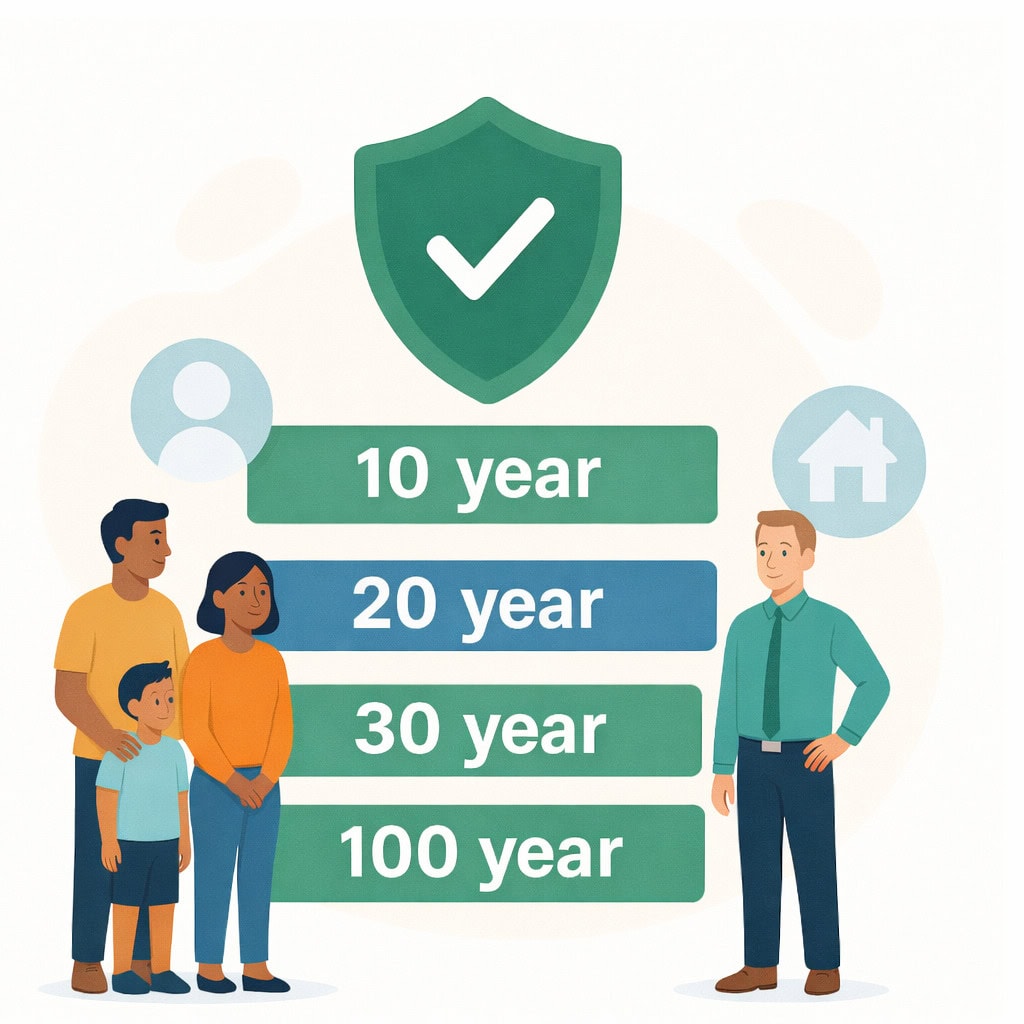
Term life insurance covers you for a fixed period at a locked-in premium. TD currently offers three term lengths: 10, 20, and 30 years. All three renew automatically at the end of the term without a medical exam (however often at a significantly higher premium), and all expire completely at age 80. Premiums are fixed during the term but increase at each renewal based on your age at that time.
10-Year Term Life
Coverage amount: $50,000 to $10,000,000
Length of coverage: 10 years, renewable every decade until age 80
Issue ages: 18 to 69
Features:
- Renews automatically every 10 years without medical re-qualification
- Convertible to Term 100 permanent coverage up to 6 months after age 69
- Instant approval up to $1,000,000 if under 50, up to $500,000 if under 60, up to $250,000 if under 70
- 10% discount for TD customers, 5% for eligible graduates or professionals (discounts cannot be combined)
- Renewal premiums increase sharply at each term end. A $60/month policy can renew at $600/month or more depending on age.
20-Year Term Life
Coverage amount: $50,000 to $10,000,000
Length of coverage: 20 years, renewable at end of term until age 80
Issue ages: 18 to 59
Features:
- Renews automatically at end of term without a new medical exam
- Convertible to Term 100 permanent coverage up to 6 months after age 69
- Instant approval up to $1,000,000 if under 50, up to $500,000 if under 60
- TD loyalty and professional discounts available
- Despite the 10% discount, brokered alternatives are almost always cheaper at the same coverage amount
30-Year Term Life
Coverage amount: $50,000 to $10,000,000
Length of coverage: 30 years, renews annually after the initial term until age 80
Issue ages: 18 to 49
Features:
- Fixed premiums for the full 30-year term, no increases until the term ends
- Renews annually after the initial 30-year period, with premiums increasing at each annual renewal
- Convertible to Term 100 permanent coverage up to 6 months after age 69
- Instant approval up to $1,000,000 if under 50
- 10% discount for TD customers or online applicants, 5% for eligible graduates or professionals
- Suited for longer-term obligations like a 30-year mortgage or young families locking in early
TD Permanent Life Insurance
Permanent life insurance provides lifelong protection with premiums that don’t increase with age. TD offers two permanent options: Term 100 for those wanting lifetime coverage at a fixed cost, and a Guaranteed Acceptance product for Canadians aged 50 to 75 who need coverage regardless of health. Neither option includes cash value or investment components.
Term 100 Lifetime Coverage
Coverage amount: $50,000 to $10,000,000
Coverage duration: Permanent (to age 100)
Issue ages: 18 to 69
Premium payment options:
- Monthly or annual payments until age 100
Features:
- Fixed premiums that don’t rise with age or health changes
- Instant approval up to $1,000,000 if under 50, up to $500,000 if under 60
- 10% discount for TD customers, 5% for eligible graduates or professionals
- No cash value or investment component, this is not a participating or whole life plan
- Premiums cannot be paid up early, payments continue to age 100 regardless of when coverage starts
TD Guaranteed Acceptance Life Insurance
Coverage amount: $5,000 to $25,000
Coverage duration: Permanent
Issue ages: 50 to 75
Premium payment options:
- Monthly or annual payments until age 100
Features:
- Guaranteed approval with no medical exam or health questions
- Fixed premiums locked in at issue
- After two years, accidental death pays up to 5x the death benefit
- Terminal illness living benefit: advance up to 50% of coverage if diagnosed
- Two-year waiting period applies: non-accidental death within the first two years returns premiums paid only, not the full benefit
- Coverage capped at $25,000 total per person
- Premiums are generally higher than comparable simplified issue options available through a broker, even without a medical exam requirement
Other TD Life Insurance Products
Beyond life insurance, TD offers additional protection through standalone or add-on policies. These include critical illness insurance, disability insurance, accidental death insurance, and a critical accident recovery benefit. These plans are easy to apply for but carry meaningful limitations worth understanding before you buy.
TD Critical Illness Recovery Plan
Pays a tax-free lump sum if you’re diagnosed with a covered illness like cancer, heart attack, or stroke.
Coverage: $10,000 to $100,000
Coverage Duration: Reduces by 50% at age 65, terminates at age 70
Issue Ages: 18 to 54
Features:
- Fixed premiums for the first 10 years
- Limited payout ceiling and early expiry compared to full-featured CI plans available through a broker
TD Accident Disability Insurance Plan
Pays a tax-free monthly benefit if you’re unable to work due to an accident. Illness-related disability is not covered.
Coverage: $500 to $1,500 per month
Coverage Duration: Until age 70
Issue Ages: 18 to 60
Features:
- No medical exam required, though pre-existing conditions are excluded
- Eligibility requires working 30 or more hours per week in a non-dangerous occupation
- Includes one-month post-disability recovery benefit
TD Accidental Death Insurance Plan
Provides a lump sum payout if death results from a covered accident.
Coverage: $50,000 to $250,000
Coverage Duration: Reduces by 50% at age 65, terminates at age 70
Issue Ages: 18 to 65
Features:
-
- Automatic approval with no medical exam or health questions
TD Customer Reviews
On Trustpilot, TD Insurance sits at 1.2 out of 5 from over 1,000 reviews. The positive reviews cluster around one thing: the application was fast and easy. Everything else is where the problems start.
The most consistent complaint pattern is what happens after you’re a customer. On r/PersonalFinanceCanada, multiple users have documented renewal shock in detail, with threads showing premiums climbing from a few hundred dollars per month to over $10,000 per year by the mid-60s. That’s not an anomaly. That’s how term renewal math works when premiums reset to your current age with no market competition involved.
Recurring complaints across Trustpilot include policy transition errors where refunds from cancelled plans take months to arrive, customer service reps with no record of previous calls, and application processes that promised no medical exam but stretched past six weeks with repeated requests. For anyone with dependents, a multi-week coverage gap during a policy switch is a real problem.
Positive reviews do exist. Fast approvals, simple online process, and no surprises during the initial term are the consistent positives. The TD name carries genuine trust for Canadians who already bank there.
The pattern I see in my practice lines up with what’s online. The application experience is genuinely smooth. It’s the renewal, the conversion window, and the service experience where things get complicated. By that point, most policyholders have moved on with their lives and don’t realize what they agreed to years earlier.
TD Life Insurance Policy Limitations
These are the structural limitations that matter most. None of them are hidden exactly, but they’re buried in policy documents that most people don’t read until something goes wrong.
- Conversion window closes at 69: You can convert a term policy to Term 100 only up to 6 months after your 69th birthday. Miss that window and the option is gone permanently. Converting at 55 versus 68 is not the same decision at all.
- Renewal premiums increase sharply: Premiums are fixed during the initial term but reset completely at renewal based on your current age. A $60/month policy can become $600/month or more at the next renewal. I see this regularly when clients call after opening their renewal notice.
- All term coverage expires at age 80: Regardless of how many times a policy has renewed, coverage stops completely at 80. There is no option to continue.
- No joint or spousal policies: TD only offers individual policies. Joint-first-to-die coverage and spousal plans are not available, which is a meaningful gap for couples who want combined protection under one plan.
- Almost no riders: Waiver of premium is the only rider available on TD life insurance policies. No child rider, no accidental death benefit, no critical illness add-on, no disability rider beyond the basic waiver.
- Guaranteed Acceptance two-year waiting period: Non-accidental death within the first two years returns premiums paid only, not the full death benefit. Full coverage only activates after year two.
- No whole life or universal life: If your needs shift toward permanent coverage with cash value, estate planning, or investment components, TD has nothing to offer. You would need to start fresh with a different insurer entirely.
These limitations aren’t obvious when you’re getting an online quote at 35 with a clean application. They become very obvious at 62 when the renewal notice arrives, or at 68 when the conversion window is about to close and nobody from TD has called to flag it.
How TD Life Insurance Compares to Brokered Alternatives
TD sells directly to consumers, which means you’re choosing from their lineup only. No Manulife. No Canada Life. No Empire Life. No iA Financial. Just TD’s products at TD’s prices, with TD’s limited rider options. A licensed broker works across the full market, which changes what’s available to you significantly. For context on how the broader Canadian market is structured, our breakdown of the 10 biggest life insurance companies in Canada covers relative size and product depth across carriers.
When someone comes to me after getting a TD quote or a renewal notice, here’s how I actually approach the comparison. First question: can this client qualify for a fully underwritten plan? If yes, Manulife and Canada Life are typically the strongest options for standard-rated clients who want flexibility and conversion options that go well beyond what TD offers. Canada Life’s My Term product runs from 5 to 50 years in length. TD caps at 30. That difference matters for younger clients with long mortgage horizons.

For clients where health has shifted somewhat, Empire Life and iA Financial both have simplified issue products with competitive pricing that often beats TD’s renewal rates even without full underwriting. Our guide to life insurance with diabetes shows how this carrier routing works in practice when health history is a factor. This is the scenario TD counts on you not knowing about. Their renewal is the path of least resistance. Most clients take it because they don’t know a better option exists.
TD advertises a 10% discount for existing banking clients. I understand why that feels like a good deal. But the discount applies to a base rate that is, in my experience, almost always higher than comparable brokered alternatives with no discount at all. It’s not that TD is being deceptive. It’s that their cost structure as a bank-owned direct insurer is different from carriers that distribute through brokers. The end premium is what matters, and on that measure, brokered alternatives win nearly every time.
What a broker also gives you that TD cannot is access to critical illness coverage bundled with life insurance, joint and spousal policies, disability insurance from dedicated carriers, and child riders. These aren’t edge cases. They’re products that most families with dependents should at least consider, and TD simply doesn’t offer them.
Before you renew or convert a TD policy, get a second opinion. Book a free 30-minute call or get a quote and I’ll run the comparison across the carriers I actually work with.
Honest Verdict: Who Should Actually Use TD Life Insurance
After 25 years of doing this, here’s my honest answer: TD life insurance makes sense in a narrow set of situations, and convenience alone isn’t one of them.
The clearest case where TD is worth considering is when someone’s health has changed significantly and their options on the brokered market have narrowed. If a client can no longer qualify for a fully underwritten plan and simplified issue products from carriers like iA Financial or CPP are either unavailable or too expensive, then staying with TD’s existing policy or converting it to Term 100 before the window closes may genuinely be the best move. In that scenario I’m not recommending TD because it’s good value. I’m recommending it because the alternative is worse. That’s a different thing.
The other scenario is someone who already has a TD policy in their first term, is healthy, and has no interest in shopping around. If the premium is affordable, the coverage amount is right, and you’re not approaching renewal yet, there’s no urgent reason to disrupt a policy that’s working. I’m not going to tell someone to cancel a clean in-force policy just to move carriers. That creates new contestability periods and potential gaps.
Beyond those two situations, TD is rarely the optimal choice. Not because the company is unreliable, it isn’t, but because the product lineup is too narrow, the pricing is too high relative to brokered alternatives, and the renewal mechanics create a cost cliff that most policyholders don’t see coming until they’re already standing at the edge of it.
The searchers who land on this page asking “is TD life insurance worth it” deserve a straight answer. For most Canadians who are healthy, under 55, and shopping for new coverage: no, there are better options. For someone already with TD who is approaching a renewal or conversion decision: call a broker before you do anything. That conversation costs nothing and the information could save you thousands.
Why TD Life Insurance Costs More Than Broker Alternatives
The 10% TD customer discount is the thing that frustrates me most about how TD markets their life insurance. It’s presented as a meaningful saving, and for someone who doesn’t know the market, it looks like one. But the discount applies to a base rate that is almost always higher than what a broker can find without any discount at all. You’re not getting 10% off the market rate. You’re getting 10% off TD’s rate, which started higher to begin with.
Think of it like mattress shopping. Nobody buys a mattress at full price because the industry figured out long ago that a visible discount makes people feel like they’re winning. The number that matters is what you actually pay at the end, not the percentage shaved off a number you never verified. TD’s 10% works the same way. The net premium is what counts, and on that measure, brokered alternatives win in nearly every scenario I’ve run.
The table below compares TD’s Term 20 premiums against brokered market alternatives for $1,000,000 in coverage for male and female non-smokers at standard rates, with TD’s 10% discount already applied. The gap is real at every age, and it widens significantly as you get older.
💡 TD vs. Broker Premiums for $1,000,000 Term 20 Life Insurance (with TD 10% Discount)
| Age | Male | Female | ||
|---|---|---|---|---|
| TD Cost | Alternative | TD Cost | Alternative | |
| 30 | $60.30 | $51.30 | $42.30 | $35.10 |
| 40 | $95.40 | $81.99 | $72.90 | $59.13 |
| 50 | $252.00 | $231.30 | $167.40 | $150.84 |
| 60 | $799.20 | $775.80 | $594.90 | $542.70 |
protectyourwealth.ca
At age 30 the difference is meaningful but manageable. By age 60 the gap has widened considerably. Over a 20-year term the cumulative difference in premiums can run into thousands of dollars for the same coverage amount. That’s the actual cost of the TD discount.
Thinking About Cancelling Your TD Life Insurance Policy?
Before you cancel, it’s worth a 15-minute conversation with a broker first. Not because cancelling is always wrong, but because the timing of when you cancel matters more than most people realize.
Here’s the situation I see regularly. Someone has a TD term policy, they’re frustrated with the price or the service, and they want out. That’s a completely reasonable position. But if you cancel before securing replacement coverage, you’re uninsured during the gap. And if your health has changed since you originally applied, that gap could become permanent. A new application gets underwritten based on your health today, not the day you first got covered.
The smarter sequence is this: get comparable quotes from the brokered market first, confirm you’re approved and the new policy is in force, then cancel TD. Never the other way around. I’ve seen people do it backwards and discover a health change mid-process that leaves them scrambling.
The other scenario worth flagging: if you’re within a few years of your conversion window closing (before age 69 on most TD policies), cancelling a term policy also means walking away from the right to convert to permanent coverage without a medical exam. That right has real monetary value if your health has changed. A 30-second conversation can tell you whether that window matters in your situation.
If you’re thinking about cancelling a TD policy, get in touch before you do anything. The conversation is free and takes less time than calling TD’s cancellation line.
Frequently Asked Questions About TD Life Insurance
Does TD Insurance require a medical exam?
Most TD life insurance plans don’t require a medical exam for instant approval. The thresholds are: up to $1,000,000 if you’re under 50, up to $500,000 if you’re under 60, and up to $250,000 if you’re under 70. For amounts above these thresholds or applicants with health concerns, TD may request a health questionnaire or additional screening.
What happens when my TD term life policy renews?
TD automatically renews 10 and 20-year term policies at the end of each term without a medical exam. The 30-year term renews annually after the initial term. In all cases, premiums increase at renewal to reflect your age at that time, and all term coverage expires completely at age 80. The renewal premium is almost always significantly higher than your original premium, and higher than what you could find on the open market at the same age.
Can I convert my TD term policy to permanent coverage?
Yes, but only within a specific window. You can convert a TD term policy to Term 100 permanent coverage up to 6 months after your 69th birthday, with no medical exam required. On older policies the window may close earlier. Converting at a younger age locks in a significantly lower permanent premium. A 55-year-old converting a $100,000 policy pays roughly $150/month for life. The same conversion at 68 runs around $329/month through a broker, and TD’s own conversion rate at that age is typically higher.
Can I get critical illness or disability coverage through TD?
Yes, but as standalone products only, not as riders on a life insurance policy. TD offers a Critical Illness Recovery Plan for applicants up to age 54 and an accident-only disability plan. Both are easy to apply for but carry meaningful limitations: the CI plan expires or reduces at age 65 and terminates at 70, and the disability plan covers accidents only, not illness. Brokered alternatives offer more comprehensive coverage and longer durations.
Does TD offer joint or family life insurance plans?
No. TD only offers individual policies. Joint-first-to-die coverage and spousal plans under one policy are not available through TD. If you want combined family protection, you’ll need to look at brokered alternatives from carriers like Canada Life or Manulife.
Is TD Insurance covered by Assuris?
Yes. TD Insurance is a member of Assuris, which protects Canadian policyholders if a life insurance company becomes insolvent. This protection applies to all member life insurers in Canada, not just TD.
Can I cancel my TD life insurance policy?
Yes. You can cancel at any time without penalty. TD offers a 30-day review period from the policy start date during which you can cancel and receive a full refund of premiums paid. After that period, cancellation ends your coverage with no refund on premiums already paid.
Find the Right Insurance Provider for You and Your Family
If you’re not sure which insurance provider is right for you, consider working with a life insurance expert. At Protect Your Wealth, we compare policies and quotes from the best life insurance companies in Canada to help clients find the right policy for their unique needs, at no cost to them.
Contact Protect Your Wealth or call us at 1-877-654-6119 to talk to an advisor today. We’re proudly based out of Hamilton, and service clients anywhere in Ontario, BC, Alberta, Manitoba, New Brunswick, Nova Scotia, and Saskatchewan, including areas such as Oakville, Lethbridge, Richmond and Winnipeg.