

Mortgage Insurance Versus Life Insurance
Here are 10 reasons why you should avoid Bank Mortgage Insurance in Canada.
7 Minute read
Originally published: June 14, 2021
Updated: October 2, 2023

Often the term “mortgage insurance” is thrown out by banks as a clever way to disguise what in essence is a creditor product with a declining benefit. If you compare mortgage insurance versus life insurance they do not offer the same amount of benefits. Life insurance offers much more benefits to it and holds its value better. Banks often push unsuspecting clients to purchase a product based on their own sales targets rather than what is in the best interest of their clients. It’s also convenient for them to do so while you’re applying for a mortgage with the bank. We have 10 Reasons Why You Should Avoid Bank Mortgage Insurance in Canada, mortgage insurance is not right for everybody, and it is not mandatory. Mortgage insurance in Canada is a declining benefit, it is costly, and lacks the freedom of a life insurance policy.

In this article:
- What is mortgage insurance?
- Do I Need Mortgage Insurance When Buying a House?
- Reason #1: Post-Underwriting
- Reason #2: Cost
- Reason #3: Portability
- Reason #4: Named Beneficiary
- Reason #5: Declining Benefit
- Reason #6: Convertibility
- Reason #7: Preferred Underwriting
- Reason #8: Consolidation of Benefits
- Reason #9: Expertise and Licensed Insurance Professionalism
- Reason #10: Shop the Market
- Frequently Asked Questions (FAQ) about Mortgage Insurance Versus Life Insurance
Choose Wisely: Bank or Broker?
If you find yourself on the path where mortgage insurance is a must, consider your options wisely. Purchasing it via an insurance broker instead of directly through a bank can offer you much more flexibility and tailored options, ensuring you get the best coverage suitable for your needs.

What is Mortgage Insurance?
Mortgage Insurance is insurance that protects your mortgage lender in the event that you default on your mortgage, which is why it’s also sometimes called mortgage default insurance or bank (creditor) insurance. In Canada, mortgage insurance is required for down payments that are less than 20% of the purchase price. Otherwise, it’s not mandatory. In the event that you do need it, purchasing it with an insurance broker instead of with a bank will provide you with more flexibility with the insurance policy. Mortgage insurance is specifically designed to protect the lender of the mortgage in the case that the buyer cannot pay off the mortgage (such as death), and will completely pay off the mortgage in that case. This may seem like an ideal product for many new homeowners, but that’s without considering life insurance, and the additional benefits that mortgage insurance with a bank doesn’t offer.
Life insurance isn’t just to help your loved ones cover funeral costs, but can also be enough to cover outstanding mortgages and other financial costs. There are several reasons why having a life insurance policy to protect you has more benefits than a mortgage insurance policy.
Do I Need Mortgage Insurance When Buying a House?
In short no, but depending on your situation and especially your downpayment, it might be required.
In Canada, you will be required to have mortgage insurance if your down payment when mortgaging is less than 20% of the purchase price. If you have a downpayment of less than 20% of the purchase price then this is being it is determined to be a high-ratio mortgage. The term “high ratio” shows the range between the mortgage amount (the loan) and the purchase price (the value).
Otherwise, if your downpayment is 20% or over then mortgage insurance is not mandatory.
Below is our list of 10 reasons why you should avoid mortgage insurance from banks, and consider owning an independent life insurance policy instead.
Reason #1: Post-Underwriting
Although applying for mortgage insurance is much quicker than traditional life insurance, mortgage insurance from banks is post underwritten. This means that they will investigate your eligibility AFTER a claim has been made. You may be paying premiums for years and in the event of a tragedy, your loved ones may discover that you never qualified for the insurance in the first place and will not receive the claim.
With life insurance policies, you’ll always qualify for a claim because they have done the underwriting with your application. Once you’ve been approved for a life insurance policy, you’re guaranteed your benefits.
Reason #2: Cost
Often, mortgage insurance proves less cost-effective compared to independent life insurance policies, typically offering fewer features and flexibility. The premiums, calculated as a percentage of the mortgage loan balance, lead to increased overall mortgage costs as they are usually incorporated into the loan. Additionally, in certain provinces, an upfront provincial sales tax (PST) on mortgage insurance premiums contributes to the overall expense, adding to the inconvenience.
Although obtaining mortgage insurance may seem initially convenient, the resultant higher costs, limited features, and the added complication of PST make it less appealing. Meanwhile, life insurance often stands out as a more financially sensible and versatile solution, providing extensive benefits and adaptability.
It is crucial for consumers to consider the long-term financial repercussions and cost-effectiveness when choosing insurance, potentially finding greater value and flexibility in independent insurance policies over standard mortgage insurance options.

Reason #3: Portability
If you buy mortgage insurance coverage from your lender, it may disappear if you refinance. However in the case of a new lender, it will require a new policy based on attained age at that time. Just as you want to avoid depending on your employer’s life insurance coverage in case you change jobs, you should also make sure your insurance isn’t going to vanish just because you found a better mortgage.
While mortgage insurance will disappear if you change lenders, banks, or move houses, a life insurance policy is owned by you: you can keep it if you switch banks, pay off your mortgage or move to a new home.
Reason #4: Named Beneficiary
These are the proceeds if something were to happen to the policyholder. Mortgage insurance plans purchased through the bank automatically pay off your loan no matter what situation your family faces at your death. An individual life insurance policy lets you name your spouse or children as beneficiaries, giving them flexibility to pay off the mortgage when they feel the time is right.
Reason #5: Declining Benefit
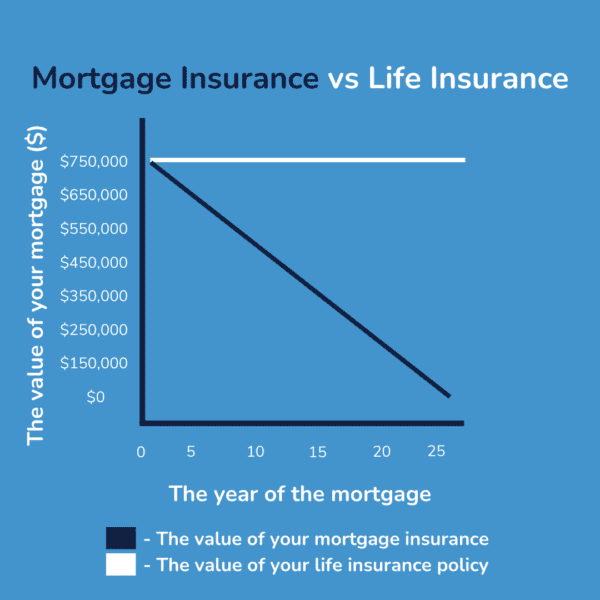
As mentioned before, the creditor policy is a declining benefit. Mortgage insurance benefits gradually decline in an attempt to match the declining balance of your debt (declining benefit), and will disappear once you completely pay off your mortgage. Those plans are like a runaway train, you may move into a bigger house with a bigger mortgage, but the death benefit keeps shrinking anyway. Buying an individual life insurance policy keeps you in the driver’s seat, letting you lower the benefits as you see fit or keeping a level benefit for life.
Life insurance benefit coverage stays constant throughout your lifetime or term, and is generally renewable each term. You’ll always get the full face value you first applied for.
Reason #6: Convertibility
An individually owned term insurance policy in most cases will allow the policy to be converted without medical to a permanent (life long) solution. A creditor insurance policy owned through the bank does not provide this benefit, which is especially important if one gets sick and can no longer qualify for coverage.
Reason #7: Preferred Underwriting
An independently pre-underwritten policy allows the insurer to determine if you qualify for “preferred” rates which will lower premiums even further. When applying for mortgage insurance, banks will only ask a few medical questions and base rates off of that information. So even if you’re in perfect health, you’ll pay the same rates as someone who is less healthy for your mortgage insurance.
Reason #8: Consolidation of Benefits
by combining your life insurance with other insurance needs such as income replacement, child care, education, etc, you will benefit from fees saved on multiple policies and tiered discounts (typically insurance companies discount in 250K bands of insurance), along with simplicity of understanding how much coverage you have in one place. With a bank and their mortgage insurance, you can only insure your mortgage, and there are no add-on benefits you can include.
Life insurance benefits typically include:
- Income replacement
- Child care/child term benefit
- Critical illness rider/ terminal illness benefit
- Accidental death benefit
Reason #9: Expertise and Licensed Insurance Professionalism
Most bank staff selling creditor mortgage insurance are unqualified and unlicensed in life insurance. Licensed professionals shop the market to give you the best solution for your needs.
A licensed professional with a focus on selling life insurance policies from various insurance companies is a life insurance broker. A life insurance broker works with multiple insurance providers, giving them more options to find the coverage that’s right for you. A captive agent, in contrast, can only offer you a small selection of life insurance options because they only sell insurance from one company. A life insurance broker is someone who is much more focused on serving your interests than just closing deals. Since life insurance brokers are independent, they are not concerned with winning over a particular business. They also require legal contracts such as the LIRD form, and must be licensed in Canada, which means that they must work in your favour. Working with a life insurance broker is important also because of the fact that there are life insurance scams in Canada, so for your own safety, it is wise to work with a licensed life insurance advisor.
Reason #10: Shop the Market
Buying an independent life insurance policy from a licensed broker allows the market to be shopped to find the best possible solution from a wide range of insurers. Banks often work with only 1 insurance company to provide a singular solution. Furthermore, licensed professionals have a responsibility to sell based on a Needs Based approach and can accurately assess your needs.
Lastly, while looking at life insurance, make sure to consider disability insurance and critical illness insurance in case you become unable to pay your mortgage due to serious illness or injury. In the event that you do require mortgage insurance, consider purchasing from a broker or insurance company for added flexibility that mortgage insurance with a bank doesn’t provide.
Get in Touch With Us, Today!
Contact Protect Your Wealth or call us at 1-877-654-6119 to talk to an advisor today learn more about both life insurance and mortgage insurance coverage options! We’re based out of Hamilton, and proudly service clients anywhere in Ontario, British Columbia, and Alberta, including Ancaster, Burlington, Dundas, Calgary, and Kelowna. and the surrounding areas.
Frequently Asked Questions (FAQs) About Mortgage Insurance Versus Life Insurance
Mortgage life insurance pays off your mortgage in case of your death, providing a safety net for your heirs, but it’s less flexible and usually more costly than regular term life insurance.
Consider it if:
- You have health issues and can’t secure other life insurance.
- You desire specific coverage just for your mortgage.
- Your existing life insurance doesn’t adequately cover your mortgage.
Be cautious because:
- It often has higher premiums and less flexibility, with payouts going directly to lenders.
- Policies may lack transparency, with potential unexpected premium hikes.
- It’s essential to discern between genuine policies and solicitations that use scare tactics post-loan closure.
For many, a standard term life insurance policy offering flexibility in payout use, potentially lower premiums, and broader coverage might be a more suitable alternative to mortgage life insurance.
Mortgage insurance is a product sold by banks or through the mortgage broker channel. This type of insurance is referred to as creditor insurance (or credit protection) and is optional coverage, purchased to cover the remaining mortgage balance in case of premature death. It is typically post under written (qualified only if death occurs), a declining benefit with no named beneficiary or ability to port to a new mortgage lender.
It’s required if your down payment is less than 20% of the purchase price.


Leave A Comment