 ·

How Much Does Life Insurance Cost in Canada?
By Parvesh Benning, Licensed Life Insurance Broker
The cheapest quote you see online is rarely the cheapest policy you can actually get, and your health is usually the reason.
Life insurance in Canada can cost a few dollars a month or several hundred, and the gap comes down to your age, your health, whether you smoke, how much coverage you buy, and how long you want it to last. This guide shows you real monthly rates and, more importantly, how to read them so you are not comparing the wrong numbers.
Updated: June 17, 2026

How Much Does Life Insurance Cost in Canada?
By Parvesh Benning, Licensed Life Insurance Broker, Updated: June 17, 2026
The cheapest quote you see online is rarely the cheapest policy you can actually get, and your health is usually the reason.
Life insurance in Canada can cost a few dollars a month or several hundred, and the gap comes down to your age, your health, whether you smoke, how much coverage you buy, and how long you want it to last. This guide shows you real monthly rates and, more importantly, how to read them so you are not comparing the wrong numbers.
Two healthy forty-year-olds can ask for the same coverage and be quoted very different prices, and neither of them is being treated unfairly. Below you will find current monthly rates by age and amount, a calculator to size your own coverage in a couple of minutes, and a plain explanation of why the lowest sticker price is not always the policy that fits you.
Start with the calculator to get a coverage target, then use the rate sections further down to see what that coverage tends to cost at your age.
Canadian Life Insurance Coverage Estimator
Estimate how much after-tax income your family would lose, and what coverage range to consider.
Using Tax Year 2026 Information
What this guide covers
- What life insurance costs per month in Canada
- What it costs by coverage amount
- What term life costs by length: 10, 20, and 30 years
- Life insurance rates by age
- Why two people pay different prices for the same coverage
- What else affects the cost
- How smoking changes your premium
- Term vs permanent: the cost difference
- How much coverage you actually need
- How to lower your premium
- What life insurance premiums are
- Frequently asked questions
What Does Life Insurance Cost Per Month in Canada?
For a healthy non-smoker, term life insurance in Canada often runs from about $10 to $90 a month, depending mostly on your age, how much coverage you buy, and how long you want it to last. That is a real range, not a dodge. The number lands where it lands once a carrier sees the full picture.
Here is where I get frustrated. Someone reaches out because they saw an ad on Instagram, big coverage for almost nothing a month, and they want to know why I can’t match it. The reality is there are so many factors behind that number they are not seeing. It might be a one year term. It might be a much younger female. It might be a tiny amount of coverage. The headline price is real for somebody, just maybe not for you.
So “average” is the wrong thing to chase. It is useful for a rough sense of scale and nothing more. What actually decides your premium is your age, your sex, whether you smoke, your health, the coverage amount, and the term length. Change any one of those and the monthly number moves.
A rough sense of monthly cost
Healthy non-smoker, $500,000 of coverage on a 10 to 20 year term. Larger coverage amounts cost more, and the per-dollar cost actually improves as the amount goes up.
In your 30s
often under $30
lowest rates of any age band
Around 40
roughly $27 to $50
still very affordable for the coverage
50 and up
higher, still workable
matching the term to the need keeps it efficient
Illustrative monthly ranges based on current carrier rates, subject to underwriting and change. Coverage above $500,000 costs more in total but less per dollar of protection. Your quote depends on your full profile.
One point worth being clear about. These ranges are built around $500,000 because it is a common starting point, not because it is the right number for you. For a lot of households with a mortgage, young kids, and income to replace, $500K is on the small side. Bigger coverage costs more in total, but the price per dollar of coverage actually drops as the amount goes up, so do not let the word “more” scare you off the amount you actually need.
My advice is to flip the order most people use. Do not start by hunting for the lowest monthly price. Start by figuring out the right amount of coverage to protect your family or your business, then let your age, health, and smoker status decide the term and the carrier that fits. Get that order right and the price takes care of itself.
The sections below break the cost down the way it actually gets priced: by coverage amount, by term length, and by age. If you want a number tied to your own situation rather than a range, the calculator at the top of this page is the fastest way to start, or you can get in touch and we will work out the coverage amount first.
What Life Insurance Costs by Coverage Amount
The more coverage you buy, the more you pay in total, but the cost per dollar of protection actually improves as the amount goes up. That is the part people miss. Doubling your coverage rarely doubles your premium, because a chunk of the cost is fixed no matter the size of the policy.
The table below shows the lowest available monthly rate for a 40-year-old non-smoker on a 10-year term, by coverage amount, for a healthy applicant. Treat these as a floor, the cheapest end of the market, not a quote. Your own number depends on your full profile.
| Coverage amount | Male, 40, non-smoker | Female, 40, non-smoker |
| $100,000 | from about $11/mo | from about $10/mo |
| $250,000 | from about $15/mo | from about $12/mo |
| $500,000 | from about $27/mo | from about $18/mo |
| $1,000,000 | from about $47/mo | from about $31/mo |
| $2,000,000 | from about $88/mo | from about $55/mo |
Lowest available monthly rates, 10-year term, healthy non-smoker. Based on current carrier rates, illustrative only, subject to underwriting and change. Sample premiums are for illustration only and assume non-smoker status, standard underwriting, no additional health concerns, and current carrier rates at the time of quoting. Final premiums depend on age, sex, province, coverage amount, term length, health history, lifestyle, and insurer approval.
Look at the male column from $500K to $1M. The coverage doubles, but the premium goes from about $27 to about $47, nowhere near double. The death benefit is twice as large while the cost rises by roughly three quarters. That is the fixed cost working in your favour, and it is the single most common thing clients are surprised by.
This matters because a lot of people anchor on $500,000 and stop there, when their actual need is closer to $1M once you account for a mortgage, income replacement for a couple of decades, and kids. The gap to properly cover that is often smaller than expected. I would rather a client carry the coverage that actually clears the debts and replaces the income than under-insure to shave fifteen dollars a month. If you are not sure which amount fits, our guide on how much life insurance you need walks through it.
A couple of notes on the ends of the range. $750,000 sits where you would expect, between the $500K and $1M figures, and it is a common landing spot when someone’s need falls in that gap. For very large amounts like $5M, pricing moves into high-net-worth territory and is driven by financial underwriting and the purpose of the coverage, so those are quoted case by case rather than off a chart.
One thing the table cannot show you: every figure here assumes good health. Once a health condition is in the mix, the cheapest name on this list may not be your cheapest route at all. That is exactly what the next part on why two people pay different prices for the same coverage gets into.
What Term Life Costs by Length: 10, 20, and 30 Years
A longer term costs more because you are locking in the same price for more years, and the carrier is taking on more of your aging in that fixed rate. The coverage amount is identical across all three below. The only thing changing is how long the price stays frozen.
I do not have a direct quote from my notes on this one, so here it is in plain terms: the rates below are for a 40-year-old non-smoker buying $500,000 of coverage, cheapest available, on each term length.
Male, 40, non-smoker, $500,000 coverage, lowest available monthly rate. Based on current carrier rates, illustrative only, subject to underwriting and change. A 40-year-old woman with the same profile generally pays less.
People look at that and assume the 30-year is the bad deal. It is not. It depends entirely on what you are protecting. The right way to choose is to match the term to the need, not to the lowest number.
If you have a 25-year mortgage and a newborn, a 10-year term saves you money today and then leaves you re-shopping at 50, when rates are a lot higher and your health may have changed. A longer term costs more per month but holds that price through the years you actually need the protection. For a shorter debt or a bridge to retirement, the 10 or 20 makes more sense. Our guide on choosing the right term length walks through how to line it up with your situation.
If you already know the length you are leaning toward, we have broken down the numbers further for a 10-year term and a 20-year term on their own pages.
Life Insurance Rates by Age
Age is the single biggest lever on your premium, and it moves in one direction. Every year you wait, the price goes up, because the carrier is pricing the risk that you do not make it through the term. The increases are gentle in your 20s and 30s, steeper through your 40s, and they accelerate once you pass 50.
Here is the same coverage, a $500,000 10-year term for a non-smoker, priced across the ages I get asked about most. Watch how the gap widens as you move down the list.
Age 30
~$19/mo
Age 40
~$27/mo
Age 50
~$58/mo
Age 60
~$148/mo
Male, non-smoker, $500,000, 10-year term, lowest available monthly rate. Based on current carrier rates, illustrative only, subject to underwriting and change. Women generally pay less at every age.
From 30 to 40, the cost goes up by roughly half. From 40 to 50, it more than doubles. From 50 to 60, it more than doubles again. That is the curve, and it is why “I’ll get to it next year” is the most expensive sentence in this business.
The takeaway is not to panic, it is to lock in early. Term premiums are level, so the rate you qualify for today is the rate you hold for the whole term. Buying at 35 instead of 45 can mean carrying the same coverage for years at a price your older self could never get. If you are weighing whether to wait, that decision has a real dollar cost, which we get into in the cost of procrastinating on life insurance.
Why Two People Get Very Different Prices for the Same Coverage
Two people who look identical on paper get different prices because the rate you are offered is the best perceived rate for someone with your health history and status. It does not mean you are getting a bad deal. It means the carrier has assessed the risk, and that is the optimal price for you at the time of application.
And here is the part I always make sure clients hear. If something happens, you are covered for the exact same amount as the person paying less. The cheque to your family is identical. The price difference reflects risk, not the size of the protection. Your rate can also change in the future if your health improves, but as it stands, that number is the right one for you today.
So what actually moves the price between two non-smokers the same age? Health. When a carrier sees a condition it does not love, it does not always decline you. More often it applies a rating, which is just a percentage added on top of the standard price. Here is how that stacks up on a $500,000 10-year term for a 40-year-old.
Standard, good health
about $27/mo
the advertised cheapest rate
Same person, health rating
about $38 to $50/mo
a 50% to 100% rating added on
No-medical / simplified
from about $37/mo
few or no health questions
Male, 40, $500,000, 10-year term, illustrative monthly figures based on current carrier rates, subject to underwriting and change.
Notice what happens. Once the health rating climbs, the fully underwritten price you saw advertised is gone, and a no-medical policy that skips most of the health questions can match it or beat it. That is the crossover, and almost no cost page online will tell you about it.
This is the call I make on every difficult-health file, and I use a rough divider for it. When I expect the rating to be high enough, often around the 150% range or higher, a simplified issue policy, which is coverage with fewer medical questions, becomes worth comparing on cost. Below that, and if the client is comfortable doing the full medical and nurse visit, the fully underwritten path is usually worth it because the base price is lower and the long-term options are better. It is judgment from experience, not a fixed rule, and it depends on the specific condition and carrier.
The catch is that you cannot see your rating from a quote screen. An online tool shows you the standard price and assumes you qualify for it. It has no idea a carrier is going to add 75% for your file, or that a different carrier two doors down would have taken you at standard. That is the whole reason a broker who places these every week is worth the call. I can read where a file is likely to land before we ever submit it, and route you to the carrier and product that prices your health the best, whether that is fully underwritten or no-medical coverage.
If you have a health condition and you are bracing for an ugly number, do not assume the worst from a website. Talk to a broker directly and we will figure out the right lane first, then the price.
Not sure which lane prices your health the best?
That is the call a broker makes every day. We read where your file is likely to land, then compare carriers so you see the lowest price you actually qualify for, fully underwritten or no-medical.
What Else Affects the Cost of Life Insurance
Beyond age and smoking, a handful of factors decide where your premium lands. None are dealbreakers on their own. They are the inputs a carrier weighs before it quotes you, and knowing them ahead of time is half the battle.
Your sex
Women generally pay less than men for the same coverage, because the data shows they live longer on average. You can see it in every table on this page: a 40-year-old woman pays noticeably less than a man at the same coverage and term.
For transgender, nonbinary, or genderqueer applicants, carriers may ask additional questions, but the file should be assessed on the insurer’s underwriting rules and the full medical picture, not identity alone. We cover related ground in what women need to know about life insurance.
Your health and family history
Health is the factor with the widest swing, and the one most worth getting right before you apply. Carriers look at your medical history, your height and weight, and your immediate family’s history with conditions like heart disease, diabetes, or certain cancers.
A condition rarely means an automatic decline. More often it means a rating, and the carrier you apply to changes that outcome a lot. Something like being on antidepressants is priced very differently from one carrier to the next, which is the whole reason shopping the file matters.
Your lifestyle and occupation
Your job, hobbies, and record all feed the price. A dangerous occupation, a risky hobby like rock climbing, or a driving record with DUIs can push the rate up.
Most of this is outside your control or already in the past. That is exactly why shopping across carriers matters, since a higher-risk occupation that one insurer rates heavily, another may take in stride.
The type of policy and any riders
The product is a big lever. Term life is the more affordable option and covers a set number of years. Permanent life covers you for life and costs more, which we break down in the term versus permanent section below.
Riders, the optional add-ons like a child rider or a disability waiver, add protection and cost. They earn their place when they fit your situation and are dead weight when they do not, so it is worth talking them through rather than ticking every box.
That is a lot of moving parts, and that is the point. No website can weigh all of them for your file. To see how your own mix shapes the price, get in touch and we will walk through it.
How Smoking Changes Your Premium
Smoking roughly doubles to triples your life insurance premium, and it is one of the few cost factors you can actually change. For a 40-year-old on $500,000 of 10-year term coverage, the move from non-smoker to smoker rates looks like this.
Male, 40
Non-smoker
about $27/mo
Smoker
about $68/mo
Female, 40
Non-smoker
about $18/mo
Smoker
about $54/mo
$500,000, 10-year term, lowest available monthly rate. Based on current carrier rates, illustrative only, subject to underwriting and change.
Same coverage, same age, same payout to the family. The smoker is just paying two to three times as much for it. A couple of things people get wrong about how carriers define a smoker, though, and they cost money.
The big one: to be classed as a non-smoker, you generally need to have been tobacco-free for at least a year, sometimes longer depending on the carrier. The good news is that once you cross that line, you can re-shop and move to non-smoker rates, so quitting pays you back directly. Carriers also tend to treat occasional smoking, vaping, and in many cases cannabis as smoking, even one cigarette here and there, so it is worth being honest about your habits and then planning around the one-year mark.
This is also a spot where the carrier you apply to matters, because they do not all treat cannabis or vaping the same way. If you use cannabis occasionally or you have recently quit, that is worth a conversation before you apply, because the right carrier choice can be the difference between smoker and non-smoker pricing. Get in touch and we will line you up with the one that reads your situation most favourably.
Term vs Permanent Life Insurance: The Cost Difference
Permanent life insurance costs several times more than term for the same coverage amount, because term covers a set number of years while permanent is built to last your whole life and to build cash value along the way. That price gap is real, and it scares a lot of people off permanent without them understanding what they are comparing.
Term versus permanent is a bigger topic than one number, and it deserves its own conversation in due course. But here is how I frame it for clients. First, get the right amount of coverage to cover your needs. Then look at the permanent options, because it is not just whole life. There is universal life, there is term to 100, and the right answer depends on real questions.
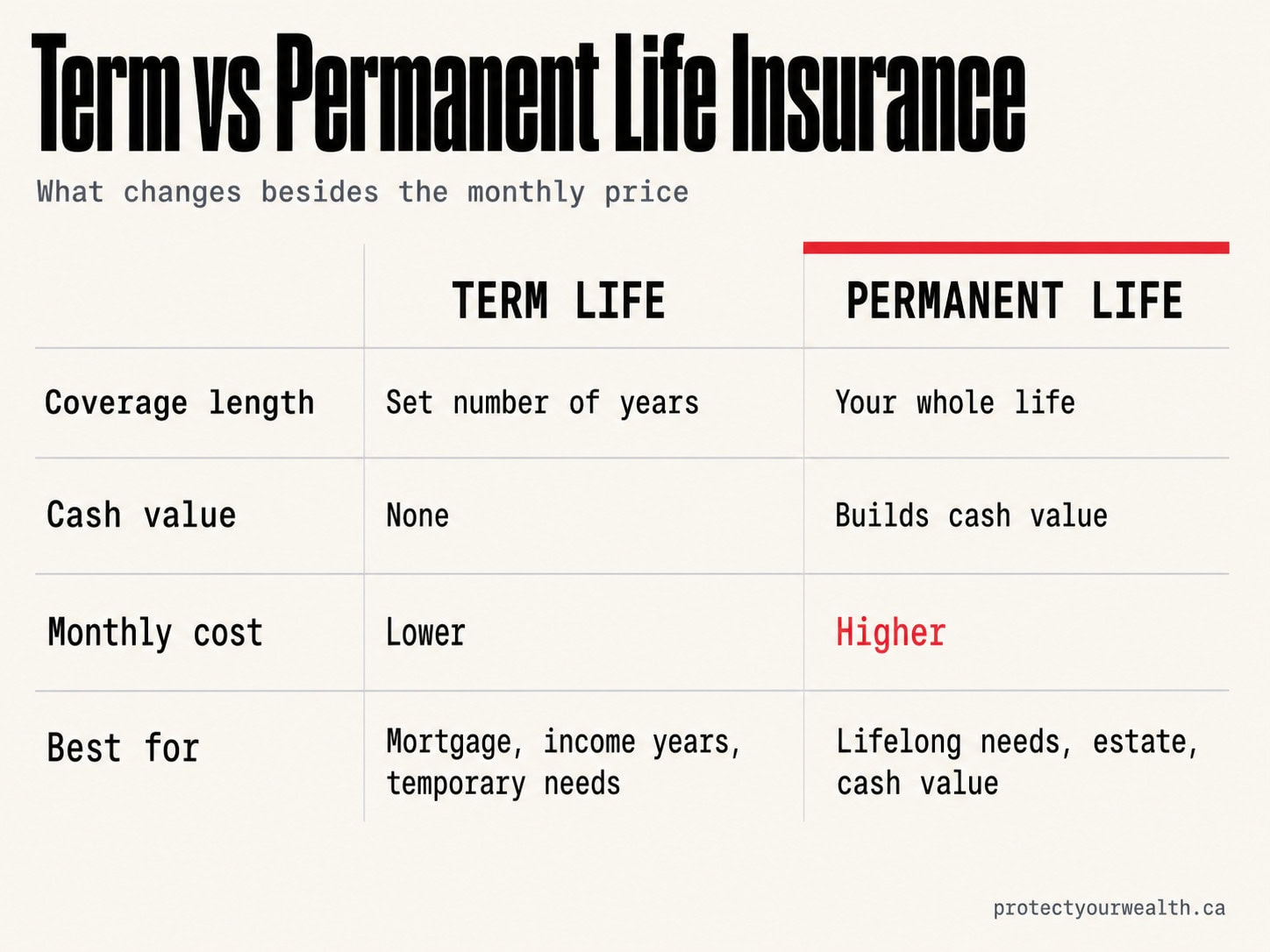
The questions that decide it
Is this corporate-owned or personally owned? Are you going to overfund the policy? Might you borrow against the cash value down the road? Do you need coverage to last forever, or just through a stretch of years? And does your budget actually allow for permanent? The answers point you to the right product, and the cost follows from there.
Now the part most people do not know, and it takes the pressure off the decision. Most term policies in Canada let you convert to a permanent policy without a medical, usually up to somewhere between age 65 and 75 depending on the policy. So you do not have to choose forever coverage at application. You can start with affordable term and convert later if your needs change.
The one caveat: the cost to convert rises each year as you age, since the permanent rate is based on your age at conversion. It is not a decision you need to make at application, whether that is a month, a few months, or a few years down the road, but it is not free to wait either. It is a luxury that gives you options, and I would rather a client hold that option than lock into the wrong product early.
If permanent is on your mind for estate planning or cash value, the guaranteed cash value side of whole life is worth understanding before you commit. And if you are genuinely torn between the two, that is the conversation to have with a broker, so get in touch and we will work through those questions together.
How Much Coverage Do You Actually Need?
Figure out the right amount of coverage first, then worry about the price. That is the order I push every client toward, because a cheap policy that is too small to clear your debts and replace your income is not actually cheap. It just feels that way until it is needed.
A quick starting point is to multiply your annual income by 10 to 15. It is rough, it ignores your savings and your specific situation, but it gets you in the right neighbourhood. The more complete way to size it is the DIME formula, which forces you to look at the four things your family would actually have to cover.
Total your debts other than the mortgage, then add a realistic estimate for final expenses.
Decide how many years your family needs your income replaced, then multiply your annual income by that number.
Add what would be left on the mortgage so the home is paid off rather than carried.
Estimate the cost of schooling per child and multiply by the number of kids.
Add the four together and you have a far more honest number than any single multiple of income. Even the DIME formula leaves things out, though, like coverage you already have and the real value of a stay-at-home parent, whose work would cost a fortune to replace. Treat it as a strong starting estimate, not the final word.
A few habits that keep the number right: think about how the coverage fits your whole financial plan, leave yourself a buffer, talk the figure through with your family, and consider splitting it across more than one policy if that suits your situation. For a fuller walk-through by life stage, see how to determine your needs based on your age and life stage, or the quick version in 5 easy tips to discover how much you need.
The calculator at the top of this page runs this logic for you in a couple of minutes. If your situation is more involved, a business, a blended family, existing coverage to account for, that is worth a conversation, so get in touch and we will size it together before looking at a single rate.
How to Lower Your Life Insurance Premium
The biggest savings come from a few specific moves, not from generic “get healthy” advice. Here are the levers I actually reach for with clients, including a couple most people never think to ask about.
Apply for a preferred rate
If you are in excellent health and comfortable with a nurse visit, some carriers offer preferred classes that price below the standard rate. Not everyone qualifies, but for the right person it is real money.
Pay annually, not monthly
This is the one people overlook most. Paying your premium once a year instead of monthly typically saves around 9%, because carriers build a financing cost into monthly billing.
Use a multi-life policy
A husband and wife can be covered under one multi-life policy and save the duplicate policy fee. This is not a joint first-to-die. It is two separately insured people on one contract, which trims the cost.
Past those three, the fundamentals still matter. Buying earlier locks in a lower rate for the whole term, since age only pushes the price up. Getting to non-smoker status after a year tobacco-free can cut the premium substantially. And right-sizing the coverage, rather than over-buying, keeps you from paying for protection you do not need. We go deeper on the health side in boosting your financial health to lower your costs.
Here is the honest truth about the single biggest saver, though. It is shopping the whole market, because the same person can be quoted very different prices depending on which carrier reads their profile most favourably. That is the part you cannot do from one company’s website, and it is free to have a broker do it for you. Get in touch and we will run your profile across carriers to find the lowest price you actually qualify for.
Frequently Asked Questions
QUESTION 01
What is the average cost of life insurance per month in Canada?
For a healthy non-smoker, term life insurance often runs from about $10 to $90 a month, depending mainly on your age, coverage amount, and term length. An “average” is only useful as a rough sense of scale, because your own price is set by your specific profile once a carrier reviews it.
QUESTION 02
How much does $500,000 of life insurance cost?
A 40-year-old non-smoker can expect roughly $27 a month for a man and about $18 for a woman on a 10-year term at the lowest available rates. The figure rises with a longer term, older age, smoking, or health ratings, and these are illustrative rates subject to underwriting.
QUESTION 03
How much does $1,000,000 of life insurance cost?
A 40-year-old non-smoker often pays from about $47 a month for a man and about $31 for a woman on a 10-year term. Notice that doubling the coverage from $500K does not double the price, because part of the cost is fixed regardless of the amount.
QUESTION 04
Is term life insurance cheaper than whole life?
Yes, term life costs several times less than whole life for the same coverage amount, because term covers a set number of years while whole life lasts your whole life and builds cash value. Whole life is not overpriced, it is a different product solving a different need, so the right choice depends on what you are protecting.
QUESTION 05
What raises the cost of life insurance the most?
Age, smoking, and health ratings move the price the most. Every year you wait raises the rate, smoking can double or triple it, and a health condition can add a percentage on top, though which carrier you apply to changes that outcome significantly.
QUESTION 06
Can I get life insurance without a medical exam?
Yes. No-medical policies skip the exam: simplified issue plans still ask some health questions, while guaranteed issue plans ask few or none. When an expected health rating is high enough, sometimes around the 150% range or higher, these become worth comparing against fully underwritten coverage. They cost more than fully underwritten coverage for someone in good health, so the right path depends on your situation.
Get the right price for your situation
See what life insurance actually costs for you, not for an average.
The cheapest quote online is rarely the cheapest policy you can get once your health is factored in. As an independent brokerage, we compare carriers across the whole market to find the coverage and price that fit you, at no cost to you. We have provided life insurance and segregated fund solutions since 2007.
Call 1-877-654-6119. Based in Hamilton, Ontario, serving clients across Ontario, British Columbia, Alberta, Manitoba, Saskatchewan, New Brunswick, and Nova Scotia.





