·
· 
Life Insurance for Work Permit Holders in Canada: Who Qualifies and How
By Parvesh Benning, Licensed Life Insurance Broker
Most advisors tell work permit holders to wait until they have PR. After 25 years placing coverage across Canada, I completely disagree.
One carrier saying no doesn’t mean the market said no. There are more than ten Canadian carriers willing to write coverage for work permit holders, and the limits depend more on which carrier you submit to than on your permit type itself.
Updated: May 29, 2026

Life Insurance for Work Permit Holders in Canada: Who Qualifies and How
By Parvesh Benning, Licensed Life Insurance Broker, Updated: May 29, 2026
Most advisors tell work permit holders to wait until they have PR. After 25 years placing coverage across Canada, I completely disagree.
One carrier saying no doesn’t mean the market said no. There are more than ten Canadian carriers willing to write coverage for work permit holders, and the limits depend more on which carrier you submit to than on your permit type itself.
Coverage limits across the major Canadian carriers swing from $250,000 to no maximum at all for the exact same client, depending only on where the application gets submitted. That gap is the real story for anyone holding a work permit in Canada.
What follows is the carrier-by-carrier reality, the TEER occupation codes that unlock higher limits, and the bridge-policy approach for clients whose immigration status is still in motion.
The Quick Answer
Day 1
Coverage is available from your first day in Canada on a valid permit.
10+
Canadian carriers actively consider work permit applicants.
TEER 0-1
Occupation codes that unlock the highest coverage limits.
Permit type and occupation code matter more than time in Canada. The right carrier match can mean the difference between $250,000 and several million in available coverage.
What’s covered on this page
- Work permits and life insurance in Canada: who qualifies
- How underwriters actually evaluate work permit applicants
- Policy options: term, simplified, and permanent
- How to apply for life insurance without permanent residency
- When to apply and what to expect
- How coverage limits vary by carrier and permit type
- Bridge products: carriers that don’t ask about residency status
- Tips to improve approval odds
- What happens if your work permit expires
- Frequently asked questions
Work permits and life insurance in Canada: who qualifies
Work permit holders qualify for life insurance in Canada from day one of arriving here. Not all companies are created equal. Some have zero limitations on permit holders. Others cap coverage. A few exclude entire categories outright, and most clients never realize it until after a declined application is already on their record.
When a work permit holder calls me, the first question isn’t about health. It’s when the permit expires, and whether an extension or PR application is already in motion. That answer tells me which carriers are realistic before we even open up the health conversation.
Permit categories at a glance
Open work permits
Not tied to one employer. Most flexible file from an underwriting view. Includes IEC permits (valid up to 24 months) and spousal open permits.
Employer-specific permits
TFWP and IMP files tied to one organization. Some carriers want extra verification on short-term or contract roles. Skilled trades and IMP professionals still have solid options.
PGWP, caregiver, PNP
Each routes differently. PNP unlocks the highest limits at several carriers. Caregivers have their own product set. PGWP sits between the two.
Permit type is the starting point, not the answer. The file actually gets decided by the combination of permit validity, occupation code (the TEER category under Canada’s National Occupational Classification), and which carrier the application lands at. For a broader newcomer view covering PR applicants and other temporary-resident categories beyond work permits, see our life insurance for newcomers in Canada guide.
How underwriters actually evaluate work permit applicants
Permit validity and permit type carry the most weight in routing decisions. Time in Canada, occupation, and health round it out, but permit validity is what tells me which carriers are even on the table for a given file.
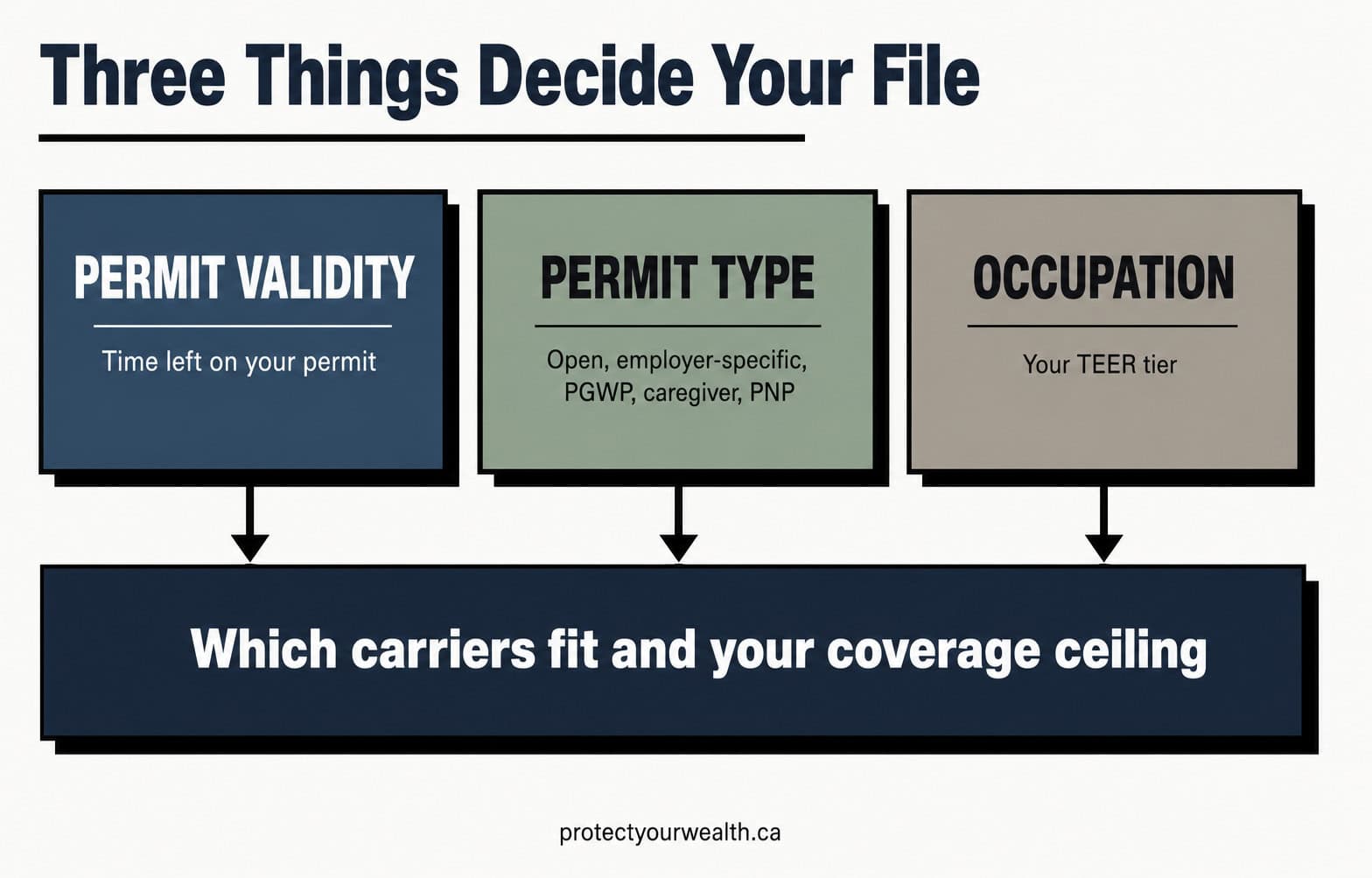
If the permit has reasonable time remaining, options open up across multiple carriers. Inside three months of expiry, some carriers want proof an extension is in motion before they’ll look at the file. Already expired? Options narrow. They don’t disappear.
Occupation plays a bigger role than most people expect. A few carriers route directly off the TEER code from Canada’s National Occupational Classification system. A TEER 0 or 1 file (university-educated professionals, management roles) can access significantly higher coverage at certain carriers than a TEER 4 or 5 file, even when everything else looks identical.
| Factor | What it actually changes |
|---|---|
| Permit validity and expiry | Decides which carriers are eligible to receive the application. Within 3 months of expiry, some carriers want extension proof. |
| Permit type | Open, employer-specific, PGWP, caregiver, and PNP all sit in different carrier buckets with different ceilings. |
| Occupation (TEER) | TEER 0 and 1 unlock the highest coverage at several carriers. TEER 4 and 5 are capped lower at those same carriers. |
| Time in Canada | Under one year usually means a paramedical, blood work, and hepatitis B and C screening regardless of amount. |
| Employment proof | Not universally required. A job letter helps support coverage amount but isn’t a documentation gate at every carrier. |
| Travel home | Frequent extended trips back to country of origin can change some carriers’ assessment. Flag it upfront, not at underwriting. |
Health history, lifestyle, and financial fit show up the same way they would for any Canadian applicant. Nothing unusual there. The work-permit-specific layer is the routing question above. Accelerated underwriting is available at several carriers for clients who have been in Canada over a year and meet age and amount thresholds.
Policy options: term, simplified, and permanent
Term life is the go-to product for most work permit holders. It’s the easiest to get approved, the most widely available across carriers, and the lowest cost for the coverage amount. Most term policies are also convertible to permanent later, which matters when a client’s status changes and they want to lock in insurability without a fresh medical.
Simplified issue is the product nobody talks about, and it’s the one that does most of the heavy lifting on bridge cases. There’s no nurse visit, no bloodwork, and at certain carriers the application doesn’t ask about permit status the way a fully underwritten product does. Premiums run a bit higher and the coverage ceiling is lower than fully underwritten, but for a client who needs coverage in force this week, or whose permit situation isn’t a clean fit for a regular Term application, simplified gets the job done. For more on that product family, see our no medical life insurance overview.
Where permanent products get restricted: Whole life and universal life are available to some work permit holders but not universally. A handful of carriers don’t issue permanent products to certain permit categories regardless of how the rest of the file looks. When a client wants permanent coverage and the current permit blocks it, the play is term or simplified now, then revisit permanent once the immigration picture stabilizes. That’s the bridge strategy in practice.
The product choice almost always follows the carrier choice on these files. I work backwards from which carrier can issue what, given the permit type and occupation code, and the product falls out from there. Going the other way (picking a product first, then hoping a carrier will issue it) is how clients end up with declines on their record.
How to apply for life insurance without permanent residency
Applying as a work permit holder is the same process as any Canadian applicant, with one document added: a copy of the work permit. Everything else (ID, banking, health declaration) is standard.
- Valid work permit. The one document that’s specific to this file type. If it expires inside three months, have proof of an extension application ready too.
- Canadian ID and SIN. Driver’s licence or other government ID, plus SIN for tax reporting on the policy.
- Active Canadian banking. Premium pre-authorized debit needs a Canadian bank account. This matters even more if the permit is close to expiry.
- Health declaration. Same questionnaire any applicant fills out. Honest disclosure here is what protects the policy at claim time.
- Pay stub or job letter (sometimes). Not universally required. Helps support larger coverage amounts on fully underwritten files.
Paramedical exams are triggered by coverage amount, age, and time in Canada, not by permit status itself. Under one year in Canada usually means a nurse visit, bloodwork, and a urinalysis at most carriers regardless of how much coverage is being applied for. The exam takes about 30 minutes, the nurse comes to the client, and the insurer covers the cost.
Simplified issue skips all of that. A short health questionnaire, sometimes a same-day decision. For a fuller breakdown of what to expect from the application itself, see our how to buy life insurance in Canada guide.
If the permit is already expired, there are product paths where residency status isn’t part of the underwriting questions at all. Those still need a Canadian address and active Canadian banking. Ties to Canada matter regardless of which product is on the table.
Not sure which carriers will actually consider your permit type?
Submitting to the wrong carrier doesn’t just waste time. It puts a decline on the file that follows the client to every other carrier through the MIB database. A 15-minute call before any application gets submitted is the cheapest insurance against that.
When to apply and what to expect
The best time to apply is when the permit has the most time left on it. More runway means more carriers in play and better pricing. That said, timing shouldn’t become a reason to wait. Even with a permit expiring in three months, or one that’s already expired, there are options. The range of what’s available just narrows.
Permanent residency, when it eventually comes through, has zero cost impact. PR rates are identical to Canadian citizen rates at every carrier I work with. Clients sometimes hold off on applying because they think PR will unlock cheaper premiums. It won’t. What drives the price is age, health, and the coverage amount, not the immigration class on the file.
A practical timing rule of thumb: Under one year in Canada, expect additional medical requirements at most carriers regardless of coverage amount (paramedical, blood work, hepatitis B and C screen). After one year, standard age-and-amount requirements apply. After two years, most carriers treat the file the same way they’d treat a Canadian citizen’s.
The cost-of-waiting math also matters. Premiums go up with age, and health surprises happen. A client who waits two years for PR before applying is two years older when they finally do, possibly with new conditions on file. The file that would have been Standard rates today might be Standard plus a rating in two years. Locking in coverage at current age and current health is the play, even if a better policy gets shopped later.
How Coverage Limits Vary by Carrier and Permit Type
This is where most online guides fall short. The coverage limits available to work permit holders vary significantly by carrier, and the differences aren’t published anywhere you can easily find them. What follows is based on the internal underwriting guidelines I work with directly.
Manulife
Best for: Skilled workers with PR application
- Skilled Worker (Professional class): up to $10M life, $2M CI
- Skilled Worker (Other): $2M life, $500K CI
- PGWP: $1M life at 250% rating, $250K CI
- Live-in caregiver: $250K life, $100K CI
- Married to Canadian/PR: 50% of spouse amount
- Other temp visa, refugee, student: $250K life at 250%, no CI
Requires 6 months in Canada plus evidence of PR application. GIO, BVP, Guaranteed Issue Life, and accelerated underwriting not available.
BMO
Best for: PNP and foreign-trained professionals
- Provincial Nominee Program: $500K life, $150K CI (6 months min)
- Foreign-trained physicians and skilled workers: $2M life, $250K CI (3 months min, employment contract, PR application)
- Married to Canadian/PR (applied for residency): $2M life, $250K CI
- Domestic workers/nannies: $300K life, $50K CI
- Standard LMIA work permit holders outside these categories: not eligible
Waiver of Premium and ADB not available until permanent status. A 2024 questionnaire update may further restrict caregivers, so verify before application.
Empire Life
Best for: PNP and skilled professionals with preferred rates
- Provincial Nominee: $2M life, $500K CI, preferred rates and disability waiver available
- Foreign-trained MD or skilled professional: $2M life, $500K CI, preferred rates and disability waiver
- Standard temporary resident: $500K life ($1M if more than 2 years in Canada), $100K CI
- PGWP: $500K life, $100K CI (3 months plus intent to stay)
- Live-in nanny or caregiver: $250K life, $100K CI, disability waiver available
- Convention refugee: $250K life, no CI (1 year working full-time)
Asylum seekers, non-convention refugees, and seasonal workers are not insurable.
Beneva
Best for: TEER 0 and 1 occupations (highest limits)
- TEER 0 and 1 (open or employer-specific): $5M life, $500K CI
- TEER 2 and 3 with PNP or CSQ (Quebec Selection Certificate): $2M life, $250K CI
- TEER 4 and 5, PGWP: $1M life, $100K CI
- Caregiver or nanny: $500K life, $100K CI (non-insurable occupation for disability)
- Study permit: $250K life, no CI
- Refugee: $250K life, $100K CI
Permit must be valid 3 plus months. Under 1 year in Canada triggers paramedical plus blood profile. Foreign citizens with no Canadian status are not eligible.
Desjardins
Best for: TEER 1 skilled workers with PNP (no maximum)
- TEER 1 skilled worker with PNP or QEP (Quebec Experience Program): no maximum on life or CI
- TEER 2 and 3 skilled worker with PNP/QEP: no maximum life, $500K CI cap
- Foreign-trained physician: no maximum
- Post-diploma work permit: $1M life, $250K CI
- Temp work permit (TEER 0, 4, 5, caregivers): $250K life with no PR app, $500K with PR app in progress
- Refugee (after 1 year): $250K life, no CI
Embassy workers, seasonal workers, and asylum claimants are not eligible.
iA Financial Group
Best for: Any status (Access Life has zero restrictions)
- Traditional life: full underwriting rules, all products available to work permit holders
- Traditional critical illness: capped at $100K for work permit holders
- Traditional disability: available after 1 year in Canada
- iA Access Life (simplified): no immigration limitations, available from day one regardless of status
Access Life is one of the few products where underwriting questions don’t include residency status. See our full Industrial Alliance review for context on iA’s broader product set as a bridge solution for clients who don’t fit traditional categories elsewhere.
Assumption Life
Best for: Larger non-resident coverage with newcomer-friendly UW
- Work permit holders (FUW): up to $750K life
- PGWP: up to $750K life
- CSQ or Provincial Nominee: up to $1M life
- Study permit (18+ with work permit): up to $500K life
- Convention refugee: $250K life
- Simplified Issue: up to product maximum
Permit must be valid 1 plus year and not expiring within 3 months. Disability Income, Waiver of Premium, and Accidental Death riders are not available. Super visa holders, asylum claimants, and visitor visa holders are not eligible.
Carriers that close the door on standard work permits
RBC Insurance is the carrier I see clients get declined at most often. Standard work permits aren’t eligible there. A decline shows up on MIB and complicates every future application elsewhere, even at carriers that would have written the same file without issue. Humania also does not insure non-residents. The first question on every work permit file isn’t health. It’s which carriers are even on the table.
This is why the first question I ask isn’t about your health. It’s about your permit. Knowing your permit type, your occupation code, and how long you’ve been in Canada tells me which carriers are realistic options before we even get into health history. Submitting to the wrong carrier doesn’t just waste time. It creates a record that can complicate future applications.
Bridge products: carriers that don’t ask about residency status
There’s another way to handle a work permit file when the right fully underwritten carrier isn’t obvious, or when permit status itself is the blocker. A simplified-issue policy where permit status doesn’t even come up in underwriting at all. The policy gets issued based on health questions, not immigration documents. We put coverage in force now under one of these products, and revisit the product mix once the immigration picture stabilizes. That’s the bridge strategy in practice.
Three carriers in Canada offer simplified-issue products where residency status is not part of the application:
- iA Access Life: Up to $500,000 in coverage (Immediate Plus, healthier applicants) down to $50,000 (Guaranteed Access, broadest acceptance). Available regardless of immigration status, no medical exam, issue ages 6 months to 80.
- Canada Protection Plan: Up to $250,000 life and $100,000 critical illness for work permit holders under their A-Z or Express Elite simplified-issue products.
- Assumption Life Simplified Issue: Up to $750,000 in life coverage for work permit holders. No additional underwriting beyond the simplified-issue health questions.
Apply now under simplified issue
You complete a short health questionnaire, typically 9 to 19 questions depending on the product. No medical exam, no nurse visit, no immigration documentation request. The decision happens quickly and the policy is in force as soon as the first premium clears.
Coverage stays in force regardless of permit changes
Once issued, the policy is a contract. Renewal of your work permit, expiry of your work permit, or transition to PR doesn’t change the policy. The premium and coverage amount stay locked unless you change them. That’s the protection layer the bridge gives you.
Switch to fully underwritten when your status stabilizes
Once you have PR or two-plus years in Canada with a clean health profile, fully underwritten policies open up at lower premiums and significantly higher coverage ceilings. We apply for the new policy, and once it’s in force, the simplified policy can be cancelled. You’ve only paid for the months the bridge was needed.
The trade-off is straightforward. Simplified issue runs higher premiums than fully underwritten coverage at the same age and health, and the coverage ceilings are lower. Most simplified products cap between $250,000 and $750,000, where fully underwritten options can reach $2 million or more for the same client. The bridge is the right move when waiting for fully underwritten eligibility means going uninsured, or when permit status alone would block the application. It’s the wrong move when a fully underwritten carrier already accepts your file at a lower premium.
Tips to improve approval odds
Three things move the needle most on a work permit application: time on your permit, getting the carrier routing right before you submit, and having documentation ready. Each one is something you control before you apply, not something you hope for after.
Apply when your permit has the most time remaining
This is the single highest-leverage move you can make on a work permit file. More time on your permit means more carriers in play, which means better pricing and more coverage options. Waiting until the last few months of your permit cuts your options without saving you any money. The reverse is also true: applying when you have over a year of permit validity often unlocks carriers that close their doors at 6 months or less.
Get a carrier routing assessment before you submit anything
This is where most work permit files get lost before they even start. Submitting to a carrier that excludes your permit category isn’t a minor inconvenience. It puts a hard decline on your record through the MIB database, which complicates every future application elsewhere, even at carriers that would have written the exact same file without issue. A 15-minute conversation with a broker who knows the routing landscape can tell you which carriers will actually consider your permit type, occupation code, and time in Canada before any application gets submitted.
Have your documentation ready before the application starts
Work permit copy is the one document specific to this file type. Beyond that, the application is standard: government ID, SIN for tax reporting, Canadian banking for premium pre-authorized debit, and a complete health declaration. If you’re applying for a larger policy (typically over $500,000 on a fully underwritten product), a recent pay stub or job letter supports the coverage amount. Having all of this together before you start cuts the application timeline from weeks to days.
What Happens If Your Work Permit Expires?
Your existing policy stays in force after your permit expires.
As long as premiums keep clearing, coverage continues. The carrier cared about your status at the application stage. After issue, the policy is a contract, not a privilege tied to your immigration class.
Most carriers don’t monitor immigration status on an ongoing basis once coverage is in place. The application is when status matters. After the policy is issued, you have a binding contract the carrier owes you for the term you bought, regardless of what happens with your permit in the years that follow.
The caveat that catches people: Certain policy changes trigger a new underwriting review where your current status becomes relevant again. Increasing your coverage amount, converting a term policy to permanent, or adding new riders all open the file back up. Make those changes before your permit expires, not after.
There are also simplified-issue products where residency status isn’t part of the underwriting criteria at all (covered earlier on this page). An expired permit doesn’t create a coverage problem with those because the carrier wasn’t asking about status to begin with. You still need active Canadian banking and a Canadian mailing address to maintain the policy. Those ties to Canada are what keep the options open.
Before your permit expires, action these two things:
Confirm your policy’s portability. Ask your broker whether your coverage moves with you regardless of where you live or what immigration status you hold. Most term policies are portable, but confirming is faster than discovering otherwise mid-transition.
Lock in premium continuity. Banking changes, address changes, or a phone number switch can lapse premiums if the carrier loses contact. Update those details before the permit lapses, not after. Gaps in coverage are much harder to fix than they are to prevent.
Frequently Asked Questions
Q1
Can I get life insurance on an open work permit?
Yes. Open work permits are often the most flexible from an underwriting standpoint because they don’t tie you to one employer. Carriers like iA Access Life and Canada Protection Plan offer simplified-issue products where permit status isn’t even part of the application. Fully underwritten options are available at multiple carriers depending on your TEER occupation code, time in Canada, and whether you have a Permanent Residency application in progress.
Q2
How much life insurance can a work permit holder get in Canada?
Coverage limits range from $250,000 to over $10 million depending on carrier, permit category, and occupation code. Standard work permit holders generally see ceilings between $500,000 and $2 million at fully underwritten carriers. Skilled professionals with a Provincial Nominee Program designation can access up to $10 million life and $2 million critical illness at Manulife. Most simplified-issue products cap between $250,000 and $750,000.
Q3
Does my life insurance policy end when my work permit expires?
No. Once your policy is in force, the carrier doesn’t monitor immigration status on an ongoing basis. The application stage is when status mattered. After that, the policy is a contract for the full term you purchased, regardless of what happens with your permit. Premiums need to keep clearing through Canadian banking for coverage to stay active.
Q4
Do I need a medical exam to qualify for life insurance on a work permit?
It depends on the product. Simplified-issue policies require only a health questionnaire (9 to 19 questions) with no medical exam. Fully underwritten policies typically require a paramedical visit with bloodwork, urinalysis, and hepatitis B and C screening for applicants under one year in Canada, regardless of coverage amount. The nurse comes to your home, the appointment takes about 30 minutes, and the insurer pays for it.
Q5
Can I keep my life insurance if I leave Canada permanently?
Most term life policies are portable, meaning coverage continues if you move out of Canada as long as premiums keep clearing. Permanent policies (whole life and universal life) are generally portable as well. The complication is that any policy change after you leave (coverage increase, conversion, rider additions) may trigger a new underwriting review where your changed residency status becomes relevant. Premium payment also requires active Canadian banking at most carriers, so confirm the setup with your broker before any move.
Q6
Will buying life insurance affect my permanent residency application?
No. Life insurance applications and PR applications are completely separate. Immigration, Refugees and Citizenship Canada does not see your life insurance file, and insurance carriers do not report to immigration. The two processes have no overlap in data, decision-making, or reporting. Buying coverage today has no positive or negative effect on a PR application.
Q7
Is critical illness insurance available to work permit holders?
At some carriers, yes, with limits that vary widely. iA Financial Group caps critical illness at $100,000 for work permit holders. Canada Protection Plan caps at $100,000. Empire Life offers up to $500,000 critical illness for foreign-trained skilled professionals and Provincial Nominees, with disability waiver available. Manulife provides critical illness up to $2 million for the professional skilled worker class with a PR application in progress. Standard temporary work visa holders outside these categories often see critical illness restricted or unavailable.
Talk to a broker who places these files weekly
Find coverage that fits your permit, not the other way around.
Independent broker placing term life, simplified issue, and permanent coverage with over 20 Canadian carriers. 25-plus years routing work permit files to the carriers that will actually write them.
20+
Canadian carriers
25+
Years experience
7
Provinces serviced
Based in Hamilton, serving clients across Ontario, British Columbia, Alberta, Manitoba, New Brunswick, Nova Scotia, and Saskatchewan, including: