

Life Insurance with Epilepsy
Talk to one of our experienced advisors, today!
11 minute read
Originally published: July 15, 2022
Updated: February 27, 2023

Life Insurance with Epilepsy
Talk to one of our experienced advisors today!
11 Minute read
Originally published: July 15, 2022
Updated: February 27, 2023
Epilepsy causes seizures, it can be hereditary or caused by a trauma or stroke. 300,000 Canadians have the condition as of April 2022, which is about 1% of the population. It’s incurable, but good therapy can help manage seizures. Because of the dangers associated with epilepsy, having the condition may affect your ability to buy life insurance. You may have trouble acquiring affordable life insurance if you have severe epilepsy or don’t control your seizures, but finding a quality life insurance policy with well-controlled epilepsy shouldn’t be hard.
Having epilepsy may affect your choices when it comes to life insurance. We have many clients that are worried that they won’t qualify for life insurance because of their condition. Not knowing that you can protect your loved ones financially can cause feelings of worry and anxiety. A common question we get asked is “can I buy life insurance if I have epilepsy?”
Yes, you can get life insurance if you have epilepsy! At Protect Your Wealth, we are here for you to help you navigate your options and choose a policy that suits your needs.
In this article:
What is Epilepsy?
Epilepsy is a neurological condition marked by frequent seizures. A seizure is typically characterized as a brief change in behavior caused by a momentary shift in the electrical activity of the brain. Normally, the brain generates small electrical impulses in a regular sequence. These impulses move along neurons, the brain’s network of nerve cells, and throughout the body via chemical messengers known as neurotransmitters.
Types of Seizures
There are two types of seizures: primary generalized seizures and partial seizures. The difference between these groups can be seen in how they begin. Primary generalized seizures begin with a massive electrical discharge involving both sides of the brain at the same time. A partial seizure starts with an electrical discharge in a specific location of the brain.
Hereditary factors play a role in partial generalized epilepsy, which is more likely to involve genetic factors than partial epilepsy, which occurs in a specific area of the brain. Some partial seizures are caused by a head injury, a brain infection, a stroke, or a tumor, but in the majority of cases, the reason is unknown.
Seizures are classified into four types:
- Petit Mal or Absent Seizures: This rare type of seizure lasts roughly 15 seconds and is characterized by irregular brain activity. There aren’t always warning indicators, and to an outside observer, these seizures can appear as a brief period of non-responsiveness, as if you’re daydreaming.
- Focal Onset Aware Seizures: This type of seizure affects only one side of the brain. You stay conscious throughout the seizure, which normally lasts 1 to 2 minutes.
- Focal Onset Impaired Awareness Seizures: Similar to a Focal Onset Aware Seizure, however you are not conscious or aware of your surroundings. These episodes might last anything from a few seconds to two minutes.
- Gran Mal or Tonic-Clonic Seizures: These are more physical seizures, with a period of muscle tension and loss of consciousness followed by spasms. A seizure can last anywhere from 3 to 4 minutes. This is the type of seizure that most people think of when they think about epilepsy.
The type of seizures you have as part of your epilepsy can have a big impact on the type of life insurance you can get.
What Effect Does Epilepsy Have on Life Insurance Rates?
If you have epilepsy, you may be concerned that you won’t be able to apply for life insurance, or that if you do, it will be expensive. Maybe you’ve put off looking for a life insurance policy because it’s too daunting and unpleasant to go through all of the information. However, it may be useful to remember that epilepsy is not an uncommon condition. With epilepsy being the fourth most common neurological ailment, it should come as no surprise that many people with this condition seek for and are approved for life insurance on a daily basis.
You may be able to qualify for a Standard rating based on the severity and frequency of the episodes, depending on the life insurance company’s epilepsy underwriting requirements. Depending on the severity of your disease, as well as your personal habits and overall medical history, you may be able to obtain a less expensive plan than you anticipated.
What questions will my life insurance company have regarding my epilepsy?
If you have epilepsy, your life insurance insurer will usually require the following information:
- The type of epilepsy you have and whether or not there was a specific cause
- When you were first diagnosed
- The frequency with which you experience fits or attacks, as well as the length of time since the last one
- Whether or if the epileptic attacks cause a change in consciousness
- It goes without saying that you must reveal your epilepsy when applying for life insurance; if you or someone acting on your behalf provides misleading information when applying, Legal & General reserves the right to change or cancel the policy and refuse to pay the cover amount.
- Any premiums paid in this case may not be returned.
Types of Life Insurance Policy for Epilepsy
Below is the major categories of life insurance risk ratings and associated insurance policies someone can get with that rating.
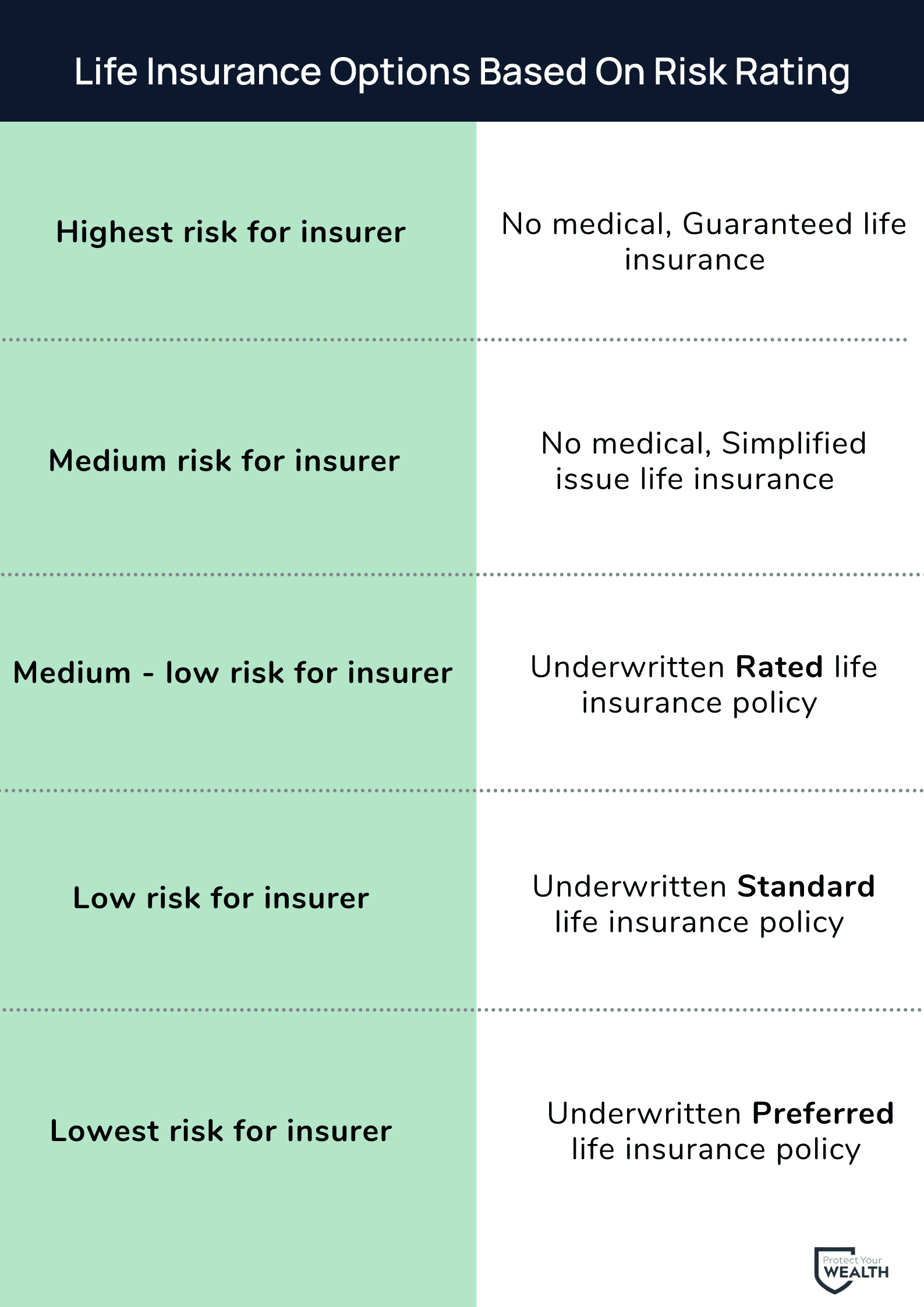
If you are considered:
- High risk – Your option for life insurance is no medical or guaranteed life insurance policies. This is for individuals with severe health concerns who do not qualify for medically underwritten policies. Offers limited coverage (up to $50,000) at inflated costs. Does not require a medical checkup or any questionnaire.
- Medium risk – Your option for life insurance is no medical or simplified life insurance policies. This is a common option for individuals with serious health conditions who do not qualify for medically underwritten policies. Provides moderate coverage (up to $500,000) at moderate costs. Does not need a medical checkup and consists of a brief questionnaire.
- Medium to low risk – Your option for life insurance is a traditional underwritten rated life insurance policy. This is common for those with health difficulties. Provides extensive coverage (up to $3,000,000 or more). Significantly more expensive than normal policies. Almost always requires a medical exam.
- Low risk – Your life insurance option is traditional underwritten standard rated policies (most regular policies and products). This is common for individuals in good health or with moderate health difficulties. Offers extensive coverage (up to $3,000,000) at regular rates. When compared to the vast majority of other insurance options, costs are fairly modest. In certain situations, can be issued without a medical exam (e.g., younger ages).
- Lowest risk – If you are above average in health, you may be considered for underwritten preferred rated policies. These policies are for persons with excellent health and excellent shape. Offers extensive coverage (up to $3,000,000) at inexpensive rates.
Along with the type of policy you may qualify for, there are some types of insurance products that are better for those with epilepsy.

Term Life Insurance
Term life insurance policies are the most cost-effective alternative for those seeking life insurance. These plans provide coverage for a set length of time and have no financial value. If you need life insurance to help your spouse pay off your mortgage or to pay for your children’s college education if you die, a term life insurance policy may be the most cost-effective solution. A benefit of many term life insurance policies is that they can be changed into whole life policies without having to go through the underwriting process again, which means that later issues from your epilepsy will not present problems in this conversion.
It is important to note that If you select a fully underwritten policy, the insurer will require you to undergo a medical exam before deciding whether or not to provide coverage. Medical underwriting may result in you being denied coverage or charge huge premiums if your epilepsy is severe or poorly managed.

No Medical Life Insurance
A no medical exam life insurance policy may be a good choice if you are concerned about having a medical exam, particularly if you have more than five seizures yearly or are not managing your epilepsy as prescribed by the doctor.
With this kind of coverage, you are not required to have a medical checkup but are instead required to complete a thorough survey about your health on which you are expected to be honest. The coverage limits on these kinds of insurance are often smaller ($500,000 for term policies and $50,000 for whole life plans), but they might be the best choices for people with severe epilepsy.
There are also two main types of no-medical life insurance: simplified issue life insurance and guaranteed issue life insurance.
1. Simplified Issue Life Insurance
Even though simplified issue life insurance does not require a physical, you will still need to provide information about your medical history and current health. This kind of life insurance is designed for people who want a quick approval and a brief underwriting time. In some circumstances, you can obtain insurance in a matter of days rather than weeks or months. Depending on the life insurance company, simplified life insurance may be available as a term or permanent coverage.
This kind of life insurance is ideal for people who don’t want to get a medical test, are unsure of the kind of coverage they may get, or even just need life insurance right now. Coverage for simplified issue life insurance is typically higher as well, if you’re looking for more than $50,000. Simplified issue life insurance can be either term life or permanent life policies.
2. Guaranteed Issue Life Insurance
Neither a physical exam nor a questionnaire about your health and medical history are required for guaranteed issue life insurance. Your coverage is guaranteed, as the name implies. Similar to simplified life insurance, this coverage can be obtained quickly, so you won’t have to wait a long time or stress over being initially rejected. However, this results in more expensive rates and less coverage. This is because offering insurance to individuals who want it carries a significant amount of risk. Getting the compensation money can also take longer.
This kind of life insurance is best for people who don’t qualify for anything else or who want to at least partially provide for their family in the event of their death, as the maximum coverage this provides is $50,000. This policy is also a permanent life policy, which means once approved, it’ll cover you for life or until you cancel the policy/stop paying your premiums.
Epilepsy and the Cost of Life Insurance: Health Considerations
The life insurance provider will ask you certain questions regarding your epilepsy when you apply for coverage. The following are just a few of the fundamental details the life insurance provider could inquire about:
- Your first seizure’s date
- Whether or not you have an official epilepsy diagnosis
- Whether you are adhering to that treatment regimen, which includes regulating your diet, changing your lifestyle, and taking drugs
- How long ago you received a diagnosis
- Regardless of whether you follow a certain treatment strategy
If you have epilepsy, you might be concerned about how it would affect your ability to buy life insurance. It shouldn’t be too difficult for the majority of people with epilepsy to find life insurance coverage at a reasonable price. However, it could be challenging for you to acquire an affordable life insurance coverage if you have severe epilepsy or if you aren’t following your doctor’s recommendations for controlling your seizures.
Frequently Asked Questions (FAQs) about Life Insurance with Epilepsy
One option to offer financial protection for yourself, your dependents, or your business is to get life insurance. Insurance funds might be used to replace lost income or to pay for funeral expenses, personal or business obligations, estate taxes, or medical bills. It can also assist you in establishing a savings, investment, or retirement fund, as well as providing a financial cushion for your beneficiaries.
Epilepsy is currently classified as a substandard high risk medical condition by the life insurance market. As a result, insurers may request higher premiums or refuse your application.
That depends because there are numerous elements that can influence epilepsy-related life insurance underwriting choices. Depending on the cause of your epilepsy, if your epilepsy does not include a change or loss of consciousness, was diagnosed more than six months ago, you have less than 12 attacks per year, and your most recent attack occurred more than a year ago, you are likely to be offered standard rates for life insurance. If your epilepsy experience falls outside of those parameters, your rates may be higher.
Even if you are told you have epilepsy during your policy, your insurance company cannot cancel or raise the rates on your life insurance policy once it has been purchased and issued.
Make sure to talk to your agent or broker about your epilepsy because he or she will be aware of the details that insurers value. Additionally, they might include remarks in the application that are true to your own experiences with the disease.
No medical life insurance tends to be more expensive due to it being offered to offer coverage for those with health conditions and may not qualify for more affordable, traditional policies. These health conditions increase your likelihood of death and increase the risk to insure you.
For most traditional life insurance policies, it is necessary to undergo a medical exam. This allows for life insurance companies to do a thorough analysis of to decide your premiums.
Simplified issue life insurance will ask health questions and do a full underwriting outside of the traditional medical exam. This means you will need to be in a good health in order to qualify for affordable rates. Guaranteed issue life insurance, on the other hand, requires no health questions, underwriting and guarantees approval. This comes at a higher cost than traditional life insurance policies.
Simplified term life insurance is a type of life insurance that does not require a medical exam or ask as many health questions as the traditional term life insurance policies.
Finding the right life insurance plan for you
Even if you’ve been diagnosed with epilepsy recently or have been living with it for years, there’s an affordable life insurance product or package for your situation. A life insurance specialist can help you create the best plan and package for your needs.
At Protect Your Wealth, we work with and compare policies and quotes from the best life insurance companies in Canada to ensure the best solution for you and your needs. We provide expert life insurance solutions, including no medical life insurance, critical illness insurance, term life insurance, and permanent life insurance to build the best package to give you the protection you need.
Contact Protect Your Wealth or call us at 1-877-654-6119 to talk to an advisor today! We’re proudly based out of Hamilton, and service clients anywhere in Ontario, British Columbia, and Alberta including areas such as Milton, Victoria, and Edmonton.



Leave A Comment