 ·

Life Insurance for Recovering Alcoholics in Canada (2026 Rules)
By Parvesh Benning, Licensed Life Insurance Broker
How Canadian carriers actually assess alcohol history, from day-one guaranteed issue coverage to standard rates after five years of sobriety.
This guide breaks down how sobriety timelines change your coverage options across fully underwritten, simplified, and guaranteed issue products, and what happens behind the scenes when a broker routes an alcohol-related application.
Updated: May 21, 2026

Life Insurance for Recovering Alcoholics in Canada (2026 Rules)
By Parvesh Benning, Licensed Life Insurance Broker, Updated: May 21, 2026
How Canadian carriers actually assess alcohol history, from day-one guaranteed issue coverage to standard rates after five years of sobriety.
This guide breaks down how sobriety timelines change your coverage options across fully underwritten, simplified, and guaranteed issue products, and what happens behind the scenes when a broker routes an alcohol-related application.
At three months sober, guaranteed issue is realistically the only option. But the landscape shifts fast as sobriety builds, and which carrier you apply to matters far more than most people realize. This page walks through every tier of coverage available to Canadians with an alcohol history, the actual carrier rules that determine your outcome, and the submission strategy that protects your options.
Can you get life insurance with an alcohol history in Canada?
Yes. Coverage is available at every stage of recovery. What changes is the product tier and the price.
Currently drinking or under 1 year sober: Guaranteed issue only. No medical questions, but graded death benefits (reduced payout in the first two years) and higher premiums.
1 to 5 years sober: Simplified issue products open up. Some fully underwritten carriers will consider your application with ratings of +100% to +400% depending on the carrier, substance, and treatment history.
5+ years sober, no relapse: Standard rates are possible at multiple carriers. Some require longer. BMO needs 10 years treatment-free for preferred rates. Ivari needs 6 years for standard.
The carrier you apply to first matters. A formal decline can complicate every future application because other carriers may ask about it and review your prior application history. The section below on how carriers differ covers this in detail.
In this guide
- How alcohol use affects life insurance eligibility
- Day-one coverage: guaranteed issue and simplified options
- Coverage options by sobriety stage
- How Canadian carriers differ on alcohol applications
- What lab tests mean for your application
- How to improve your chances and lower your premium
- Disclosure and why full honesty protects your claim
- Frequently asked questions
How Alcohol Use Affects Life Insurance Eligibility
Alcohol use affects life insurance eligibility based on how six underwriting factors stack together, not just whether you drank. Two people with the same sobriety timeline can get completely different outcomes depending on what else is on their file.
01 — Sobriety Length
The single biggest factor. Most carriers want 2 to 3 years minimum before considering a fully underwritten application. BMO requires 5 years treatment-free for standard rates and 10 years for preferred.
02 — Treatment History
Completed programs (inpatient, outpatient, AA, counselling) are viewed positively. But recent treatment, even successful treatment, triggers caution at most carriers.
03 — Relapse
This is where applications fall apart. Desjardins declines after a single relapse. Assumption Life declines after more than one. Sun Life adds at least 2 years to your timeline for one relapse, and multiple relapses within 5 years are an outright decline.
04 — Co-morbid Conditions
Liver damage, depression, anxiety, or any other condition tied to alcohol use changes the underwriting math. If you carry a mental health diagnosis alongside alcohol history, carriers assess both together and the combined picture drives the decision.
05 — Severity and Pattern
Big difference between heavy drinking for a year in your twenties and a 15-year pattern. Empire Life draws a hard line at 5+ drinks per day with no treatment: that range runs from a 200% rating to outright decline.
06 — Age
Older applicants with long sobriety get better outcomes. Canada Life is more favourable for those over 40 with 5+ years clean. Sun Life declines anyone under 25 regardless of sobriety length.
None of these factors exist in isolation. A 45-year-old with 7 years sober, completed AA, no relapse, and normal labs is a straightforward standard-rate case at most carriers. A 32-year-old with 3 years sober but one relapse and concurrent anxiety is a completely different file. The carrier you submit to first determines whether that file gets rated or declined.
Day-One Coverage: Guaranteed Issue and Simplified Options
Guaranteed issue life insurance is available from day one of recovery, with no medical questions and no sobriety requirement. That is the starting point for anyone who needs coverage immediately.
Realistically, at three months sober, guaranteed issue is the only option. It depends on their alcohol consumption and factors like whether they are attending AA, how much they were drinking, whether there are other health concerns. But typically at that stage this is it.
The trade-off with guaranteed issue (no medical) life insurance is cost and payout structure. Premiums are higher, coverage amounts are lower (usually capped at $25,000 to $50,000), and most policies include a graded death benefit, which means if the insured dies in the first two years, beneficiaries receive a return of premiums paid plus interest rather than the full face amount.
As sobriety builds, simplified issue products start to open up. These skip the blood work and medical exam but still ask health questions, including questions about treatment history. Here is what each carrier actually requires:
Canada Protection Plan, Guaranteed Acceptance: Available to anyone. No health questions. Treatment in the last 12 months does not disqualify. Graded death benefit applies for the first 2 years.
Assumption Life GI: No medical questions. Available regardless of history.
Foresters GI: No medical questions. Available regardless of history.
Beneva GI: GI fallback only. Beneva’s simplified product declines anyone with any alcohol or drug abuse history, lifetime. If Beneva is the carrier, GI is the only path.
Canada Protection Plan, Deferred Elite: Treatment must be more than 5 years ago. If less than 5 years, you are deferred to GI. Two-year waiting period applies on the deferred product.
Canada Protection Plan, Simplified Elite: Treatment must be more than 5 years ago. Full simplified coverage with no graded benefit. This is the strongest no-medical product available for someone with alcohol history and long sobriety.
Humania, IWME (No Medical): Treatment or medical advice for alcohol use must be more than 2 years ago. DUI in the last year is a disqualifier. If you clear those questions, coverage is available without a medical exam.
The point of knowing these products is not to settle for one. It is to have coverage in place while sobriety builds toward fully underwritten rates. Get something now, then shop again when the timeline works in your favour.
Coverage Options by Sobriety Stage
Coverage options expand at each sobriety milestone, from guaranteed issue on day one to preferred rates after a decade clean. The table below maps what actually opens up at each stage based on current carrier rules.
Understanding the difference between guaranteed issue, simplified issue, and fully underwritten products matters here because each tier has different costs, coverage limits, and qualification rules.
Active use or under 1 year sober
Guaranteed issue only. No carrier will consider a fully underwritten or simplified application. CPP Guaranteed Acceptance and Foresters GI are the most common placements. Graded death benefit applies. Coverage caps around $25,000 to $50,000.
1 to 2 years sober
Humania IWME opens at 2 years (no treatment or medical advice for alcohol in the past 2 years). Some fully underwritten carriers will look at the file but expect high ratings, typically 200% to 400%. Assumption Life quotes 400% at 1 year of abstinence. Empire Life may consider a high rating if treatment is complete and there is no relapse.
2 to 5 years sober
Most fully underwritten carriers will consider the application. Ratings range from +100% to +200%. Desjardins drops to +100% at the 3 to 5 year mark. Ivari starts considering applications at 2 years on a rated basis. RBC runs 175% to 300% depending on co-morbid factors. This is the window where a preliminary assessment before submission saves you from unnecessary declines on your record.
5+ years sober, no relapse
Standard rates become possible. Assumption Life moves to standard. Canada Life is favourable for applicants over 40. Manulife’s best case is standard for those over 30 with 5+ years. CPP Simplified Elite opens with full simplified coverage, no graded benefit. Sun Life’s best case is standard but a single relapse within the past 5 years resets the clock.
10+ years sober
BMO preferred rates require 10 years with no treatment. Ivari reaches standard at 6 years. At this stage, most carriers treat the file like a standard applicant, though some will still note the history. The further you get from the last drink, the less it weighs.
The mistake people make is waiting for the next milestone before getting any coverage. Get something in place now, even guaranteed issue, then upgrade as sobriety milestones unlock better products. You can always shop a new policy or request a rate reconsideration later.
How Canadian Carriers Differ on Alcohol Applications
Canadian life insurance carriers differ dramatically on alcohol-related applications, and submitting to the wrong one first is the most expensive mistake you can make. It is imperative to get this information upfront prior to submitting an application.
The biggest problem I see is people not understanding timing and how different insurance companies underwrite. Typically I will do an assessment based on information available from underwriting guides. If there is clear guidance I may go straight to application. If it is a bit more complicated, I prefer to do a preliminary assessment first, which means I contact the carrier’s underwriting desk anonymously with the client’s details, no names, to get an indication before anything official goes on record.
Why does that matter? A formal decline from one carrier shows up on your MIB file. Every carrier you apply to afterward sees that decline and asks about it. One bad submission can turn a manageable file into a difficult one. The table below is what I actually work from when deciding where to submit.
| Carrier | Under 5 Years Sober | 5+ Years Sober | Relapse Rule |
|---|---|---|---|
| Sun Life | Moderate to high substandard | Best case standard | Single: +2yr decline. Multiple within 5yr: decline |
| Canada Life | 150% to 250% | Standard (favourable if over 40) | Case by case |
| Manulife | 150% to 200% | Standard (best case, over 30) | Co-morbid factors weighted heavily |
| Empire Life | Possible high rating (1yr+ post-treatment) | Lower ratings | Any relapse: decline |
| Assumption Life | 400% at 1yr abstinence | Standard (no relapse) | More than 1 relapse: decline |
| RBC | 175% to 300% | Standard (most favourable) | Age + sobriety length primary |
| Ivari | Rated basis at 2yr+ | Standard at 6yr+ | Not specified |
| BMO | Not eligible within 5yr of treatment | Standard (5yr), Preferred (10yr) | Treatment in past 5yr disqualifies standard |
| Desjardins | 2-3yr: +200%, 3-5yr: +100% | Standard | Single relapse: decline |
Source: internal underwriting guides. These indications reflect typical outcomes and may not apply to every case. Confirm current carrier rules through a licensed broker before making coverage decisions.
Look at the spread. A 35-year-old with 3 years sober and no relapse could be looking at +100% at Desjardins, +200% at RBC, or an outright non-starter at BMO. Same person. That difference is potentially thousands of dollars a year on a term policy.
This is exactly why the preliminary assessment matters. I can call Desjardins and RBC, give them the anonymous details, and get an indication before committing. If Desjardins comes back at +100% and RBC at +200%, the submission decision is obvious. If both are saying decline, we know to go simplified and wait. No guessing, no unnecessary declines on the file.
If your history also involves drug use alongside alcohol, the underwriting rules shift further. Each substance carries its own timeline and the carriers that are lenient on alcohol are not always the same ones that are lenient on drugs. That is a separate assessment entirely, and I cover it in the guide on life insurance for recovering addicts.
Figuring out which carrier to approach and when to apply is not something you should work out alone. An independent broker compares across every carrier listed above and runs preliminary assessments before anything goes on your record. Get in touch or book a call to talk through your situation.
What Lab Tests Mean for Your Application
Lab tests determine whether your application proceeds at the rate class the carrier initially indicated or gets reclassified based on what the blood work shows. It depends on if we are doing a fully underwritten policy, which will likely require bloodwork, or a simplified policy, which does not.
The main thing is understanding if their lab tests will come back in a normal range and trying to find out when they were last tested. If it has been some time, a simplified policy may be the justified and preferred route. If they are confident the results will be clean, we can go fully underwritten. But I want to make sure that going fully underwritten does not eliminate simplified options if the results come back unfavourable.
That last point is critical and most people miss it. A fully underwritten application generates a medical file. If the blood work comes back showing elevated liver enzymes or high CDT, that result is now on record. Some simplified carriers pull MIB data or ask about prior applications. A bad set of labs on a fully underwritten attempt can close doors that were open before you applied.
What is CDT and why do insurers care about it?
Carbohydrate-deficient transferrin (CDT) is a blood marker that indicates heavy alcohol consumption over the previous two to four weeks. Insurers use it because it is difficult to game. You cannot abstain for a few days and clear it the way you might with a urine-based substance test.
Elevated CDT on a fully underwritten application will result in a decline or postponement at virtually every carrier. Normal CDT combined with normal liver function (GGT, AST, ALT) is one of the strongest signals in your favour.
Urine tests screen for nicotine, THC, opioids, cocaine, and other substances. If you also smoke or vape, nicotine and cotinine will show up in urine and that triggers smoker classification at every carrier, which compounds an already rated file.
My approach when someone is not sure about their labs: start with simplified. Lock in coverage that does not require blood work. Then, once they have had recent testing through their own doctor and the numbers look clean, we go for a fully underwritten application at the carrier with the best rates for their sobriety timeline. Coverage is in place the entire time. No gaps.
How to Improve Your Chances and Lower Your Premium
The fastest way to improve your chances and lower your premium is to get coverage in place now at whatever tier you qualify for, then systematically upgrade as sobriety milestones unlock better rates. Waiting for the perfect moment is how people end up uninsured when something else develops.
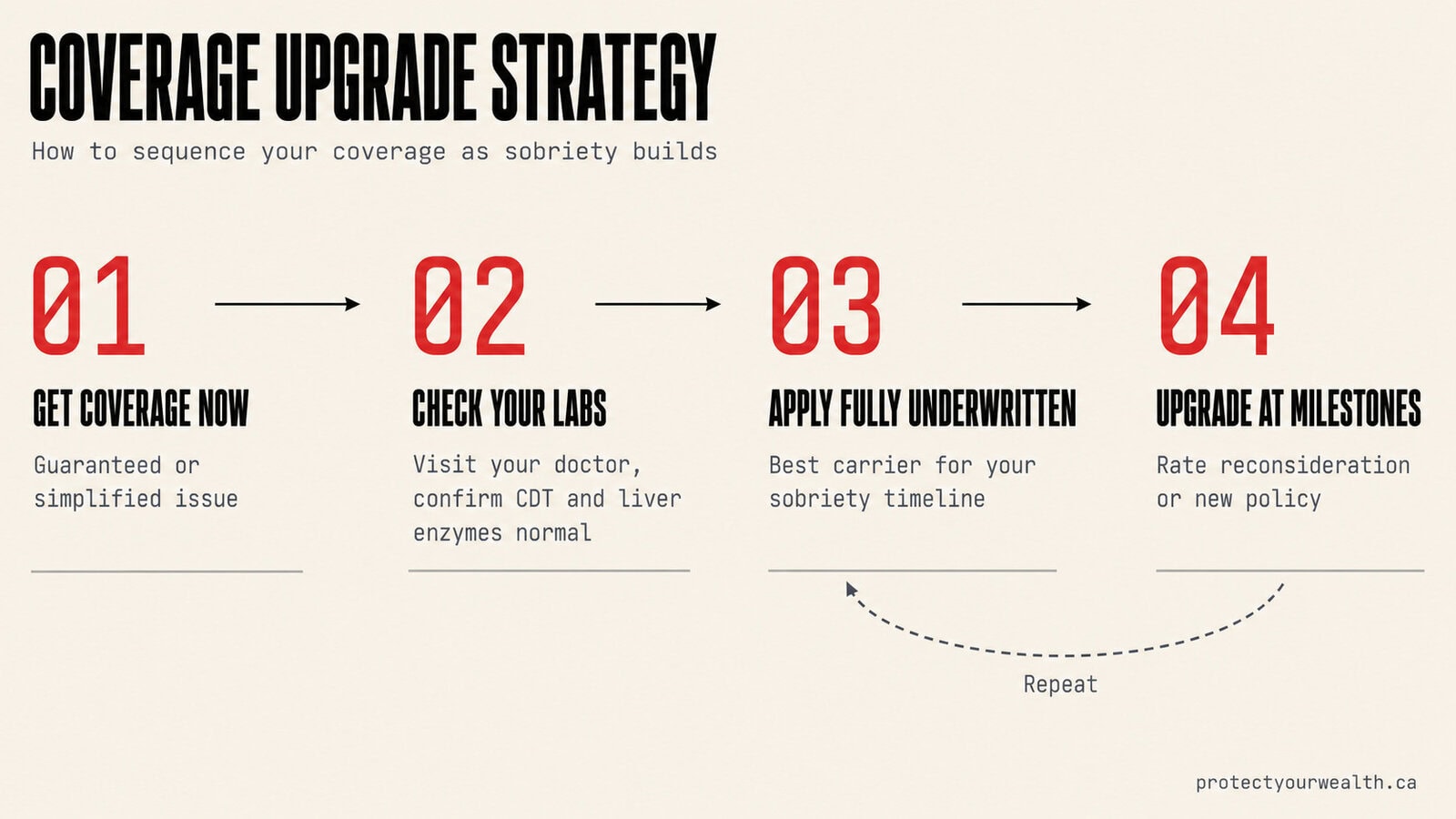
Start with simplified issue if your labs are unknown or uncertain. Lock in coverage without blood work, then pursue fully underwritten once you have clean results from your own doctor.
That sequencing matters more than people think. I covered this in the lab tests section but it is worth repeating: a bad set of blood work on a fully underwritten attempt creates a record that can follow you. Simplified first, fully underwritten second. Coverage is in place the entire time.
Document your recovery. Treatment completion letters, AA attendance records, counselling notes, and a letter from your family doctor all strengthen your file.
Carriers like Sun Life and Manulife weight treatment history heavily. A file that shows “5 years sober, completed treatment, no relapse, ongoing support” reads completely differently than “5 years since last drink, no documentation.” Same sobriety length, very different underwriting outcome.
Request a rate reconsideration when you hit a new milestone instead of starting a brand new application from scratch.
If you already hold a rated policy and reach a sobriety milestone that would qualify you for a better rate class at that same carrier, a reconsideration avoids a new medical exam and a new MIB entry. Not every carrier offers this, but it is always worth asking. If reconsideration is not available, shopping a new policy at a carrier with better rules for your current timeline is the next move. The factors that drive term life insurance pricing go well beyond just health history, so comparing across carriers at each milestone is how you bring costs down over time.
One more thing. Stay ahead of your milestones. If you are at 4 years sober and you know Desjardins moves to standard at 5, start the conversation with your broker at 4 years and 6 months. Preliminary assessments, doctor visits, updated documentation: get it all lined up so the application goes in the day you hit the mark.
Disclosure and Why Full Honesty Protects Your Claim
Full disclosure on your application is what protects your claim from being denied when your family needs it most. I have seen exactly what happens when it goes wrong.
I had taken over servicing on a client policy that I had not originally written. It was transferred to me from a retiring broker. The client unfortunately died within 2 years of the policy being issued. During the claim investigation, it was determined the client had not disclosed significant alcohol abuse. That claim was denied. The family received nothing.
That is the only time in my career I have seen a claim denied outright. And it came down to one thing: non-disclosure within the contestability window.
THE CONTESTABILITY WINDOW
In Canada, life insurance policies include a two-year contestability period. During those first two years, the insurer has the right to investigate any claim and can void the policy entirely if they find material misrepresentation on the application.
After two years, the policy becomes incontestable in most cases, meaning the insurer generally cannot deny a claim based on non-disclosure. But fraud (intentional concealment) can void a policy at any point. Alcohol history that was deliberately hidden qualifies.
People underestimate how much insurers can find. MIB records, pharmacy databases, doctor records requested through an APS (a report from your doctor or specialist), hospital admissions, even prior applications to other carriers. If you disclosed alcohol history on one application five years ago and omit it on a new one, those records do not disappear.
Here is the thing most people do not realize: disclosure does not automatically mean decline. It usually means a rating. You pay more, but you have a valid policy that pays out. Non-disclosure means you pay less in premiums for coverage that might be worthless when your family files the claim. I would rather have a client pay +200% on a policy that works than save money on one that gets voided. For more on what triggers a denied payout, the guide on reasons life insurance claims are denied in Canada covers the full picture.
When we fill out the application together, I walk through every question. If there is something you are unsure whether to disclose, we disclose it. Let the underwriter make the call. That is their job. Ours is to make sure the file is clean.
Frequently Asked Questions
Q1
Can alcoholics get life insurance in Canada?
Yes. Coverage is available at every stage of recovery. Guaranteed issue products accept applications with no health questions and no sobriety requirement. Simplified issue products open up after 2 years at some carriers. Fully underwritten policies with standard rates are possible after 5 or more years of sobriety at most major carriers.
Q2
How long do you have to be sober to get standard life insurance rates?
Most fully underwritten carriers require a minimum of 5 years of sobriety with no relapse for standard rates. Some are faster: Assumption Life reaches standard at 5 years, Ivari at 6 years, and BMO needs 10 years treatment-free for preferred. Canada Life is more favourable for applicants over 40 with 5 or more years clean. Every carrier has different thresholds, which is why comparing across carriers matters.
Q3
What is a CDT test and why do life insurance companies use it?
Carbohydrate-deficient transferrin (CDT) is a blood marker that indicates heavy alcohol consumption over the previous two to four weeks. Insurers use it because it cannot be cleared by abstaining for a few days. Elevated CDT on a fully underwritten application typically results in a decline or postponement. Normal CDT combined with normal liver function tests (GGT, AST, ALT) is one of the strongest signals in your favour during underwriting.
Q4
Does casual or social drinking affect life insurance rates?
Moderate social drinking within typical limits does not affect your rate class at most carriers. Insurers generally define heavy drinking as 3 to 4 or more drinks per day. If your consumption stays below that threshold and you have no history of treatment, diagnosis, or alcohol-related health issues, it is unlikely to impact your application. For similar questions about recreational substance use, the guide on life insurance and occasional drug use covers what carriers look for.
Q5
How does alcohol history affect a term life insurance policy you already have?
If you already hold a term policy, your alcohol history only becomes a factor again if you apply for new coverage, convert to a permanent policy, or if a claim is investigated within the two-year contestability period. An existing policy that was honestly disclosed and approved cannot be repriced because of past alcohol use. If your sobriety has improved since you were rated, you can request a rate reconsideration or shop a new policy at a carrier with better terms for your current timeline.
Q6
What happens if you do not disclose alcohol history on your application?
Non-disclosure of alcohol history is a material misrepresentation. If the insured dies within the two-year contestability window and the insurer discovers undisclosed alcohol abuse during the claim investigation, the claim can be denied entirely. After two years, most policies become incontestable, but deliberate fraud can void a policy at any time. Disclosure typically results in a rated policy that pays out. Non-disclosure risks a voided policy that pays nothing.
Your recovery timeline is yours. Your coverage strategy should match it.
Getting life insurance with an alcohol history is not about finding a carrier that will say yes. It is about finding the right carrier at the right time, with the right product tier, so you are not overpaying or risking an unnecessary decline. That is what an independent broker does.
At Protect Your Wealth, we compare quotes and policies from the top life insurance companies in Canada to match your file to the carrier most likely to approve you at the most competitive rate available for your file. We have been doing this since 2007, including no medical life insurance, critical illness insurance, and permanent life insurance solutions.
Based in Hamilton, serving clients across Ontario, British Columbia, Alberta, Manitoba, Saskatchewan, New Brunswick, and Nova Scotia, including Toronto, Vancouver, Edmonton, and Portage la Prairie.





