·
· 
Life Insurance with Ovarian Cancer in Canada
Finding life insurance with ovarian cancer can feel overwhelming, but there are affordable options in Canada that may help you protect your loved ones with confidence.
📖 10 Minute Read
📅 Originally Published: September 30, 2022
🔄 Updated: September 16, 2025

Life Insurance with Ovarian Cancer in Canada
Finding life insurance with ovarian cancer can feel overwhelming, but there are affordable options in Canada that may help you protect your loved ones with confidence.
📖 10 Minute Read
📅 Originally Published: September 30, 2022
🔄 Updated: September 16, 2025
At this time, many Canadians diagnosed with ovarian cancer are unsure whether they can qualify for life insurance. The good news is that coverage is often still available, depending on your stage, treatment history, and how long you have been in remission.
In this guide, we will explain how insurers in Canada assess applications, what documents may be required, and the types of policies that are usually available. By learning how underwriters approach ovarian cancer, you can apply with clarity and avoid unnecessary surprises.
We often work with clients who are worried if they can get life insurance if they have cancer or are a cancer survivor. The types of cancers our clients have ranges from breast cancer, prostate cancer, and skin cancer, but the answer is simple:

Yes, you can get life insurance even if you’ve been diagnosed with ovarian cancer or are a cancer survivor!
In this Article:
-
- Overview of Ovarian Cancer
- What Underwriters Will Ask
- Life Insurance Options
- Underwriting Wait Times & Eligibility by Stage (Canada)
- Documents Underwriters May Request & How to Prepare
- Guaranteed Issue: Two-Year Deferral Explained
- Critical Illness vs. Life Insurance: When CI Helps During Treatment
- Frequently Asked Questions
Overview of Ovarian Cancer

Ovarian cancer is one of the most challenging cancers that Canadian women may face. Because early symptoms are often vague, it is commonly diagnosed at later stages. Insurers consider both the type of ovarian cancer and treatment history when reviewing applications for life insurance.Many women who complete treatment and remain in remission may still qualify for coverage. Understanding how insurers view ovarian cancer is the first step toward planning for long term financial protection.
Ovarian Cyst
It is important to note that not every ovarian growth is cancerous. Ovarian cysts are fluid filled sacs that often develop during ovulation and are usually benign. Many resolve on their own without treatment, while some may require monitoring or minor procedures.
Insurers will often differentiate between benign ovarian cysts and ovarian cancer. If you only had a cyst with no evidence of cancer, underwriting outcomes are generally more favorable. Always provide medical documentation to confirm diagnosis and treatment, as this may allow you to qualify for traditional life insurance rather than limited options.
Signs and Symptoms
Recognizing the signs of ovarian cancer is important for early diagnosis and treatment. Some of the most common symptoms include:
- Persistent bloating or abdominal swelling
- Pelvic or abdominal pain
- Loss of appetite or feeling full quickly
- Changes in urinary habits, such as urgency or frequency
These symptoms may also be linked to less serious conditions, but if they continue for more than a few weeks, women should speak with a doctor. Early detection improves both treatment options and, over time, eligibility for life insurance coverage.
What Underwriters Will Ask
When applying for life insurance after ovarian cancer, underwriters review specific details to assess risk. These questions are meant to understand your health history and current condition:
- Type of ovarian cancer diagnosed
- Stage at diagnosis and current remission status
- Date of last treatment and results
- Current medications and follow up care
- Other health conditions or risk factors
Providing complete and accurate information allows your broker to present a strong case and helps avoid delays or unnecessary declines.
Life Insurance Options
Depending on your health status and remission history, you may qualify for different types of life insurance in Canada. These range from traditional coverage for those in remission to simplified and guaranteed products for individuals still undergoing treatment or recently diagnosed.
If you are exploring options after cancer treatment, our guide to life insurance for cancer survivors may help you compare policies more effectively.
Term Life Insurance
If you have been in remission for several years, traditional term life insurance may be possible. Approval depends on the stage at diagnosis, time since treatment, and current medical stability.
Simplified Issue
Simplified issue life insurance does not require a medical exam but does involve a health questionnaire. This option is common for those who have completed treatment but are not yet eligible for traditional coverage.
Learn how simplified coverage compares to other solutions in our critical illness insurance guide, which may provide added financial protection during recovery.
Guaranteed Issue
Guaranteed issue life insurance is available without medical questions or exams. It is best suited for individuals who are still undergoing treatment or who have advanced stage ovarian cancer.
Underwriting Wait Times & Eligibility by Stage (Canada)
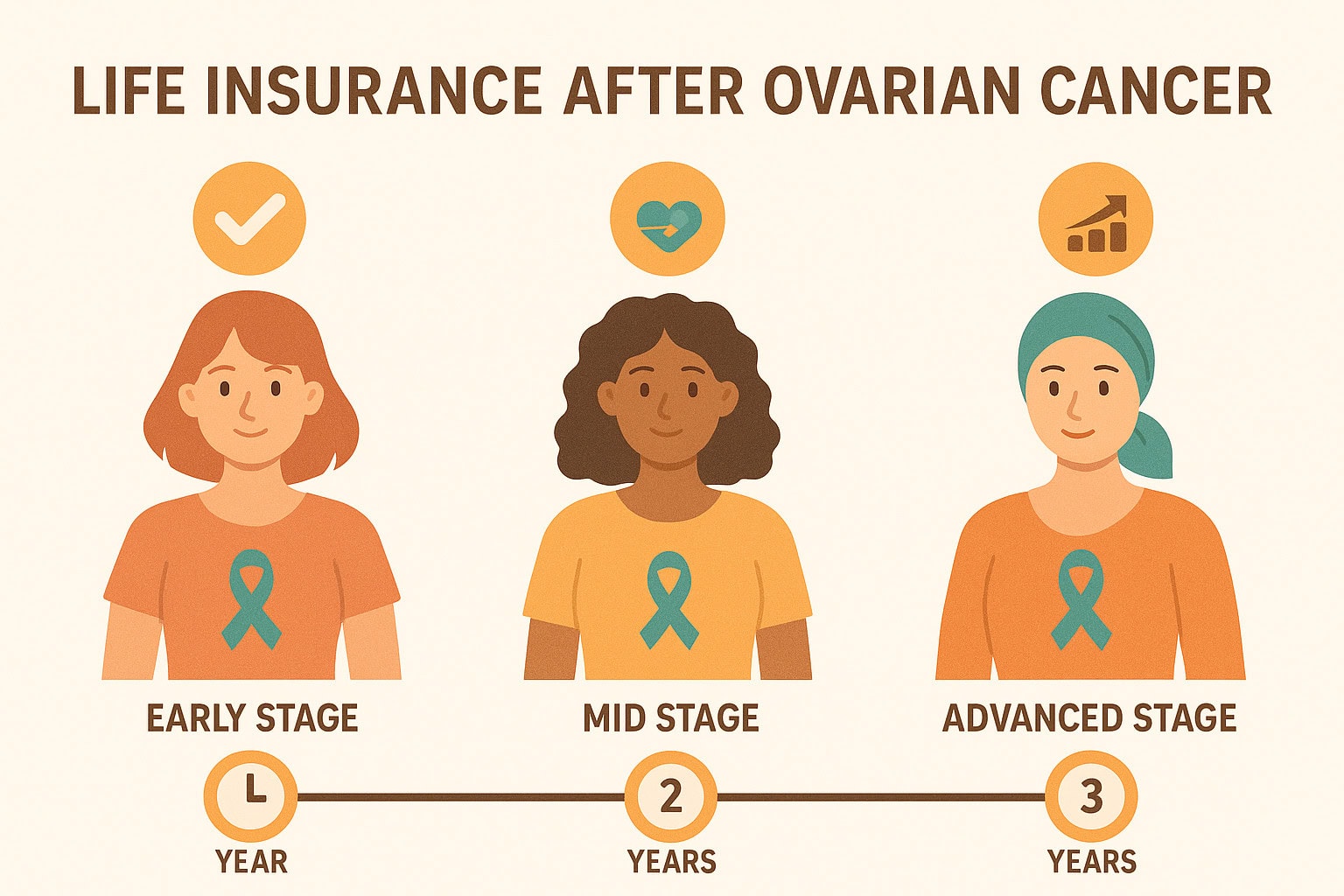
Life insurance companies in Canada use detailed underwriting rules when assessing applications from individuals who have had ovarian cancer. The most important factors are stage of cancer, time since treatment, and remission stability.
Stage I: If diagnosed early and treatment was successful, many insurers may consider an application after about 2 years in remission. Some will prefer 3–5 years before offering traditional coverage, but simplified coverage may be available sooner.
Stage II: Approval is less common immediately after treatment. Most carriers require at least 3–5 years of remission, sometimes longer, before considering simplified or traditional life insurance. Guaranteed issue is usually the fallback in the meantime.
Stage III: Underwriters are far more cautious. Many insurers require 5+ years of stable remission and clean follow up reports before even simplified products are considered. Guaranteed issue is the most likely starting point.
Stage IV: Applicants with advanced stage ovarian cancer or those still in treatment almost always qualify only for guaranteed issue life insurance. These policies carry a two year waiting period on cancer related claims but eventually provide full coverage.
These timelines are general guidelines. Each insurer has its own underwriting manual, and your broker’s role is to match your application with the carrier most likely to approve it.
Documents Underwriters May Request & How to Prepare
Being prepared with medical information is one of the best ways to improve your chances of approval. When applying for life insurance after ovarian cancer, underwriters may request supporting documents to confirm your history and current health status.
- Pathology and surgical reports to verify the original diagnosis and type of ovarian cancer
- Oncologist consultation notes confirming treatment details and remission status
- Medication lists showing current and past prescriptions
- Follow up reports that demonstrate consistent medical care and monitoring
Having these documents ready before you apply allows your broker to submit a more complete file. This often reduces delays, minimizes the need for additional requests, and increases the chance of being approved on the first attempt.
For general cancer follow up guidelines, see the Canadian Cancer Society’s ovarian cancer follow up resources.
Guaranteed Issue: Two-Year Deferral Explained
Guaranteed issue life insurance provides access to coverage when traditional or simplified policies are not possible. However, most policies include a two year deferral period. This clause is important to understand so families know what benefits are available during the first years of coverage.
If the insured passes away within the first two years from a condition related to ovarian cancer, the insurer usually refunds all premiums paid, often with interest, rather than paying the full death benefit. After the deferral period ends, the full face amount becomes available.
Although the waiting period can feel discouraging, guaranteed issue policies are often the only option for individuals recently diagnosed or still undergoing treatment. They provide peace of mind knowing that coverage will eventually convert to full protection.
Critical Illness vs. Life Insurance: When CI Helps During Treatment
Critical illness insurance and life insurance serve different purposes but can complement each other during and after treatment. Critical illness insurance pays out a lump sum if you are diagnosed with ovarian cancer and survive the required waiting period, usually 30 days. This money can help with treatment costs, travel expenses, or time off work.
Life insurance, on the other hand, provides financial protection for loved ones after death. If you are still in treatment and not yet eligible for traditional life insurance, critical illness coverage may serve as an important bridge. It ensures financial support during recovery while you wait to reapply for life insurance after remission.
Many Canadians use critical illness coverage alongside guaranteed issue life insurance to balance immediate and long term needs. A broker can help you design a strategy that works for your health situation and financial goals.
FAQ – Frequently Asked Questions
What if I had advanced ovarian cancer?
If your cancer was advanced, options are limited but still available. Most people in this situation qualify for guaranteed issue life insurance. These policies have a two year waiting period on cancer related claims, then provide full benefits.
Can I obtain life insurance after an ovarian cancer diagnosis?
Yes. Expect higher premiums at first and possible waiting periods. Insurers review your stage, treatment dates, remission stability, age, and requested coverage. Options often start with simplified or guaranteed plans, then expand over time.
When am I able to get life insurance as an ovarian cancer survivor?
Many Canadian insurers consider traditional coverage after about two to five years in remission for earlier stages. Later stages often require more time. Your broker matches your file to the insurer most likely to approve.
Does life insurance protect against cancer?
Once a policy is issued based on accurate disclosure, new cancer diagnoses are generally covered. Claims can be denied if material medical information was not disclosed at application.
How does a family history of cancer impact eligibility or price?
With traditional life insurance, family history can influence pricing. With simplified issue, questions are fewer so impact is smaller. With guaranteed issue, approval does not depend on medical or family history.
Can I get life insurance in Canada if I have ovarian cancer?
Yes. Many applicants qualify for simplified or guaranteed issue coverage now, then revisit traditional coverage once remission is established and follow up reports are stable.
Do I need a medical exam to qualify?
Not always. Simplified issue uses a health questionnaire without an exam. Guaranteed issue has no health questions. Traditional policies may require medical evidence once remission has been stable for some time.
How long after remission can I apply for traditional coverage?
Earlier stages are often considered after two to five years in remission. Later stages may need longer stability or may remain limited to simplified or guaranteed options. Each insurer reviews files case by case.
What happens during the two year waiting period on guaranteed issue?
If death is related to a pre existing condition during the waiting period, most policies refund all premiums paid, sometimes with interest. After two years, the full coverage amount applies.
Case Study: Sara, 52, Ontario
🧑🦳 Persona: Sara is 52 and lives in Ontario. She had Stage I epithelial ovarian cancer, completed surgery and chemotherapy 3 years ago, and her follow up reports show stable remission. She wants coverage to protect her mortgage and to leave a small legacy.
🧩 Problem: Unsure whether she qualifies for traditional life insurance yet, and worried about higher premiums because of her cancer history.
✅ Resolution: We placed a blended strategy. Primary protection with term life insurance for the mortgage, plus a small simplified issue policy for added security while underwriting appetite continues to improve.
- Policy snapshot: Term 20 for mortgage needs, small simplified policy for top up.
- Why it works: Remission at 3 years put her close to traditional eligibility, while the simplified top up ensures immediate protection.
- Future move: Review at year 5 of remission and replace the simplified policy with traditional coverage if eligible.
🔗 Helpful resources:
Life insurance for cancer survivors ·
No medical life insurance
Case Study: Leila, 47, Alberta
🧑⚕️ Persona: Leila is 47 and lives in Alberta. She was treated for Stage III ovarian cancer last year and is on maintenance therapy with ongoing oncology follow ups. She needs coverage for family income protection.
🧩 Problem: Traditional and simplified coverage are unlikely right now due to recent treatment and stage. She needs a solution that can activate later.
✅ Resolution: We placed guaranteed issue life insurance today for immediate peace of mind, and discussed adding critical illness insurance in the future if available. We scheduled a review after two more years of stable follow ups.
- Policy snapshot: Guaranteed issue with a two year waiting period on cancer related claims.
- Why it works: Provides coverage now, with the plan to revisit simplified or traditional options as remission time grows.
- Future move: Reassess at year 3 post treatment for simplified eligibility, then at year 5 for potential traditional coverage.
Finding the right life insurance for you
If you have been diagnosed with ovarian cancer or are a survivor, there’s a life insurance product or package for your situation. Working with a life insurance advisor can help you build the right life insurance plan and package for your needs.
At Protect Your Wealth, we work with and compare policies and quotes from the best life insurance companies in Canada to ensure the best solution for you and your needs. We provide expert life insurance solutions, including no medical life insurance, critical illness insurance, term life insurance, and permanent life insurance to build the best package to give you the protection you need.
Contact Protect Your Wealth or call us at 1-877-654-6119 to talk to an advisor today! We’re proudly based out of Hamilton, and service clients anywhere in Ontario, British Columbia, and Alberta, including areas such as Toronto, Kamloops, and Edmonton.