·
· 
Life Insurance After a Stroke in Canada
By Parvesh Benning, Licensed Life Insurance Broker
A stroke does not put life insurance out of reach. What it changes is which insurer you should apply to first, and in some cases that ordering decision is the difference between a fairly priced policy and a far more expensive last-resort option.
If you have had a stroke or a TIA, you can still protect your family. The route depends on how long ago it happened, how well you have recovered, and which insurer sees your file first. This guide walks through how coverage is approved after a stroke, what each path actually costs, and how a broker decides where your application belongs.
Updated: June 16, 2026

Life Insurance After a Stroke in Canada
By Parvesh Benning, Licensed Life Insurance Broker, Updated: June 16, 2026
A stroke does not put life insurance out of reach. What it changes is which insurer you should apply to first, and in some cases that ordering decision is the difference between a fairly priced policy and a far more expensive last-resort option.
If you have had a stroke or a TIA, you can still protect your family. The route depends on how long ago it happened, how well you have recovered, and which insurer sees your file first. This guide walks through how coverage is approved after a stroke, what each path actually costs, and how a broker decides where your application belongs.
Most stroke survivors who ask me about coverage assume they have one option, if any. The truth is there are usually three, and the gap between the cheapest and the most expensive is enormous for the exact same policy.
Insurers care about three things after a stroke or TIA: how long ago it happened, how complete your recovery has been, and how well any related conditions like blood pressure or cholesterol are managed. Those answers decide whether you land in fully underwritten, simplified, or guaranteed-issue coverage, and that decision is where a broker earns their keep.
Can you get life insurance after a stroke in Canada?
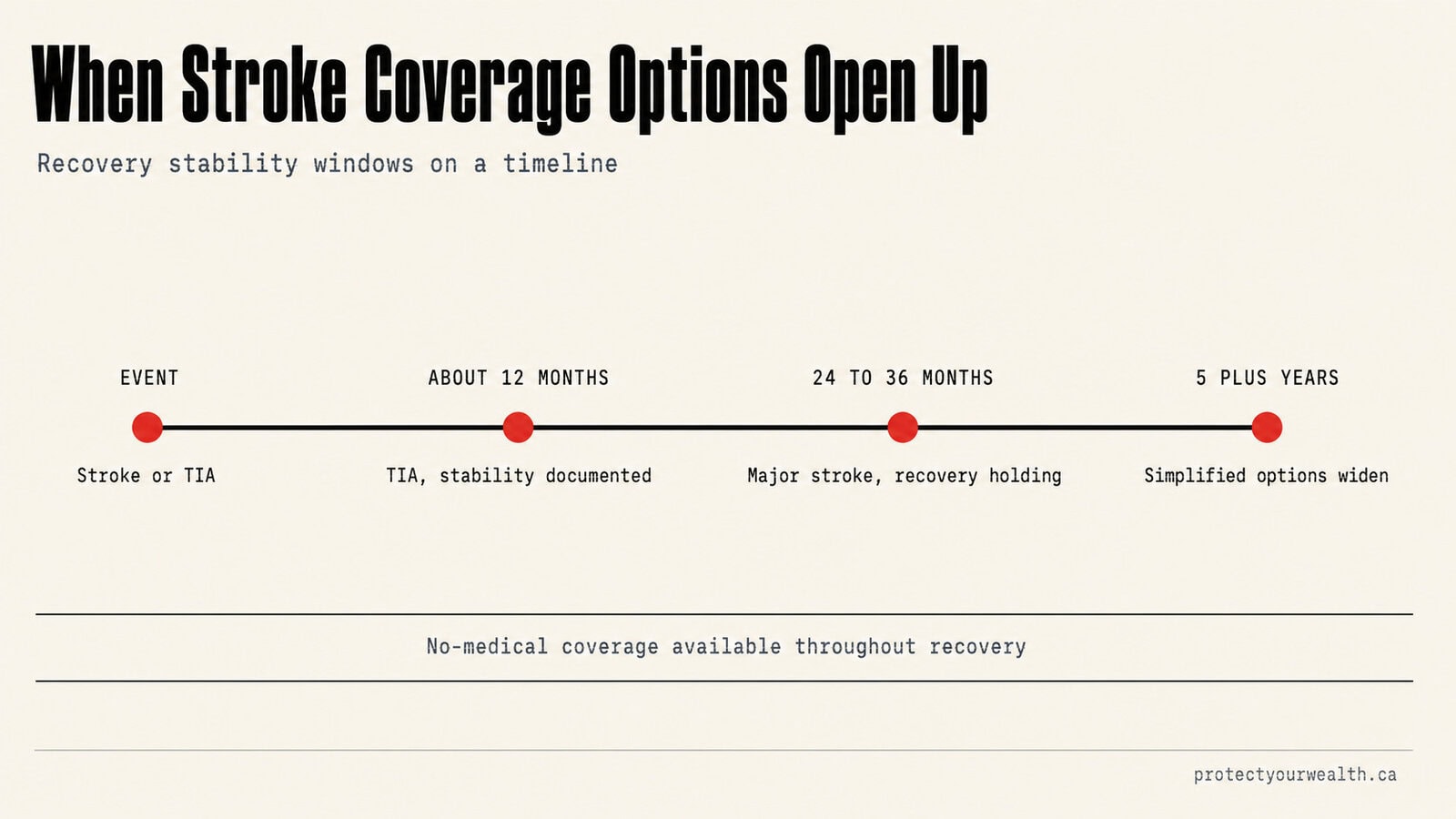
Yes. A single, well-recovered stroke or TIA may be considered for standard or rated coverage once enough stability is documented, usually 12 months after a TIA and 24 to 36 months after a major stroke.
Earlier in recovery, or after multiple events, no-medical options still apply. The right path depends entirely on the details of your file, which is what the rest of this guide walks through.
What this guide covers
- Stroke recovery and life insurance in Canada
- Lifestyle and medical factors that affect approval
- Can you get coverage after a stroke or TIA?
- How Canadian underwriters assess stroke history
- Underwriting factors for stroke and TIA applicants
- How a broker routes a stroke file, and what each path costs
- Timing your application and no-medical alternatives
- Documentation and how to improve your approval odds
- Coverage if you are at risk of a stroke
- Frequently asked questions
Stroke Recovery and Life Insurance in Canada
A stroke changes your insurance options, but it rarely closes them. What matters to an insurer is not just that you had a stroke, it is what kind, how long ago, and what your recovery looks like now. Two people with the same diagnosis can get very different answers depending on those three things.
Quick refresher on the terms, because they affect how a file is read. A stroke happens when blood flow to part of the brain gets cut off. A TIA, what people call a mini-stroke, gives brief symptoms and clears, but underwriters treat it as a warning sign, not a non-event. And most strokes in Canada are ischemic, caused by a clot, rather than the bleed type.
The three things every insurer weighs first
Type of event. A single TIA reads lighter than a major stroke. A bleed reads differently than a clot.
Time since the event. The further out and the more stable, the more doors open. This is usually the single biggest factor.
Current health and recovery. Clean imaging, controlled blood pressure and cholesterol, no lingering deficits. That is the file that gets the better answer.
None of this is something you have to figure out alone, and you should not have to guess which insurer is friendliest to your situation. That is the part a broker handles. If you want to understand the broader picture first, our overview of no medical life insurance in Canada covers the faster-approval options many survivors start with, and our life insurance page lays out the fully underwritten side.
Lifestyle and Medical Factors That Affect Approval
Insurers look past the stroke itself at what caused it and how well it is controlled now. The stroke is the headline. What an underwriter actually reads is the story underneath it: was this a one-off, or is it part of a pattern that is still active? That is the difference between a manageable file and a hard one.
Two buckets get reviewed. The medical side is what happened and how stable you are. The lifestyle side is what you are doing about it.
Medical factors
Type of event. A TIA usually reads lighter than a major stroke.
Time since the event. Most insurers want 12 months of stability after a TIA, 24 to 36 months after a major stroke, before fully underwritten coverage.
Residual symptoms. Lingering weakness, slurred speech, or vision changes can mean a rating or a temporary postponement.
Follow-up testing and medication. Clean imaging and steady use of blood thinners, cholesterol, or blood pressure medication show the risk is being managed.
Lifestyle factors
Tobacco or vaping. Recent use can move the file into smoker pricing and make a stroke history harder to place.
Weight and blood pressure. Uncontrolled hypertension or a high build class is a common reason for a higher rate or a postponed file.
Activity and diet. Documented exercise, rehab attendance, and cholesterol control all strengthen the picture.
Family history. Early cardiovascular disease in a parent or sibling can lift your risk class, especially alongside other factors.
Here is what most people miss. You do not present this file to an insurer raw, and you do not have to. How the history is organized and which insurer sees it first changes the outcome. How your medications affect a life insurance application is worth a read if you are managing blood pressure or cholesterol, because steady, documented use usually helps your case rather than hurting it. A broker who knows the carrier differences can frame consistent follow-up and lifestyle change toward a standard or simplified result instead of a rated one.
Can You Get Coverage After a Stroke or TIA?
Yes. A stroke or TIA does not disqualify you from life insurance in Canada. What it does is set a clock running, and where you are on that clock decides which type of coverage you can get right now.
I tell people it almost always comes down to time since the event. The longer you are out and the cleaner the recovery, the more the price drops and the more insurers open up. Under a year out, the realistic option is usually no-medical. Past the stability window, the better-priced doors start opening.
Often eligible after 6 to 12 months of symptom-free recovery with consistent follow-up.
Most insurers review fully underwritten coverage after 24 to 36 months of documented recovery, depending on severity and any lasting effects.
No-medical or guaranteed-issue coverage is usually the path to immediate protection while timelines mature.
These are general windows, not promises, and every insurer draws the line a little differently. That is the whole reason it pays to have someone who knows which carrier is reasonable at 18 months versus which one wants the full three years. A broker who works high-risk life insurance files can usually tell you where you stand before you ever fill out an application.
Not sure which path your stroke history fits?
That is the exact question worth answering before you apply anywhere. The wrong first application can cost you money and leave a mark on your record. The right one gets you covered at a fair price.
A broker can run your specifics past insurers quietly, without a formal application on file, and tell you where you actually stand.
How Canadian Underwriters Assess Stroke History
An underwriter is really answering one question: how likely is another event? Everything they ask is built around that. The stroke already happened, so what they are weighing is whether your file points to stable, managed recovery or to risk that is still moving.
The clearest signal is time plus stability. A clean two or three years with good imaging and controlled risk factors tells a very different story than something recent or still settling. After that, it comes down to the details.
If you are in the first year or two, a no-medical or simplified plan can carry you in the meantime. Past the two-year mark, most people open up to fully underwritten coverage with broader options and better pricing. The mistake is assuming the file speaks for itself. It does not, and which insurer reads it matters as much as what is in it. A broker who handles critical illness insurance alongside life coverage can also flag where a stroke history affects more than just your life policy.
Underwriting Factors for Stroke and TIA Applicants
The single factor that moves your file the most is time since the event, followed closely by how well your other risk factors are controlled. Everything else sits underneath those two. An insurer is trying to confirm the event is behind you and that what caused it is being managed, not left to drift.
I have seen the same person get a rated offer at one carrier and a near-standard offer at another, on the identical file. That is not luck. It is knowing which insurer weighs which factor more heavily.
Time since the event
Most offers strengthen once two to three years have passed with no recurrence.
Blood pressure and cholesterol
Consistently managed numbers point to lower long-term cardiovascular risk.
Neurological recovery
Full motor function, clear speech, and stable cognition support a better rate class.
Documentation
Neurologist or physician reports and test results that confirm the recovery is holding.
Lifestyle
Non-smoking status, balanced diet, and regular activity all improve the read.
Early in recovery, a no-medical or simplified plan is often the practical move. Once stability is documented, most people can shift to fully underwritten term or permanent coverage for better long-term value. The next section is where this all comes together: how I take a file like this and decide exactly where it should go, and what each path costs. A broker handling term life insurance can also map out when it makes sense to start simplified now and convert later.
Timing Your Application and No-Medical Alternatives
The best time to apply is the moment your file can clear the rung you actually want, not a day sooner and not years later out of caution. Apply too early and you risk a decline or a heavy rating that follows you. Wait too long and your family is exposed the whole time for no reason.
Apply too early
A decline or a heavy rating can stick to your record and make the next application harder.
Wait too long
Your family carries the risk the entire time, often for a rate improvement that never arrives.
This is where I push back on the common advice to just wait it out. Waiting is not free. Something else can develop while you sit on the sidelines, a blood pressure problem, diabetes, whatever, and now you are insuring two problems instead of one. If you need protection now, take the no-medical coverage now and upgrade later.
The layering move I use most
Start with a no-medical or simplified policy during recovery so your family is covered today. Once your stability is documented, apply for fully underwritten term or permanent coverage at a better rate, then keep or drop the first policy depending on what makes sense. You stay protected the whole time.
Rough timing, and these are general guidelines rather than hard rules at every insurer: figure 12 months of stability after a TIA, 24 to 36 months after a major stroke, before fully underwritten coverage opens up. Inside those windows, no-medical and simplified plans do the job. The lines move from carrier to carrier, which is the whole reason it helps to have someone who knows them. Our guide to no medical life insurance walks through how those plans work and who they fit.
How a Broker Routes a Stroke File, and What Each Path Costs
Timing drives almost everything here. How long it has been since the stroke or TIA decides which door opens first, so the first thing I do is put the file on a ladder: fully underwritten first, then simplified, then guaranteed issue.
I never jump straight to the no-questions option, even when experience tells me a recent stroke will probably land there. I still run the check. The order matters, because each rung down costs the client more for the same coverage.
Here is the part most people never see. A single stroke or a one-time TIA with a clean recovery is a different risk class than ongoing vascular disease.
An underwriter reads one well-documented event, stable imaging, controlled blood pressure, very differently from a pattern of repeated events or disease that is still active. One may be considered for standard or rated coverage. The other usually cannot.
Treating those two files the same is the most common mistake I see.
What surprises clients most is the price spread. Same person, same $100,000, four very different prices depending on which rung the file lands on.
Fully underwritten, standard
from $56/mo
Cheapest path, for a clean recovery past the stability window
Fully underwritten, rated
$82 to $108/mo
A typical post-stroke surcharge added to the standard rate
Simplified, no medical
about $62/mo
Flat-priced, never rated, once past each insurer’s stroke window
Guaranteed issue
about $300/mo
No questions, last resort for recent or multiple events
Sample premiums are for illustration only and assume non-smoker status, standard or simplified underwriting as noted, no additional health concerns, and current carrier rates at time of quoting. Final premiums depend on age, sex, province, coverage amount, term length, health history, recovery details, and insurer approval.
Look at that spread. That is why I do not default anyone to the no-questions option.
Pushing a client to guaranteed issue when they could have qualified simplified, or even rated fully underwritten, can cost them three to five times the premium for the life of the policy. So I run the ladder properly, every time.
The old catch with simplified was timing, and this is where the routing earns its keep. A single, well-recovered stroke can reach simplified coverage sooner than most people expect. Certain insurers will consider it around the two to three year mark, and the options open up widely by five years.
I have placed stroke clients into Assumption Life’s Platinum coverage once they were past the five-year point with a clean recovery, no medical exam. A stroke with lasting deficits or multiple events is the file that routes to guaranteed issue instead.
One more thing worth knowing, because it changes the math at the top end.
Guaranteed issue is usually capped low, around $25,000 to $50,000. That is fine for a funeral, but not for replacing income or covering a mortgage.
Manulife is the exception. Its guaranteed-issue policy goes up to $100,000 to age 70. So even someone who cannot answer a single health question still has a path to real coverage, not just a token amount. Knowing that before anyone applies is the whole game.
A postponement is not a decline, and it is not the end of the road. It usually means the insurer wants more time since the event, cleaner follow-up, or updated medical reports before making an offer.
I have had plenty of postponed files turn into clean approvals a few months later once the documentation caught up.
Before I submit anything, I can run the specifics past underwriting without names attached, get a read on the likely rating, and then pick the rung that actually fits. That protects your record and locks in the lowest price your file can support.
If you have had a stroke or TIA, get in touch and we will sort out which path is yours before a single application goes in.
Documentation and How to Improve Your Approval Odds
The single biggest thing in your control is the paperwork. A clean, organized medical file shortens the review and often moves the rating in your favour, because the underwriter is not left guessing or waiting. A messy file invites the worst-case assumption.
Pull these together before anyone applies. It is the difference between a quick approval and a file that stalls for weeks.
Physician or neurologist statement
Date, cause, and type of the stroke or TIA, plus recovery progress and current treatment.
Hospital discharge summary
The original treatment record, including any imaging or procedures.
Recent imaging
MRI, CT, or carotid ultrasound, ideally within the past 12 months.
Medication list
Current prescriptions, which show the risk factors are being managed.
Follow-up reports
Recent specialist or family physician notes confirming the recovery is holding.
Beyond the file itself, a few habits genuinely move the needle: stay on top of your medical reviews and keep imaging current, take your medication as prescribed and document it, and keep up the heart-healthy basics like activity and not smoking. None of it is dramatic. It just builds the picture an underwriter wants to see.
The last piece is who walks the file in. An independent broker can compare carriers and steer your application toward the one most reasonable about neurological recovery, instead of you guessing and risking a decline. If you are managing related conditions, our notes on life insurance with high blood pressure cover how that side of the file is read.
Coverage If You Are at Risk of a Stroke
If you have not had a stroke yet but you are flagged as at risk, the best move is to apply now, before anything happens. High blood pressure, high cholesterol, or a family history puts you on the radar, but as long as no event has occurred, you can still qualify for preferred or standard rates. The day a stroke or TIA shows up on your file, that pricing is gone.
That is the whole point I make with at-risk clients. Insurability is something you lock in while you are healthy. Wait, and you are gambling that nothing develops in the meantime. I have watched people put it off for a year and then call me after an event, now looking at ratings or no-medical options instead of the clean rate they could have had.
If a doctor has flagged your risk, do this now
Lock in a baseline. A current physician report and blood panel showing controlled numbers supports a stronger rate today.
Document your habits. A record of activity, diet, and medication compliance can help offset family-history risk.
Layer your coverage. Lock in protection now and add to it later as your eligibility improves.
Review yearly. As your health holds or improves, your policy can be revisited for better terms.
Applying before a medical event is the simplest, cheapest way to protect your family and keep your options open. If your doctor has raised a warning but nothing has happened yet, that is the window. Our notes on life insurance with high cholesterol cover how that risk factor specifically gets read on an application.
Frequently Asked Questions
QUESTION 01
Can I qualify for life insurance after a stroke or TIA?
Yes. Many Canadians are approved for life insurance after a stroke or TIA. What matters is how long ago it happened, how stable your recovery is, and whether related conditions like blood pressure or cholesterol are managed. After one to two years of stability, fully underwritten policies usually become accessible.
QUESTION 02
How long should I wait to apply after a stroke?
Most insurers want about 12 months of stability after a TIA and 24 to 36 months after a major stroke before considering fully underwritten coverage. You do not have to wait for that window to be protected, though. A no-medical or simplified plan can cover you in the meantime, then you upgrade once your recovery is documented.
QUESTION 03
What will insurers ask me when I apply?
Expect questions on the type of stroke, the date, any lasting symptoms, your medications, and your follow-up care. Many will also want imaging reports or physician notes confirming recovery. Complete, current information is what moves a file toward approval rather than postponement.
QUESTION 04
Can I get coverage if I have had more than one stroke?
Often yes, though the realistic options are usually simplified or guaranteed issue. Insurers weigh your overall health, time since the last event, and how well related conditions are controlled. A broker can point you to the carriers that are most reasonable with multiple-event histories instead of you finding out through a decline.
QUESTION 05
Will my premiums be higher after a stroke?
They can be, depending on the type of stroke, your age, and how recent it was. A strong recovery with no lasting symptoms may still reach standard or only lightly rated pricing. Others start on a simplified plan and reapply for better rates once stability is established. The path you are routed to is the biggest driver of cost.
QUESTION 06
Does critical illness or disability insurance cover strokes?
Many critical illness policies include stroke as a covered condition, but a claim has to meet the policy’s specific definition. That can involve a survival period, defined neurological findings, and exclusions, and the wording varies by contract. Always review the policy definition before relying on stroke coverage.
QUESTION 07
Which insurers work best for stroke survivors in Canada?
There is no single answer, because it depends on your event and recovery. Carriers like Manulife, Canada Life, Beneva, Empire Life, and iA Financial each weigh stroke history differently, and some offer no-medical or simplified plans for faster approval. That variation is exactly why comparing carriers through a broker tends to beat applying to one on your own.
Still weighing your options after a stroke?
You do not have to figure out which insurer fits your recovery on your own. Tell us where you are in your recovery and we will map the path that gets you covered at the fairest price your file supports.
Get in touch or call 1-877-654-6119.