·
· 
Can You Get Life Insurance After 70 in Canada?
By Parvesh Benning, Licensed Life Insurance Broker
Most seniors over 70 have more options than they think, but the right path to approval depends on how you’re routed, not just how healthy you are.
Yes, you can get life insurance after 70 in Canada, and for most seniors the real question isn’t whether coverage exists but which type makes sense given your health picture. The options narrow as you move through your 70s, but a 72-year-old with controlled blood pressure is in a very different position than the online guides suggest.
Updated: April 13, 2026

Can You Get Life Insurance After 70 in Canada?
By Parvesh Benning, Licensed Life Insurance Broker
Most seniors over 70 have more options than they think, but the right path to approval depends on how you’re routed, not just how healthy you are.
Yes, you can get life insurance after 70 in Canada, and for most seniors the real question isn’t whether coverage exists but which type makes sense given your health picture. The options narrow as you move through your 70s, but a 72-year-old with controlled blood pressure is in a very different position than the online guides suggest.
Updated: April 13, 2026
Yes, most Canadians over 70 qualify for life insurance, and many qualify for more than one type. Fully underwritten policies, simplified issue plans with no medical exam, and guaranteed-acceptance coverage are all available depending on your age, health profile, and how long you need the coverage. The path changes as you move through your 70s, but coverage does not disappear.
- Fully underwritten coverage available to most applicants aged 70 to 75 with stable, managed health
- Simplified issue plans available with no nurse visit or blood work, up to age 80 at most carriers
- Guaranteed-acceptance coverage available to age 85 at select carriers, benefit amounts $5,000 to $50,000
- Sample $25,000 Term 10 rates at age 70: from $32.63/month for females and $47.30/month for males
Life Insurance for Seniors Over 70, 75, and 80 in Canada: What’s Available at Each Age
Most Canadians over 70 qualify for at least one coverage option, and many qualify for more than one. The type that makes sense depends on three things: how much coverage you need, how long you need it for, and where your health sits today. Those three answers point you toward fully underwritten coverage, simplified issue, or guaranteed-acceptance, and each works for a different profile.
Ages 70 to 75
Full underwriting is still on the table. Term plans up to 14 or 15 years are available from some carriers, meaning a 71-year-old can secure coverage to age 85 or 86. For seniors willing to go through the process, this age band offers the most cost-effective options.
Ages 76 to 80
Simplified issue becomes the practical default. No nurse visit, no blood work, just a short health questionnaire with decisions in a few days. Premiums run higher than fully underwritten but approvals are fast and predictable when conditions are managed and disclosed clearly.
Ages 80 and Over
Guaranteed-acceptance coverage is the primary option. No health questions, no exam, automatic approval. Coverage amounts run from $5,000 to $50,000 with a two-year waiting period for non-accidental deaths. It covers final expenses with certainty regardless of health history.
Each carrier sets its own issue-age limits, which is where the carrier comparison below is useful. The same age and health profile can land in different tiers depending on where the application goes.
What Canadian Insurers Actually Look at When You Apply After 70
Insurers at this age aren’t looking for perfect health. They’re looking for stable, managed health, and there’s a real difference between the two. A few factors carry more weight than most seniors expect.
- Health Stability: Consistent medical results, well-managed conditions, and no recent unplanned hospital visits tell insurers your health is reliable and predictable. A two-year track record of steady results carries significant weight.
- Medications: The medication itself is not the concern — it’s the underlying reasons. Blood pressure or cholesterol medication shows you’re managing a known condition, which insurers often view as a positive. It’s only when medications point to something unstable or uncontrolled underneath that it changes things.
- Pending Tests or Appointments: If there’s a specialist visit coming up or test results still outstanding, every insurer will want those resolved before an application moves forward. This isn’t a decline — it’s a timing issue. Waiting 60 to 90 days for a clear picture is almost always the right call.
- Medical Follow-Up: Regular doctor visits and consistent care show good self-management. Insurers at this age reward applicants who stay on top of their health, not just those who have no health issues.
- Functional Independence: Staying active and managing daily tasks such as driving or shopping signals the kind of stability underwriters are looking for at this age.
- Application Timing: Applying earlier in your 70s gives you the most options. Waiting until your 80s typically narrows the field to guaranteed-acceptance coverage, which costs more per dollar of protection.
The seniors who move through underwriting most smoothly at this age are the ones with organized records, managed conditions, and no pending tests. That profile is more common than most people think.
How a Broker Routes a 70+ Application (and Why the Path Isn’t the Same for Everyone)
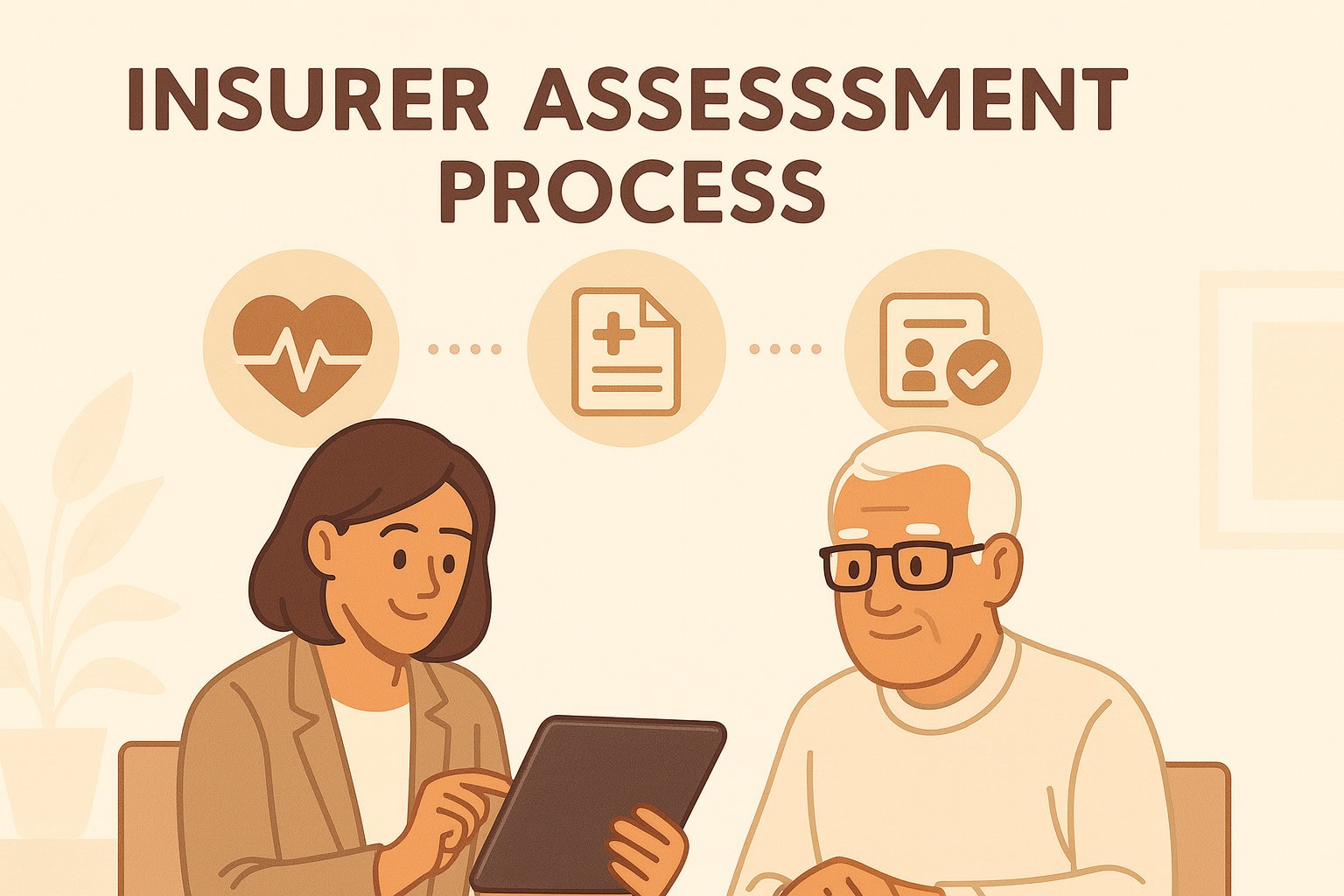
The first thing I work through on any call with a Canadian in their early 70s is three questions: how much coverage are they looking for, for how long, and are there any health concerns. That last one doesn’t close doors. It just changes the routing.
For clients in their early 70s with reasonably stable health, I always have the conversation about what a fully underwritten policy looks like. There’s a perception that once you’re past 70, simplified issue is the automatic answer. It’s not. If a client is willing to go through the process, a fully underwritten plan can deliver the most cost-effective solution. Insurers understand that health conditions come up as we age. When those conditions are controlled, blood pressure or cholesterol managed with medication, I find that actually has almost a positive impact from an underwriting standpoint. You’re addressing it, and there’s no surprise there. That’s what they want to see.
Simplified issue makes sense for clients who either can’t or don’t want to go through a nurse visit and blood work. Some clients aren’t concerned purely about price. The simplicity of a no-exam process has real value, and the premium makes sense for them. So it’s not a default either way. It comes down to what the client is willing to do and what their health picture looks like.
When there are multiple things going on at once, say controlled diabetes and a recent cardiology follow-up, I still don’t panic. Controlled diabetes with no other complications is typically not a huge concern. We can navigate it. A completed cardiology follow-up is actually viewed as a positive because the picture is clear. The medication itself is not the concern. It’s the underlying reasons, and how we navigate that from a carrier routing perspective.
One thing that changes my approach immediately: anything pending.
If there’s a specialist appointment coming up or test results still outstanding, every carrier will want those resolved before an application moves forward. This isn’t a decline. It’s a timing issue. Wait for the clear picture, then apply. Submitting with something pending creates delays and sometimes worse outcomes than waiting 60 or 90 days.
On the question of whether to wait until health improves before applying: I’ve had situations where a client waited and unfortunately something else came up health-wise that meant what they qualified for before is no longer an option. My position is straightforward: put in place the best coverage today if you have a genuine need. It doesn’t mean we can’t re-evaluate later. But don’t take for granted getting coverage today, because tomorrow may bring something else.
For seniors who still hold a term policy with a conversion option open, it depends entirely on the situation. If someone needs lifelong coverage and has health concerns, converting before that window closes can be the most optimal solution. But it’s not one size fits all. Maybe that carrier’s permanent rates are higher than another company, and if there are no major health concerns it may make more sense to look elsewhere. The goal as always is the most cost-effective policy that fits the client’s needs, which is why having access to multiple carriers matters more at this stage than any other. For a deeper look at how simplified and guaranteed options compare in practice, see our guide to simplified vs. guaranteed life insurance for seniors.
Term, Permanent, and No-Medical Life Insurance for Canadian Seniors: How to Choose
Canadians over 70 have more coverage options than most people expect. The right fit depends on your health, how long you need coverage, and how much process you’re willing to go through to get the best price. Here’s how the main types actually work at this age.
- Term life insurance: Still available from some carriers up to age 75, with 10 to 15 year options depending on the insurer. Most cost-effective for seniors who need coverage for a defined period, such as an outstanding mortgage or income replacement for a spouse. Premiums are level for the term, then the policy ends.
- Permanent life insurance: Lifelong coverage with level premiums that never increase. The right choice for seniors who want certainty, no expiry date, and no surprises on a fixed pension or CPP and OAS income. Available through full underwriting up to 75, and through simplified issue beyond that.
- Simplified issue: No nurse visit, no blood work. A short health questionnaire and a decision within days. The practical default for most seniors past 75, and a strong option at 70 to 74 for clients who prefer the certainty of no exam over the potential cost savings of full underwriting.
- Guaranteed-acceptance coverage: No health questions at all. Automatic approval regardless of medical history. Coverage runs from $5,000 to $50,000 with a two-year waiting period for non-accidental deaths. The right fit for seniors who’ve been declined elsewhere or are managing multiple serious conditions. Available from carriers including Canada Protection Plan and Assumption Life.
The hidden costs behind some senior-specific products are worth understanding before you commit. Some policies marketed heavily to seniors carry premiums that cost more per dollar of coverage than a comparable simplified issue plan from a major carrier. For a closer look at how those products stack up, see what Canadian seniors need to know before buying.
Not sure which type fits your situation?
The right path depends on your health profile and what you’re trying to accomplish. A broker with access to multiple carriers can compare fully underwritten, simplified, and guaranteed options side by side at no cost to you.
What Approval Actually Looks Like for Canadian Seniors Over 70
Here’s what most people don’t realize: the majority of Canadian seniors who apply for life insurance get approved. The question isn’t whether you qualify. It’s which path gets you there. Standard approval means base senior rates. Rated approval means a moderate increase, typically 25 to 75 percent above base, for well-managed conditions like diabetes or hypertension. Full coverage either way, and far more common than a decline.

For many seniors, simplified issue is the smartest path, not a consolation prize. No nurse visit. No blood work. Approval in days. The sample rates below show exactly why the numbers make sense.
Which Type of Coverage Fits Your Situation?
Based on age and health profile. For a specific recommendation, talk to a broker before submitting any application.
| Age 70 to 74, stable health, willing to go through a medical process | Fully Underwritten | Best long-term pricing on permanent coverage. Controlled conditions like blood pressure or cholesterol often have a positive impact at underwriting because you're managing them. |
| Age 70 to 74, stable health, wants fast coverage without an exam | Simplified Issue | No nurse visit, no blood work. Approval in days. At age 70, the premium gap between simplified and fully underwritten on a $25,000 term policy is roughly $10 to $15 per month for most applicants. |
| Age 70 to 74, controlled conditions, multiple medications | Simplified Issue | Medications are assessed by what they treat, not the medication itself. Controlled diabetes, blood pressure, or cholesterol alone rarely prevents approval. Routing to the right carrier matters here. |
| Age 75 to 80, manageable health profile | Simplified Issue | Full underwriting becomes less common past 75. Simplified issue is the practical default at this age band, with most carriers approving within days and no exam required. |
| Age 75 to 80, complex or uncontrolled health history | Guaranteed Acceptance | When health complexity makes simplified issue approval uncertain, guaranteed acceptance removes the question entirely. No health questions, automatic approval, with coverage typically from $5,000 to $50,000. |
| Age 80 and over, relatively stable health | Simplified Issue | Some carriers including Assumption Life offer simplified issue plans past 80. Worth exploring before defaulting to guaranteed acceptance, as simplified issue typically offers better value per dollar of coverage. |
| Age 80 and over, complex health history or unable to answer simplified questions favourably | Guaranteed Acceptance | No health questions. Automatic approval. Coverage from $5,000 to $50,000 with a two-year waiting period for non-accidental deaths. Available from carriers including Canada Protection Plan and Assumption Life. |
| Previously declined by another carrier | Talk to a Broker First | A prior decline doesn't automatically close the door, especially if it happened more than two years ago or the underlying reason has since changed. Different carriers assess the same health history differently. The routing matters more here than anywhere else. |
| Any age, pending specialist appointments or test results outstanding | Wait First | Every carrier will want those results resolved before the application moves forward. Waiting 60 to 90 days for a clear picture almost always produces a better outcome than submitting while something is pending. |
Outcomes are illustrative and depend on full application details. Always review your specific profile with a licensed broker before submitting to any carrier.
Term 10 Monthly Rates — $25,000 Coverage, Non-Smoker, Age 70
Sample rates for illustrative purposes. Rates vary by health profile and are subject to change. Current rates available on request.
| Carrier | Type | Male / Mo | Female / Mo |
|---|---|---|---|
| Empire Life | Fully Underwritten | $47.30 | $32.63 |
| Beneva | Fully Underwritten | $56.90 | $39.38 |
| Beneva | Simplified Issue | $57.96 | $41.49 |
| iA Financial | Simplified Issue | $72.11 | $49.41 |
| Assumption Life | Simplified Issue | $74.66 | $49.50 |
| Canada Protection Plan | Simplified Issue | $80.12 | $52.18 |
Permanent (Whole Life / UL T100) Monthly Rates — $25,000 Coverage, Non-Smoker, Age 70
Sample rates for illustrative purposes. Rates vary by health profile and are subject to change. Current rates available on request.
| Carrier | Type | Male / Mo | Female / Mo |
|---|---|---|---|
| Manulife UL | Fully Underwritten | $104.85 | $90.41 |
| Canada Life UL | Fully Underwritten | $117.92 | $94.96 |
| Assumption Life | Simplified Issue | $140.60 | $116.08 |
| Beneva | Simplified Issue | $149.54 | $123.39 |
| Canada Protection Plan | Simplified Issue | $151.85 | $110.23 |
On term coverage, the gap between fully underwritten and simplified is small enough that the faster, simpler process wins for most seniors at 70. On permanent coverage, if you're in good health and willing to go through full underwriting, the savings are meaningful over a lifetime policy. A broker with access to all of these carriers runs your specific numbers in one conversation at no cost.
How Major Canadian Insurers Differ on 70+ Applications
Not every carrier approaches a senior application the same way, and knowing which ones lean toward full underwriting versus simplified issue changes the conversation before you even start. The rate tables above show the pricing differences. Here’s what drives them.
For fully underwritten coverage, Manulife and Canada Life are the most thorough reviewers at this age. Canada Life at 70 and over requires a paramedical or tele-interview plus labs and an attending physician statement at every coverage amount, not just larger ones. That level of documentation takes time, but for seniors in genuinely good health it delivers the best long-term pricing on permanent coverage. Empire Life takes a somewhat more moderate approach and tends to be more workable on mild conditions while still offering full underwriting up to 75. Sun Life is available through full underwriting to age 85 on their permanent products, which is a longer runway than most carriers offer.
On the simplified side, iA Financial, Beneva, Assumption Life, and Canada Protection Plan are the workhorses for 70+ clients. iA’s simplified permanent product caps at $25,000 for applicants over 70, which is appropriate for final expense coverage but not larger estate planning needs. Beneva’s Simplified Whole Life and Assumption Life’s Platinum Protection both cover applicants up to 80 on simplified terms. Canada Protection Plan and Assumption Life round out the guaranteed-acceptance end of the market for seniors who’ve been declined elsewhere or are past 80.
The practical question for most seniors is not which carrier has the best brand, but which one’s underwriting posture matches your health profile. A 71-year-old with clean labs and a cooperative family doctor is a different conversation than a 78-year-old managing three conditions. Routing the application to the right carrier from the start saves time and protects your record. For a fuller picture of what’s available across the seniors market, see our complete guide to life insurance for seniors in Canada.
When to Apply for Life Insurance After 70 and What Happens If You Wait
Timing matters more at this age than at any other. The coverage available to a healthy 71-year-old is meaningfully different from what’s available at 76, and the options at 76 are broader than what’s left at 81. Applying when your health is stable and your records are current puts you in the strongest possible position. But there’s a version of “waiting for the right time” that costs seniors coverage they can never get back.

The most common timing mistake is waiting for health to improve before applying. It sounds sensible, and sometimes it is the right call. But I’ve had situations where a client waited and unfortunately something else came up health-wise that meant what they qualified for before is no longer an option. My position is straightforward: put in place the best coverage today if you have a genuine need. It doesn’t mean we can’t re-evaluate later. But don’t take for granted getting coverage today, because tomorrow may bring something else.
A few timing situations come up consistently with 70+ clients. If there are pending specialist appointments or test results still outstanding, the right move is to wait until those are resolved before submitting any application. Every carrier will want that picture to be clear. It’s a timing issue, not a health issue, and getting it right the first time protects your record. If there’s been a recent surgery or hospitalization, most carriers want to see six to twelve months of clean recovery before reviewing a fully underwritten application. Simplified or guaranteed-acceptance coverage can provide protection in the interim.
For seniors who already hold a term policy with a conversion option still open, that window deserves a real conversation before it closes. Converting makes sense when someone needs lifelong coverage and has health concerns that would make a new fully underwritten application difficult. It doesn’t always make sense if the client’s health is still clean and another carrier offers better permanent rates. There’s no universal answer. What matters is reviewing it before the option disappears, not after.
The broader point: coverage today at a fair price is almost always better than waiting for a perfect moment that may not come. Simplified issue exists precisely for seniors who need coverage now without a lengthy underwriting process. It’s not a fallback. For many clients in their 70s, it’s the right answer from the start.
How to Prepare Your Application and What to Disclose
The seniors who move through underwriting most smoothly share a few things in common. Their records are organized, their conditions are managed, and nothing gets discovered mid-application that wasn’t disclosed upfront. Here’s what actually makes a difference.
Get your medication list together before you do anything else
Write down every prescription, the dosage, and what it’s for. Omissions slow things down and sometimes raise more questions than the condition itself would have. Insurers see controlled conditions daily. What they don’t like is discovering something mid-application that wasn’t disclosed from the start.
Ask your doctor for a recent visit summary and lab results
You don’t need to hand this over at application, but having two years of results ready lets your broker quickly assess whether a simplified path or full underwriting makes more sense before anything is submitted. A completed physical within the last year puts you in a stronger position for fully underwritten coverage.
Mention your daily life, not just your medical history
Insurers at this age want to know you’re managing independently. If you drive, stay active, and handle your own affairs, say so. These things carry real weight in underwriting assessments and they’re often overlooked because applicants don’t think to mention them.
Wait until pending tests or appointments are resolved
If there’s a specialist visit coming up or results still outstanding, every carrier will want those resolved before your application moves forward. It’s a timing issue, not a health issue. Waiting 60 to 90 days for a clear picture almost always produces a better outcome than submitting while something is still pending.
Work with a broker who has access to multiple carriers
The difference between submitting to the right carrier and the wrong one at age 72 with a health history can be the difference between a standard approval and a decline on record. That decline follows you. Getting the routing right the first time is one of the most practical things a broker does at this age, and it costs nothing to get that guidance before you apply. For more on how options differ by region, see life insurance for aging populations across Canada.
Get Personalized Advice and Quotes
Not sure which path is right for your situation?
Finding the right coverage after 70 comes down to your health profile, your goals, and which carrier’s underwriting posture fits both. That’s not something an online quote tool can figure out. It takes someone who knows the carriers, knows the routing, and can run the numbers across all of them in one conversation at no cost to you.
Whether you’re looking at a 10-year term to cover a specific obligation, a permanent policy for final expenses, or a simplified plan because you want coverage in place quickly without a medical exam, the right answer depends on your situation specifically. Not a general guide. Not a comparison website. Your situation.
Quotes are free and obligation-free. Licensed across Ontario, British Columbia, Alberta, Manitoba, Saskatchewan, Nova Scotia, and New Brunswick.
Frequently Asked Questions
Find a solution for what you’re looking for
Take the necessary steps to obtain the right life insurance policy today. You can even get free professional advice from an award-winning broker at Protect Your Wealth to help you identify and secure the right life insurance coverage you need to create financial stability and protect your family and assets.
To schedule a consultation about your income protection goals, or if you have any questions about insurance in Ontario or Canada, please contact Protect Your Wealth or call us at 1-877-654-6119 to talk to an advisor today! We’re proudly based out of Hamilton, and service clients anywhere in Ontario, British Columbia and Alberta including areas such as Vaughan, Hamilton, Medicine Hat, and Kelowna.